1

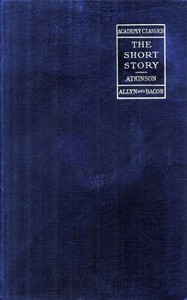
The Short-story — Background and Themes
11
1
Project Gutenberg
2007
Short stories
Readers of public-domain and historical texts
Project Gutenberg digital edition
en
Edition facts
Words: 79,346
Reading time: 345 min
Text sections: 8
Source:
Project Gutenberg record #21964
An early 20th-century anthology and textbook pairing six canonical short stories with a pedagogical introduction by high school teacher W. Patterson Atkinson, emphasizing narrative technique and literary development.
W. Patterson Atkinson’s The Short-story (1916) is a classroom anthology that pairs six canonical tales—from Irving’s “Rip Van Winkle” to Kipling’s “Wee Willie Winkie”—with a substantial introduction on the form’s definition, development, and narrative principles. Atkinson, a high school vice-principal, designed the collection for first-year pupils, testing the material with actual students and adjusting it based on their difficulties and standards of reading. The result is a volume that treats the short story not merely as entertainment but as a teachable craft with identifiable techniques.
A Teacher’s Framework for the Form
Atkinson’s introduction traces the short story from oral tradition through myth, legend, fairy tale, fable, allegory, and parable, citing examples such as “The Labors of Hercules” and “The Prodigal Son.” He notes that early stories were “merely to amuse, sometimes to instruct,” and that over time “a body of rules and a technique” emerged, referencing Aristotle. This historical framing is deliberately elementary, reflecting the book’s origin in a high school classroom. Atkinson’s own voice appears in the foreword, where he acknowledges that “their difficulties, standards of reading, and the average development of their minds and taste have constantly been remembered.” The introduction thus functions as a scaffold for the stories that follow, each of which is accompanied by notes that likely reinforce the analytical points made in the opening chapters.
Contrasts in Setting and Atmosphere
The selected stories span a wide range of settings and moods. Irving’s “Rip Van Winkle” (1820) opens with the Catskill Mountains and a drowsy village, while Poe’s “The Gold Bug” (1842) moves from a South Carolina island to a cryptogram-driven treasure hunt. Hawthorne’s “The Birthmark” (1843) is set in a laboratory transformed into “a series of beautiful apartments,” where the scientist Aylmer “had converted those smoky, dingy, sombre rooms” into a perfumed, impurpled space. This deliberate contrast between the grim reality of scientific pursuit and the enchanting illusion Aylmer creates for his wife is a recurring pattern in the collection: Stevenson’s “Markheim” (1885) shifts from a London antique shop to a psychological interior, while Harte’s “The Outcasts of Poker Flat” (1869) places its characters in a snowbound Sierra Nevada camp. The anthology thus offers a spectrum of physical and emotional landscapes, from the supernatural to the starkly naturalistic.
Recurring Motifs of Transformation and Illusion
Several stories in the collection hinge on moments of transformation or illusion. In the excerpt from “The Birthmark,” Aylmer uses scientific tricks to soothe Georgiana: “Airy figures, absolutely bodiless ideas, and forms of unsubstantial beauty came and danced before her, imprinting their momentary footsteps on beams of light.” The passage explicitly notes that “the illusion was almost perfect enough to warrant the belief that her husband possessed sway over the spiritual world.” Similarly, Poe’s “The Purloined Letter” revolves around the concealment of an object in plain sight, a kind of intellectual illusion. Kipling’s “Wee Willie Winkie” presents a child who transforms a military crisis through innocent bravery. Atkinson’s introduction, by emphasizing the short story’s evolution from myth and fable, implicitly frames these transformations as modern descendants of older narrative patterns—a connection the teacher-editor likely intended his students to recognize.
Readers approaching The Short-story should attend to the interplay between Atkinson’s pedagogical apparatus and the stories themselves. The introduction’s historical categories—myth, legend, fairy tale, fable—offer a lens through which to view each tale’s structure and purpose. The notes, though not excerpted here, likely draw explicit connections between the stories and the formal principles outlined earlier. This volume rewards a sequential reading, moving from Atkinson’s framework through the stories and back again, testing his claims against the evidence of the texts.
Reader reflection
Take a moment to reflect on this book
Create a short personal record of your experience with this book.
Your progress
0
/
10
2
What was your overall reaction to the book?
3
Is this a title you would suggest to others?
4
What was the reading difficulty like?
5
Do you expect to return to this book?
6
What was its emotional impact?
7
Was the book easy to understand?
8
Which part made the strongest impression?
9
Which lesson or insight stayed with you?
10