1

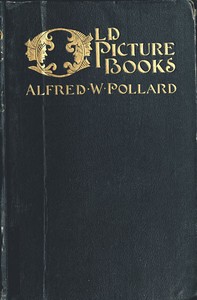
Old Picture Books, With Other Essays on Bookish Subjects — Story, Setting & Ideas
11
3
Project Gutenberg
2013
Bibliography; Illustrated books
Readers of public-domain and historical texts
Project Gutenberg digital edition
en
Edition facts
Words: 71,811
Reading time: 313 min
Text sections: 10
Source:
Project Gutenberg record #43518
Alfred W. Pollard's collection of essays on book history examines woodcuts, bindings, auctions, and printing practices, drawing on specific examples like Grüninger's 1502 Virgil and the first English book sale in 1676.
Editorial Edition Score
4.8/5
★★★★★
★★★★★
Calculated from edition completeness, EPUB availability, text structure and catalogue metadata. Not a user rating.
Edition quality
Alfred W. Pollard's Old Picture Books, With Other Essays on Bookish Subjects opens with a dedication to John Macfarlane, librarian of the Imperial Library, Calcutta, lamenting that Macfarlane's new library will likely contain no Vèrards—a pointed remark that sets the tone for a work steeped in the material realities of book collecting. The essays, revised and partly reprinted from periodicals such as Bibliographica and The Library, range across topics from Florentine rappresentazioni to English book auctions. Pollard writes as a practitioner, not a popularizer: he dissects the 'cottage' style of binding, the transference of woodcuts, and the economics of early printing with a bibliographer's precision.
The Grüninger Virgil and the 'Cottage' Style
Pollard's analysis of Sebastian Brant's edition of Virgil (Strassburg, 1502) is a case study in how he reads visual evidence. He notes the attempt to 'break the formality of the rectangle' through bugles and penthouses, a design he calls the 'cottage' style—a term that reveals his willingness to coin descriptive language for bookish artifacts. He is equally candid about failures: the use of the labour-saving 'roll' instead of hand-impressing each section is called 'another blot.' Yet the passage is not merely critical; it situates the Grüninger Virgil within a broader narrative of craftsmanship, where even flawed experiments are worth recording. Pollard's eye for technical detail—the distinction between hand-tooling and mechanical repetition—gives the essay a tactile quality, as if the reader might run a finger over the page.
The First English Book Auction
In 'The First English Book Sale,' Pollard pinpoints a precise moment: nine o'clock on the morning of October 31, 1676, at the house of Dr. Lazarus Seaman in Warwick Court, Warwick Lane. He credits an 'indiscreet pamphlet' by an English theologian in Holland for introducing auction sales to England, a detail that underscores his interest in the accidental preservation of book-trade history. Pollard contrasts the anonymity of early collectors—'men who bought books not by the cartload, but with individual thought and care'—with the sudden abundance of records after 1676. The essay is less about the sale itself than about what it reveals: the shift from private, haphazard collecting to a public, documented market. Pollard's tone is wryly appreciative of the irony that a pamphleteer's indiscretion became a key source for bibliographers.
Bindings, Cloth Cases, and National Traditions
Pollard's survey of English binding moves from the 'charming' work of the seventeenth century through the 'mere dulness' that preceded Roger Payne, to the living binders of his own day—Cobden Sanderson and Douglas Cockerell. He praises the invention of the cloth case as 'an inexpensive and very pleasing form of bookcover' that gives the buyer time to decide whether a book deserves 'the more permanent honours of gilded leather.' This practical, almost economic argument is characteristic: Pollard values innovation that serves both aesthetics and accessibility. He contrasts English restraint with French 'eccentricity,' but his nationalism is tempered by a clear-eyed assessment of craft. The passage ends with a hopeful note about 'Anglo-Saxondom's' future in the bookish arts, grounded in the work of specific artisans rather than vague patriotism.
Pollard's essays reward readers who share his appetite for concrete detail—the date of a sale, the name of a binder, the flaw in a woodcut. The collection is best approached not as a continuous argument but as a series of investigations, each anchored in a particular object or event. Readers new to bibliography will find the technical terms explained in context; seasoned collectors may appreciate Pollard's willingness to judge both successes and failures. The essays were written for an audience already familiar with the book trade, but their clarity and specificity make them accessible to anyone curious about how books were made, sold, and valued.
Reader reflection
What did you think of this book?
Answer a few questions and save a private reflection on this device.
Your progress
0
/
10
2
How did the book work for you overall?
3
Would you pass this book on to a friend?
4
How demanding did the text feel?
5
Would you read this book again?
6
Was the book easy to understand?
7
Did it raise ideas you would like to talk about?
8
How would you rate its originality?
9
Which lesson or insight stayed with you?
10