1

Crankisms — A Closer Reading
13
3
Project Gutenberg
2006
Wit and humor; Aphorisms and apothegms
Readers of public-domain and historical texts
Project Gutenberg digital edition
en
Edition facts
Words: 5,485
Reading time: 24 min
Text sections: 2
Source:
Project Gutenberg record #20024
A 1901 collection of aphorisms and witty observations on human nature, marriage, and society, illustrated by Clare Victor Dwiggins, with a preface suggesting readers apply the sayings to others for amusement.
Editorial Edition Score
4.5/5
★★★★★
★★★★★
Calculated from edition completeness, EPUB availability, text structure and catalogue metadata. Not a user rating.
Edition quality
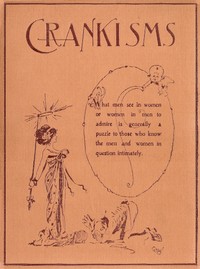
The preface to Crankisms advises reading these aphorisms “in the spirit in which sermons are listened to—with the object of discovering whom they hit.” This sets the tone for a collection that pairs cynical one-liners with Dwiggins’s illustrations, which the author credits with giving “life to dead bones of words.” The structure is simple: each page presents a single saying, often with a small drawing, creating a rhythm of assertion and visual punchline. The sayings themselves are compact, rarely exceeding three sentences, and tend toward paradox or reversal of conventional wisdom.
Aphorisms as Social Mirrors
The author’s preface explicitly invites this game of attribution: “what is more entertaining than trying the cap on others?” The reader is positioned as a spectator, applying each barb to acquaintances. This framing turns the book into a social instrument rather than a philosophical treatise. The sayings themselves are deliberately vague enough to fit many targets, but specific enough to sting—a balance that accounts for their longevity as conversation pieces.
The Rhythm of Reversal
The sayings also employ parallel structure and antithesis. “Men reason; women do not. Woman has no logic, and judging from the use it is to man, is better off without it” uses a blunt claim followed by a qualifying twist. The rhythm is conversational yet epigrammatic, suited for oral delivery. The brevity of each entry—most under 50 words—forces the wit to be concentrated, with no room for elaboration. This compression is a key feature of the genre, and Matthewman handles it with consistent polish.
Illustration as Commentary
The collaboration between text and image is central to the book’s effect. Without the drawings, the sayings might feel merely cynical; with them, they gain a theatrical quality. Dwiggins’s style, evident in the sample signatures and title page, is lively and caricatural, matching the satirical tone. The interplay between word and picture makes Crankisms a hybrid work, part literary collection, part visual comedy. Readers should attend to both elements, as the illustrations often complete or complicate the meaning of the text.
Recurring Motifs: Women, Marriage, and Self-Deception
Self-deception is another thread. “The biggest fool is the one who thinks he can fool others with impunity” and “We were all in the front row when modesty was served out—at least we think so” both target the human capacity for self-flattery. The collection’s title itself—Crankisms—implies that these are the opinions of a crank, a person with fixed, often contrary views. This framing allows the author to voice sharp judgments while maintaining a tone of ironic detachment. Readers should consider whether the sayings are meant as universal truths or as the exaggerated complaints of a particular persona.
Crankisms rewards a nonlinear reading: open to any page and let the aphorism and its illustration spark reflection. The book’s brevity (under 5,500 words) makes it ideal for browsing, but its layered ironies invite repeated visits. Pay attention to the interplay between text and image, and to the way each saying sets up a small trap for the reader’s own assumptions. Whether taken as period satire or as a mirror for perennial human foibles, this collection offers a compact, witty exercise in seeing ourselves as others might.
Reader reflection
Before you leave, reflect on the book
Use these questions to collect your thoughts before moving on.
Your progress
0
/
10
2
What was your overall reaction to the book?
3
Would you recommend this book to another reader?
4
How easy was the book to follow?
5
How valuable was this book for your own interests?
6
What was its emotional impact?
7
How did the reading compare with what you expected?
8
How closely did the book connect with your experience?
9
What is the main idea you are taking away?
10