1

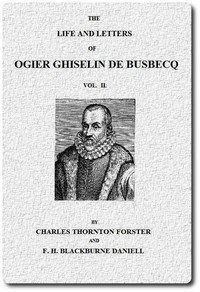
The Life and Letters of Ogier Ghiselin de Busbecq, Vol. 2 (of 2) — Reading Companion
14
2
Project Gutenberg
2016
Busbecq, Ogier Ghislain de, 1522-1592
Readers of public-domain and historical texts
Project Gutenberg digital edition
en
Edition facts
Words: 115,966
Reading time: 505 min
Text sections: 13
Source:
Project Gutenberg record #53630
This volume collects Busbecq's letters from France to Emperors Maximilian and Rodolph, offering a firsthand account of the French Wars of Religion through the eyes of an imperial ambassador. The letters detail shifting alliances, military maneuvers, and the political calculus behind events like the seizure of Verdun and the dismantling of citadels.
Editorial Edition Score
4.8/5
★★★★★
★★★★★
Calculated from edition completeness, EPUB availability, text structure and catalogue metadata. Not a user rating.
Edition quality
The second volume of Busbecq's correspondence shifts the scene from Constantinople to the French court, where the ambassador reports directly to Emperors Maximilian II and Rodolph II. The letters are arranged in two books: the first addressed to Maximilian, the second to Rodolph, covering the period from 1582 to 1589. Busbecq's voice remains that of a seasoned observer, alert to the interplay of rumor and fact. He notes, for instance, the common talk that the Prince of Condé had been taken prisoner, only to clarify that the story had no foundation. This volume includes an editorial apparatus that introduces contemporary sources such as De Thou, De l'Estoile, and Brantôme, providing a framework for understanding the conflicting accounts Busbecq navigates.
The Structure of the Letters
The volume is divided into two distinct sequences: Letters to Maximilian (I–XXXVII) and Letters to Rodolph (I–LVIII). Each letter is dated and often begins with a summary of recent events, then moves to analysis and speculation. Busbecq frequently closes with remarks on the difficulty of sending despatches, as when he writes that roads to Metz and Nancy are occupied by soldiers who examine and tear to pieces all communications. This structural pattern—report, analysis, logistical note—gives the correspondence a rhythm of urgency and reflection. The editorial footnotes, drawn from historians like Thuanus and Aubigné, add a layer of scholarly commentary that contextualizes Busbecq's assertions without overriding his voice.
Recurring Images of Fortifications and Dismantling
A striking motif in these letters is the physical alteration of strongholds. Busbecq reports that the men of Lyons levelled their citadel to the ground, and that the King ordered the citadel of Angers treated similarly. He observes a general dismantling of fortifications in France, while in other parts new ones are being built. This image of tearing down and building up mirrors the political instability: alliances shift, towns change hands, and the physical landscape is remade to reflect the balance of power. The citadel becomes a symbol of contested authority, as when the inhabitants of Auxonne accused their commander of high treason and began pulling down a large part of the fortifications. Busbecq's eye for such details turns military engineering into a metaphor for the fragility of control.
Movement Between Scenes: Court, Camp, and City
Busbecq's letters move rapidly between locations, creating a sense of a kingdom in motion. In a single letter he may cover events at the Antwerp bridge, the seizure of Verdun, a conspiracy in England, and the King's forces suffering from incessant rains and an epidemic. This geographic sweep is not merely reportorial; it reflects the ambassador's need to synthesize intelligence from multiple fronts. The movement is often abrupt, as when he notes that a small party of Huguenot soldiers seized the citadel of Angers, creating a panic, and then immediately turns to the Prince of Condé crossing the Loire. The reader is carried from one crisis to the next, with Busbecq's commentary providing the connective tissue. The letters themselves become a kind of itinerary of the French Wars of Religion.
The Ambassador's Position and Limitations
Busbecq is not a neutral chronicler but an imperial agent with a specific vantage point. He frequently qualifies his reports with phrases like they say or it is believed, acknowledging the unreliability of his sources. He admits doubt about whether his own letter will get through safely, and notes that the common talk is often mistaken. This self-awareness gives the correspondence a provisional quality: Busbecq is assembling a picture from fragments, and he knows it. The editorial introduction to the volume lists the contemporary writers he draws on, including De l'Estoile's private diary and Brantôme's memoirs, suggesting that Busbecq's letters are part of a larger web of testimony. His limitations—incomplete information, contested roads, the fog of war—become part of the story.
Readers approaching this volume should attend to the dates and the addressees, as the shift from Maximilian to Rodolph marks a change in imperial priorities. The footnotes are essential for untangling the many names and factions. Busbecq's letters reward careful reading: what seems like a throwaway remark about weather or rumor often signals a deeper political calculation. This is not a narrative history but a primary source that demands the reader's active interpretation.
Reader reflection
Take a moment to reflect on this book
Create a short personal record of your experience with this book.
Your progress
0
/
10
2
What was your overall reaction to the book?
3
Would you encourage someone else to read it?
4
How much effort did this book require?
5
Did it raise ideas you would like to talk about?
6
Do you expect to return to this book?
7
Did this book create an emotional response?
8
Which element worked best for you?
9
Which lesson or insight stayed with you?
10