1

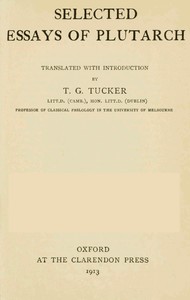
Selected Essays of Plutarch, Vol. I. — Context and Discussion
13
3
Project Gutenberg
2020
Ethics -- Early works to 1800
Readers of public-domain and historical texts
Project Gutenberg digital edition
en
Edition facts
Words: 101,257
Reading time: 441 min
Text sections: 23
Source:
Project Gutenberg record #62618
This volume of Plutarch's essays, translated by T. G. Tucker, presents moral and philosophical discourses from the Moralia, focusing on education, self-control, and the role of reason. The excerpts reveal a practical ethics rooted in classical examples, with recurring emphasis on hearing, speech, and the transition from childhood to adulthood.
Editorial Edition Score
4.9/5
★★★★★
★★★★★
Calculated from edition completeness, EPUB availability, text structure and catalogue metadata. Not a user rating.
Edition quality
Plutarch's essays in this volume, translated by T. G. Tucker, are drawn from the Moralia and address ethical conduct through a blend of philosophical argument and historical anecdote. The translator's preface notes that the selection aims to be 'typical examples' of Plutarch's writing, covering a 'tolerably large field of interesting matter' without claiming to represent the very best pieces. The excerpts show a consistent focus on the education of youth, the dangers of flattery, and the importance of reason as a guide.
The catalog subjects list 'Ethics -- Early works to 1800,' which accurately reflects the content, but the excerpts also reveal a strong emphasis on practical advice for young men, drawing on figures like Xenocrates and Bias. The essays are not abstract treatises but are addressed to specific individuals, such as a young man coming of age, and use concrete examples from Greek history and philosophy.
The Role of Hearing and Speech
One of the most striking recurring motifs in the excerpts is the emphasis on hearing as a sense that can both harm and benefit the character. Plutarch cites Theophrastus, who asserts that hearing is 'the most susceptible of all the senses,' capable of causing 'strong emotional disturbance.' He then quotes Xenocrates, who advised that 'ear-guards should be worn by boys more than by athletes,' because words can disfigure character more than blows can disfigure ears. This metaphor is extended with the story of Bias, who sent a tongue as 'the best and the worst' part of a sacrifice, illustrating the dual power of speech. The advice is not to avoid hearing altogether but to ensure that 'right communications' are fostered by philosophy. This focus on auditory education is a specific, recurring detail that distinguishes these essays from more general ethical works.
Coming of Age and the Change of Ruler
Plutarch directly addresses a young man on the threshold of adulthood, arguing that coming of age does not mean 'rejection of rule, but change of ruler.' He contrasts the 'hired or purchased director of conduct' of childhood with a 'divine' substitute—reason. This is not a metaphor for political freedom but for internal self-governance: 'Only those who follow reason deserve to be considered free.' He warns against the misconception that 'absence of restraint is the same thing as freedom,' which in fact makes one a slave to passions. The analogy of naturalized citizens who accept obligations 'with cheerful readiness' is used to encourage the youth to embrace philosophy willingly. This passage shows Plutarch's method of using concrete comparisons to make ethical points accessible.
Translator's Approach and Textual Choices
T. G. Tucker's translation is guided by a principle of fidelity: 'the English version does not seek to be either more formal or more vivacious' than the original. He aims to preserve both 'tone' and 'substance,' and states that no modern version of the Moralia was consulted. The text is based on Bernardakis's Teubner edition, with recourse to Wyttenbach and occasional 'modest emendation' where passages are 'commonly acknowledged to be corrupt.' These emendations are marked with an asterisk and listed in an appendix. Tucker also discusses his approach to spelling Greek proper names, aiming to safeguard pronunciation for readers unfamiliar with Greek (e.g., 'Pheidias' to avoid the 'fiddle' pronunciation). This editorial transparency is a notable feature of the volume.
Readers approaching this volume should expect not a systematic ethical treatise but a series of occasional pieces, each with a specific addressee and occasion. The essays reward attention to Plutarch's use of historical exempla and his recurring concern with the education of the young. Tucker's translation, while early twentieth-century in style, is careful and consistent. The notes on proper names and the appendix on textual emendations provide useful context for those interested in the scholarly apparatus behind the text.
Reader reflection
Record your reading impressions
A brief reflection can help important ideas stay with you longer.
Your progress
0
/
10
2
How did the book work for you overall?
3
Would you pass this book on to a friend?
4
What was the reading difficulty like?
5
Could you apply anything you learned?
6
What was its emotional impact?
7
Did the book meet your expectations?
8
How closely did the book connect with your experience?
9
What changed or sharpened your thinking?
10