1

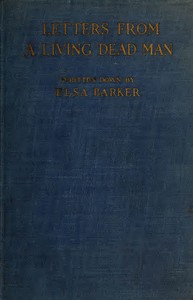
Letters from a living dead man — Reading Notes
16
4
Project Gutenberg
2025
Spiritualism; Spirit writings
Readers of public-domain and historical texts
Project Gutenberg digital edition
en
Edition facts
Words: 58,482
Reading time: 255 min
Text sections: 58
Source:
Project Gutenberg record #76854
A series of 58 letters purportedly written through automatic handwriting by a deceased man, detailing his experiences in the afterlife, with recurring motifs of light, mirrors, and movement between worlds.
Editorial Edition Score
4.8/5
★★★★★
★★★★★
Calculated from edition completeness, EPUB availability, text structure and catalogue metadata. Not a user rating.
Edition quality
The book opens not with a narrative but with an introduction recounting how the author, Elsa Barker, received an automatic message signed "X" in Paris, only to learn that the signatory had died days earlier in America. This framing establishes the work as a claimed spirit communication, a series of letters from a man who has crossed into the afterlife. The letters themselves begin abruptly with "The Return," and the table of contents reveals a structure of short, titled chapters that read as discrete dispatches.
A Structure of Dispatches
The book is composed of 58 numbered letters, each with its own title, such as "The Wand of Will" or "A Cloud on the Mirror." This structure suggests a serialized, episodic account rather than a continuous narrative. The letters vary in length and focus, often addressing a specific concept or experience. The table of contents itself becomes a map of the afterlife's geography, moving from personal encounters ("The Boy—Lionel") to abstract reflections ("The Serpent of Eternity"). The reader is invited to dip in and out, as each letter stands somewhat alone, yet the sequence implies a progression of understanding.
Recurring Images of Light and Vision
Throughout the excerpts, light and vision are central. The writer describes "a light behind the veil" and speaks of seeing "the cloud of souls" above a sleeping city. In Letter XXXIII, he recalls standing on a palace roof and watching stars, while also noting how he can "see into the world of dense matter" by changing his focus. This motif of altered sight—seeing into the invisible or looking back into the material world—recurs, emphasizing the theme of perception beyond ordinary limits. The mirror appears too: one letter is titled "A Cloud on the Mirror," suggesting a reflective surface that can be obscured or cleared.
Movement Between Worlds
The writer frequently describes traveling or shifting between planes. He speaks of "going to and fro in the earth and walking up and down in it," a phrase echoing biblical language. In Letter XXXIII, he notes that he can "come and go, almost with the quickness of thought" and that he looks back into the earthly plane "as a visitor." This movement is not just spatial but temporal: he mentions recovering memories of past incarnations and planning future earth lives. The letters themselves are presented as a bridge, a correspondence that allows the dead to communicate with the living, reinforcing the idea of a permeable boundary.
The Writer's Self-Positioning
The narrator is careful to distinguish himself from a passive medium. In Letter XXXIII, he insists he is not "an æolian harp, set in an aperture between the two worlds and played upon by any wind." Instead, he presents himself as an active agent, carrying over "five resolutions" to preserve identity and memory. This self-awareness shapes the tone: the letters are didactic, often explaining the rules of the afterlife. The writer also acknowledges the limits of his communication, noting that from Jupiter he might not be able to write at all. This grounding in practical constraints lends a peculiar credibility to the fantastical claims.
Readers approaching this work should treat each letter as a self-contained meditation rather than a chapter in a novel. The table of contents serves as a useful guide for selecting topics of interest. Pay attention to the recurring imagery of light, mirrors, and movement, which the writer uses to articulate his vision of the afterlife. The book rewards those who read with an open mind, as the narrator himself advises, and who are willing to engage with its unusual premise without demanding conventional plot or character development.
Reader reflection
Before you leave, reflect on the book
Use these questions to collect your thoughts before moving on.
Your progress
0
/
10
2
Did this book hold your interest?
3
Would you pass this book on to a friend?
4
How easy was the book to follow?
5
How understandable was the text?
6
How would you rate its originality?
7
Was the book moving at the right speed?
8
What did you appreciate most?
9
Which lesson or insight stayed with you?
10