1

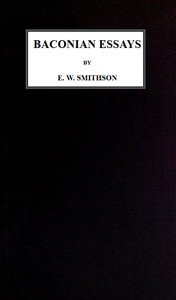
Baconian Essays — Text and Context
17
4
Project Gutenberg
2018
Shakespeare, William, 1564-1616 -- Authorship -- Baconian theory; Bacon, Francis, 1561-1626 -- Authorship; English drama -- Authorship
Readers of public-domain and historical texts
Project Gutenberg digital edition
en
Edition facts
Words: 62,481
Reading time: 272 min
Text sections: 9
Source:
Project Gutenberg record #56774
Examines the Baconian theory of Shakespeare authorship through close reading of Bacon's letters and works, arguing that Bacon was a 'concealed poet' and that the Shakespeare plays were written under a pseudonym. Draws on textual comparisons and historical context.
Editorial Edition Score
4.7/5
★★★★★
★★★★★
Calculated from edition completeness, EPUB availability, text structure and catalogue metadata. Not a user rating.
Edition quality
The volume opens with a letter from Henry James, who confesses being 'haunted by the conviction that the divine William is the biggest and most successful fraud ever practised on a patient world.' This sets the tone for a work that treats the Shakespeare authorship question as a matter of evidence rather than speculation. The essays, by E. W. Smithson and Sir George Greenwood, focus on Bacon's relationship to poetry, his letters, and the symbolic content of plays like The Tempest.
Rather than offering a general introduction to Shakespeare, the book assumes familiarity with the plays and dives into specific textual and biographical clues. The catalog subjects list 'Baconian theory' and 'English drama – Authorship,' but the excerpts reveal a narrower focus: Bacon's own writings and his circle's efforts to conceal his poetic work.
Bacon as a 'Concealed Poet'
The essays argue that Bacon deliberately hid his poetic output. Smithson points to a 1594–95 letter to the Earl of Essex where Bacon calls 'the waters of Parnassus' his best consolation, and another to Lord H. Howard referring to 'the best waters to knit minds together.' These allusions, the author claims, are coded references to poetry. A 1604 letter to the Earl of Devonshire is cited where Bacon admits writing a sonnet to Queen Elizabeth, noting that this involved 'a publishing and declaring of himself'—interpreted as dropping his poetic mask. John Aubrey is quoted as saying Bacon 'was a good poet, but concealed as appears by his letters.' The essays treat these documents as evidence that Bacon was the true author of Shakespeare's works, though they do not provide direct proof linking Bacon to the plays.
The Value of 'Poesy' in Bacon's System
Smithson examines Bacon's Advancement of Learning (1605) and its revised edition (1623) to show a shift in Bacon's estimation of poetry. In the earlier work, Bacon divides knowledge into three 'goodly fields': History, Poesy, and Philosophy, with Poesy holding a high place. The author notes that Bacon claimed 'for the expressing of affections, passions, corruptions, and customs, we are beholding to poets more than to philosophers.' But in the 1623 revision, this claim is dropped, and poetry is 'materially lowered' on the grounds that poets 'exceed the truth.' Smithson argues that this change suggests Bacon was dissatisfied with his earlier praise of poetry, possibly because it revealed too much about his own poetic activities. The analysis is based on a comparison of the two editions, though the excerpts do not include the full texts.
The Northumberland Manuscript and External Evidence
Sir George Greenwood contributes two essays, one on 'The Northumberland Manuscript,' which is a document associated with Bacon that contains references to Shakespeare plays. The excerpts do not detail the manuscript's contents, but the table of contents lists it as a key piece of evidence. Greenwood also discusses 'The Common Knowledge of Shakespeare and Bacon,' likely comparing what was publicly known about each figure. The final note by Greenwood suggests that the book aims to present a case based on historical documents rather than literary analysis. The essays rely heavily on letters, dedications, and contemporary accounts, but the excerpts are too brief to evaluate the strength of the arguments. Readers interested in the Baconian theory will find a focused, evidence-driven approach, though the book does not engage with counterarguments from mainstream Shakespeare scholarship.
These essays are best approached as a collection of arguments from the early 20th-century Baconian movement, not as a comprehensive survey of the authorship question. The authors assume the reader knows the Shakespeare canon and focuses on Bacon's writings and letters. For those new to the topic, the book may require supplementary background on the historical figures involved. The evidence presented is suggestive rather than conclusive, and the excerpts leave many claims unsubstantiated.
Reader reflection
Before you leave, reflect on the book
Use these questions to collect your thoughts before moving on.
Your progress
0
/
10
2
Did this book hold your interest?
3
Would you encourage someone else to read it?
4
How much effort did this book require?
5
Did this book create an emotional response?
6
Could you follow the author’s main argument?
7
Would this book work well in a reading group?
8
How original did the book feel?
9
What changed or sharpened your thinking?
10