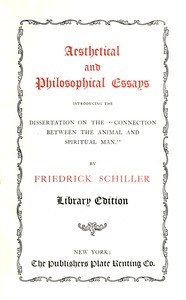
Aesthetical and philosophical essays — Themes and Context

(3 User reviews)   930
Schiller, Friedrich, 1759-1805 Project Gutenberg 2023 Not confirmed
Philosophy; Aesthetics Readers of public-domain and historical texts
Project Gutenberg digital edition en

Edition facts

Words 171,918
Reading time 748 min
Text sections 18

The catalog record for Aesthetical and philosophical essays — Themes and Context provides practical reading context through 171,918 words, 12 hr 28 min estimated reading time, and 18 detected text sections.

The text analysis averages about 31.3 words per sentence, while the detected sections provide another way to judge how the source is divided.

Project Gutenberg metadata also associates the work with “Philosophy,” connecting these edition facts with the source record’s subject description.

Schiller's essays on aesthetics, including the 'Letters on the Æsthetical Education of Man,' explore the philosophy of beauty, art, and the interplay between the animal and spiritual in human nature, with precise distinctions between grace, dignity, and attraction.
Share
Editorial Edition Score 4.8/5

Calculated from edition completeness, EPUB availability, text structure and catalogue metadata. Not a user rating.

How this score is calculated
  • Description quality20 pts
  • Title & short description10 pts
  • Source metadata20 pts
  • Text length15 pts
  • Chapters / structure15 pts
  • EPUB file integrity20 pts

Total of 100 points, scaled to a 2.5-5.0 range. Editions with an empty description or a missing EPUB file are not scored.

Edition quality

Read the Text

e want of this union and expressed it, but without determining its conditions or expressing it scientifically. He was impeded in his efforts to effect this union by the opposition between the subjective and the objective, by his placing practical reason above theoretical reason, and he set up the opposition found in the moral sphere as the highest principle of morality. Reduced to this difficulty, all that Kant could do was to express the union under the form of the subjective ideas of reason, or as postulates to be deduced from the practical reason, without their essential character being known, and representing their realization as nothing more than a simple _you ought_, or imperative “Du sollst.”

In his teleological judgment applied to living beings, Kant comes, on the contrary, to consider the living organism in such wise that, the general including the particular, and determining it as an end, consequently the idea also determines the external, the compound of the organs, not by an act springing from without but issuing from within. In this way the end and the means, the interior and exterior, the general and particular, are confounded in unity. But this judgment only expresses a subjective act of reflection, and does not throw any light on the object in itself. Kant has the same view of the æsthetic judgment. According to him the judgment does not proceed either from reason, as the faculty of general ideas, or from sensuous perception, but from the free play of the reason and of the imagination. In this analysis of the cognitive faculty, the object only exists relatively to the subject and to the feeling of pleasure or the enjoyment that it experiences.

The characteristics of the beautiful are, according to Kant:—

1. The pleasure it procures is free from interest.

2. Beauty appears to us as an object of general enjoyment, without awakening in us the consciousness of an abstract idea and of a category of reason to which we might refer our judgment.

3. Beauty ought to embrace in itself the relation of conformity to its end, but in such a way that this conformity may be grasped without the idea of the end being offered to our mind.

4. Though it be not accompanied by an abstract idea, beauty ought be to acknowledged as the object of a necessary enjoyment.

A special feature of all this system is the indissoluble unity of what is supposed to be separated in consciousness. This distinction disappears in the beautiful, because in it the general and the particular, the end and the means, the idea and the object, mentally penetrate each other completely. The particular in itself, whether it be opposed to itself or to what is general, is something accidental. But here what may be considered as an accidental form is so intimately connected with the general that it is confounded and identified with it. By this means the beautiful in art presents thought to us as incarnate. On the other hand, matter, nature, the sensuous as themselves possessing measure, end, and harmony, are raised to the dignity of spirit and share in its general character. Thought not only abandons its hostility against nature, but smiles in her. Sensation and enjoyment are justified and sanctified, so that nature and liberty, sense and ideas, find their justification and their sanctification in this union. Nevertheless this reconciliation, though seemingly perfect, is stricken with the character of subjectiveness. It cannot constitute the absolutely true and real.

Such is an outline of the principal results of Kant’s criticism, and Hegel passes high praise on the profoundly philosophic mind of Schiller, who demanded the union and reconciliation of the two principles, and who tried to give a scientific explanation of it before the problem had been solved by philosophy. In his “Letters on Æsthetic Education,” Schiller admits that man carries in himself the germ of the ideal man which is realized and represented by the state. There are two ways for the individual man to approach the ideal man; first, when the state, considered as morality, justice, and general reason, absorbs the individualities in its unity; secondly, when the individual rises to the ideal of his species by the perfecting of himself. Reason demands unity, conformity to the species; nature, on the other hand, demands plurality and individuality; and man is at once solicited by two contrary laws. In this conflict, æsthetic education must come in to effect the reconciliation of the two principles; for, according to Schiller, it has as its end to fashion and polish the inclinations and passions so that they may become reasonable, and that, on the other hand, reason and freedom may issue from their abstract character, may unite with nature, may spiritualize it, become incarnate, and take a body in it. Beauty is thus given as the simultaneous development of the rational and of the sensuous, fused together, and interpenetrated one by the other, an union that constitutes in fact true reality.

This unity of the general and of the particular, of liberty and necessity of the spiritual and material, which Schiller understood scientifically as the spirit of art, and which he tried to make appear in real life by æsthetic art and education, was afterwards put forward under the name of idea as the principle of all knowledge and existence. In this way, through the agency of Schelling, science raised itself to an absolute point of view. It was thus that art began to claim its proper nature and dignity. From that time its proper place was finally marked out for it in science, though the mode of viewing it still labored under certain defects. Its high and true distinction were at length understood.

In viewing the higher position to which recent philosophical systems have raised the theory of art in Germany, we must not overlook the advantages contributed by the study of the ideal of the ancients by such men as Winckelmann, who, by a kind of inspiration, raised art criticism from a carping about petty details to seek the true spirit of great works of art, and their true ideas, by a study of the spirit of the originals.

It has appeared expedient to conclude this introduction with a summary of the latest and highest theory of art and æsthetics issuing from Kant and Schiller, and developed in the later philosophy of Hegel.

Our space only allows us to give a glance, first, at the metaphysics of the beautiful as developed by Hegel in the first part of his ‘Aesthetik,’ and then at the later development of the same system in recent writers issuing from his school.

Hegel considers, first, the abstract idea of the beautiful; secondly, beauty in nature; thirdly, beauty in art or the ideal; and he winds up with an examination of the qualities of the artist.

His preliminary remarks are directed to show the relations of art to religion and philosophy, and he shows that man’s destination is an infinite development. In real life he only satisfies his longing partially and imperfectly by limited enjoyments. In science he finds a nobler pleasure, and civil life opens a career for his activity; but he only finds an imperfect pleasure in these pursuits. He cannot then find the ideal after which he sighs. Then he rises to a higher sphere, where all contradictions are effaced and the ideas of good and happiness are realized in perfect accord and in constant harmony. This deep want of the soul is satisfied in three ways: in art, in religion, and in philosophy.

Art is intended to make us contemplate the true and the infinite in forms of sense. Yet even art does not fully satisfy the deepest need of the soul. The soul wants to contemplate truth in its inmost consciousness. Religion is placed above the dominion of art.

First, as to idea of the beautiful, Hegel begins by giving its characteristics. It is infinite, and it is free; the contemplation of the beautiful suffices to itself, it awakens no desire. The soul experiences something like a godlike felicity and is transported into a sphere remote from the miseries of life. This theory of the beautiful comes very near that of Plato.

Secondly, as to beauty in nature. Physical beauty, considered externally, presents itself successively under the aspects of regularity and of symmetry, of conformity with a law, and of harmony, also of purity and simplicity of matter.

Thirdly, beauty in art or the ideal is beauty in a higher degree of perfection than real beauty. The ideal in art is not contrary to the real, but the real idealized, purified, and perfectly expressed. The ideal is also the soul arrived at the consciousness of itself, free and fully enjoying its faculties; it is life, but spiritual life and spirit. Nor is the ideal a cold abstraction, it is the spiritual principle under the form of a living individuality freed from the laws of the finite. The ideal in its highest form is the divine, as expressed in the Greek divinities; the Christian ideal, as expressed in all its highest purity in God the Father, the Christ, the Virgin. Its essential features are calm, majesty, serenity.

At a lower degree the ideal is in man the victory of the eternal principles that fill the human heart, the triumph of the nobler part of the soul, the moral and divine principle.

But the ideal manifested in the world becomes _action_, and action implies a form of society, a determinate situation with collision, and an action properly so called. The heroic age is the best society for the ideal in action; in its determinate situation the ideal in action must appear as the manifestation of moral power, and in action, properly so called, it must contain three points in the ideal: first, general principles; secondly, personages; thirdly, their character and their passions. Hegel winds up by considering the qualities necessary in an artist: imagination, genius, inspiration, originality, etc.

A recent exponent of Hegel’s æsthetical ideas further developed expresses himself thus on the nature of beauty:—

“After the bitterness of the world, the sweetness of art soothes and refreshes us. This is the high value of the beautiful—that it solves the contradiction of mind and matter, of the moral and sensuous world, in harmony. Thus the beautiful and its representation in art procures for intuition what philosophy gives to the cognitive insight and religion to the believing frame of mind. Hence the delight with which Schiller’s wonderful poem on the Bell celebrates the accord of the inner and outer life, the fulfilment of the longing and demands of the soul by the events in nature. The externality of phenomena is removed in the beautiful; it is raised into the circle of ideal existence; for it is recognized as the revelation of the ideal, and thus transfigured it gives to the latter additional splendor.

“Thus the beautiful is active, living unity, full existence without defect, as Plato and Schelling have said, or as recent writers describe it; the idea that is quite present in the appearance, the appearance which is quite formed and penetrated by the idea.”

“Beauty is the world secret that invites us in image and word,” is the poetical expression of Plato; and we may add, because it is revealed in both. We feel in it the harmony of the world; it breaks forth in a beauty, in a lovely accord, in a radiant point, and starting thence we penetrate further and yet further, and find as the ground of all existence the same charm which had refreshed us in individual forms. Thus Christ pointed to the lilies of the field to knit His followers’ reliance on Providence with the phenomena of nature: and could they jet forth in royal beauty, exceeding that of Solomon, if the inner ground of nature were not beauty?

We may also name beauty in a certain sense a mystery, as it mediates to us in a sensuous sign a heavenly gift of grace, that it opens to us a view into the Eternal Being, teaching us to know nature in God and God in nature, that it brings the divine even to the perception of sense, and establishes the energy of love and freedom as the ground, the bond, and the end of the world.

In the midst of the temporal the eternal is made palpable and present to us in the beautiful, and offers itself to our enjoyment. The separation is suppressed, and the original unity, as it is in God, appears as the first, as what holds together even the past in the universe, and what constitutes the aim of the development in a finite accord.

The beautiful not only presents itself to us as mediator of a foreign excellence or of a remote divinity, but the ideal and the godlike are present in it. Hence æsthetics requires as its basis the system in which God is known as indwelling in the world, that He is not far distant from any one of us, but that He animates us, and that we live in Him. Æsthetics requires the knowledge that mind is the creative force and unity of all that is extended and developed in time and space.

The beautiful is thus, according to these later thinkers, the revelation of God to the mind through the senses; it is the appearance of the idea. In the beautiful spirit reveals itself to spirit through matter and the senses; thus the entire man feels himself raised and satisfied by it. By the unity of the beautiful with us we experience with delight that thought and the material world are present for our individuality, that they utter tones and shine forth in it, that both penetrate each other and blend in it and thus become one with it. We feel one with them and one in them.

This later view was to a great extent expressed by Schiller in his “Æsthetical Letters.”

But art and æsthetics, in the sense in which these terms are used and understood by German philosophical writers, such as Schiller, embrace a wider field than the line arts. Lessing, in his “Laocoon,” had already shown the point of contrast between painting and poetry; and æsthetics, being defined as the science of the beautiful, must of necessity embrace poetry. Accordingly Schiller’s essays on tragic art, pathos, and sentimental poetry, contained in this volume, are justly classed under his æsthetical writings.

This being so, it is important to estimate briefly the transitions of German poetry before Schiller, and the position that he occupied in its historic development.

The first classical period of German poetry and literature was contained between A.D. 1190 and 1300. It exhibits the intimate blending of the German and Christian elements, and their full development in splendid productions, for this was the period of the German national epos, the “Nibelungenlied,” and of the “Minnegesang.”

This was a period which has nothing to compare with it in point of art and poetry, save perhaps, and that imperfectly, the heroic and post-Homeric age of early Greece.

The poetical efforts of that early age may be grouped under—(1) national epos: the “Nibelungenlied;” (2) art epos: the “Rolandslied,” “Percival,” etc.; (3) the introduction of antique legends: Veldeck’s “Æneide,” and Konrad’s “War of Troy;” (4) Christian legends: “Barlaam,” “Sylvester,” “Pilatus,” &c.; (5) poetical narratives: “Crescentia,” “Graf Rudolf,” etc.; (6) animal legends; “Reinecke Vos;” (7) didactic poems: “Der Renner;” (8) the Minne-poetry, and prose.

The fourth group, though introduced from a foreign source, gives the special character and much of the charm of the period we consider. This is the sphere of legends derived from ecclesiastical ground. One of the best German writers on the history of German literature remarks: “If the aim and nature of all poetry is to let yourself be filled by a subject and to become penetrated with it; if the simple representation of unartificial, true, and glowing feelings belongs to its most beautiful adornments; if the faithful direction of the heart to the invisible and eternal is the ground on which at all times the most lovely flowers of poetry have sprouted forth, these legendary poems of early Germany, in their lovely heartiness, in their unambitious limitation, and their pious sense, deserve a friendly acknowledgment. What man has considered the pious images in the prayer-books of the Middle Ages, the unadorned innocence, the piety and purity, the patience of the martyrs, the calm, heavenly transparency of the figures of the holy angels, without, being attracted by the simple innocence and humility of these forms, the creation of pious artists’ hands? Who has beheld them without tranquil joy at the soft splendor poured over them, without deep sympathy, nay, without a certain emotion and tenderness? And the same spirit that created these images also produced those poetical effusions, the same spirit of pious belief, of deep devotion, of heavenly longing. If we make a present reality of the heroic songs of the early German popular poetry, and the chivalrous epics of the art poetry, the military expeditions and dress of the Crusades, this legendary poetry appears as the invention of humble pilgrims, who wander slowly on the weary way to Jerusalem, with scollop and pilgrim’s staff, engaged in quiet prayer, till they are all to kneel at the Saviour’s sepulchre; and thus contented, after touching the holy earth with their lips, they return, poor as they were, but full of holy comfort, to their distant home.

“While the knightly poetry is the poetry of the splendid secular life, full of cheerful joy, full of harp-tones and song, full of tournaments and joyous festivals, the poetry of the earthly love for the earthly bride, the poetry of the legends is that of the spontaneous life of poverty, the poetry of the solitary cloister cell, of the quiet, well-walled convent garden, the poetry of heavenly brides, who without lamenting the joys of the world, which they need not, have their joy in their Saviour in tranquil piety and devout resignation—who attend at the espousals of Anna and Joachim, sing the Magnificat with the Holy Mother of God, stand weeping beneath the cross, to be pierced also by the sword, who hear the angel harp with St. Cecilia, and walk with St. Theresa in the glades of Paradise. While the Minne-poetry was the tender homage offered to the beauty, the gentleness, the grace, and charm of noble women of this world, legendary poetry was the homage given to the Virgin Mother, the Queen of Heaven, transfiguring earthly love into a heavenly and eternal love.

“For the twelfth and thirteenth centuries were the time of woman _cultus_, such as has never been before or since seen; it is also the time of the deepest and simplest and truest, most enthusiastic and faithful veneration of the Virgin Mary. If we, by a certain effort, manage to place ourselves back on the standpoint of childlike poetic faith of that time, and set aside in thought the materializing and exaggeration of the hagiology and Mariolatry produced by later centuries, rendering the reaction of the Reformation unavoidable—if now in our age, turned exclusively to logical ideas and a negative dialectic, we live again by thought in those ages of feeling and poetry—if we acknowledge all these things to be something more than harmless play of words and fancy, and as the true lifelike contents of the period, then we can properly appreciate this legendary poetry as a necessary link in the crown of pearls of our ancient poetry.”

In short, the first classical period of German literature was a time of youthful freshness, of pure harmony, plunged in verse and song, full of the richest tones and the noblest rhythm, so that rhyme and song alone must be looked for as the form of poetic creations. Accordingly it had no proper prose. Like our own youth, it was a happy, free, and true youth, it knew no prose; like us it dreamed to speechless songs; and as we expressed our youthful language and hopes, woes and joys, in rhyme and song, thus a whole people and age had its beautiful youth full of song and verse tones. The life was poetry and poetry was the life.

Then came degeneracy and artifice; after that the great shock of the Reformation; subsequently a servile and pedantic study of classical forms without imbibing their spirit, but preparing the way for a truer art spirit, extracted from their study by the masterly criticism of Winckelmann and Lessing, till the second classical period of German literature and poetry bloomed forth in full beauty, blending the national and legendary elements so well expressed by Herder with the highest effusions of dramatic poetry, partly creative and partly imitative of the Greek models, in Schiller and Goethe.

Schiller opens his introduction by defining aesthetics as the philosophy of art, arguing that artistic beauty surpasses natural beauty because it is a product of the mind. He contends that natural beauty is merely an imperfect reflection of mental beauty, too fluctuating for systematic science. This foundational claim sets the stage for a rigorous examination of how beauty and art relate to human nature, morality, and the tension between the sensual and the spiritual.

The collection includes the well-known 'Letters on the Æsthetical Education of Man' and shorter essays that dissect concepts like grace, dignity, and the sublime. Schiller's method is analytical, often drawing fine distinctions—for instance, between 'attraction' (Reiz) and 'grace,' or between dignity and haughtiness. These distinctions reveal a systematic thinker concerned with the moral and psychological effects of aesthetic experience.

Grace, Dignity, and the Two Venuses

Schiller distinguishes between two kinds of grace: one that animates and borders on sensuous attraction, and another that calms and approaches dignity. He warns that without dignity, grace can degenerate into concupiscence. The essay 'On Grace and Dignity' develops a taxonomy: attraction stirs the imagination, while calming grace imposes moderation. Dignity itself has shades—nobleness when near grace, haughtiness when near fear. The highest grace is 'ravishing charm'; the highest dignity, 'majesty.'

A striking passage contrasts the 'celestial Venus' and the 'terrestrial Venus,' where spiritual love kindles a fire that the physical instinct later exploits. Schiller observes that external sense, never duped by illusion, can revenge itself with 'brutal insolence' over its noble rival. This tension between the animal and spiritual man is a recurring theme, explicitly addressed in the dissertation that gives the volume its subtitle.

The Moral Utility of Aesthetic Manners

In 'The Moral Utility of Æsthetic Manners,' Schiller argues that aesthetic education cultivates a harmony between sensibility and reason. He rejects the notion that art is unworthy of scientific treatment, insisting instead that the beautiful refines character. The essay 'On the Necessary Limitations in the Use of Beauty and Form' further explores how aesthetic form must be constrained by moral purpose.

Schiller's approach is consistently dialectical: he pairs concepts such as grace and dignity, attraction and fear, to show how each term gains meaning through its opposite. For example, he writes that 'dignity prevents love from degenerating into desire, and grace, from esteem turning into fear.' This interplay of opposites structures his arguments and gives them a dynamic, almost dramatic quality.

The Sublime and the Pathetic

Two essays, 'On the Sublime' and 'The Pathetic,' extend Schiller's aesthetic theory beyond the beautiful. The sublime, for Schiller, involves a feeling of elevation mixed with awe, while the pathetic concerns the representation of suffering that evokes sympathy. These essays connect to his broader interest in the moral effects of art: the sublime strengthens the mind against fear, and the pathetic cultivates compassion.

Schiller's style in these essays is precise and often aphoristic. He writes that 'true greatness ought never to cause fear,' and that where fear appears, either the object lacks grace or the observer's conscience is uneasy. Such statements reveal his conviction that aesthetic experience is inseparable from ethical judgment. The reader will find a systematic thinker who uses fine-grained distinctions to map the terrain of human feeling.

Readers approaching this collection should attend to Schiller's method of paired concepts and his insistence on the moral dimension of aesthetics. The essays reward careful reading of his definitions, as terms like 'grace' and 'dignity' carry specific technical meanings. The dissertation on the connection between the animal and spiritual man provides a unifying thread, reminding us that for Schiller, aesthetic experience is always a negotiation between our sensuous and rational natures.

Reading Schiller’s Letters reminded me of a long autumn walk, when beauty felt less like decoration and more like a quiet argument between my restless body and my thinking mind. I remember feeling that same patient tension years ago with Essays on Darwinism — A Reader’s Guide, where nature’s grace seemed to emerge from struggle itself, not despite it.

Noah Roberts
4 weeks ago

Ava Young
1 month ago

Matthew Campbell
1 month ago

5
5 out of 5 (3 User reviews )

Add a Review

Your Rating *
There are no comments for this eBook.

Reader reflection

Take a moment to reflect on this book

Create a short personal record of your experience with this book.

Your progress 0 / 10
1

How far have you progressed with this book?

2

How did the book work for you overall?

3

Is this a title you would suggest to others?

4

Did the language feel accessible?

Related eBooks