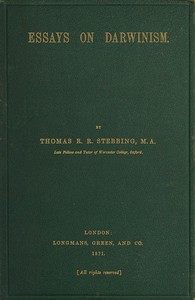
Essays on Darwinism — A Reader’s Guide

(4 User reviews)   960
Stebbing, Thomas Roscoe Rede, 1835-1926 Project Gutenberg 2015 Not confirmed
Evolution Readers of public-domain and historical texts
Project Gutenberg digital edition en

Edition facts

Words 52,164
Reading time 227 min
Text sections 22

The catalog record for Essays on Darwinism — A Reader’s Guide provides practical reading context through 52,164 words, 3 hr 47 min estimated reading time, and 22 detected text sections.

The text analysis averages about 29.5 words per sentence, while the detected sections provide another way to judge how the source is divided.

Project Gutenberg metadata also associates the work with “Evolution,” connecting these edition facts with the source record’s subject description.

Stebbing's 1871 essays defend Darwinism by analyzing the clarity of Darwin's prose, the unreliability of biblical genealogies for chronology, and the rhetorical tactics of opponents, using specific textual evidence from the excerpts.
Share
Editorial Edition Score 4.8/5

Calculated from edition completeness, EPUB availability, text structure and catalogue metadata. Not a user rating.

How this score is calculated
  • Description quality20 pts
  • Title & short description10 pts
  • Source metadata20 pts
  • Text length15 pts
  • Chapters / structure15 pts
  • EPUB file integrity20 pts

Total of 100 points, scaled to a 2.5-5.0 range. Editions with an empty description or a missing EPUB file are not scored.

Edition quality

Read the Text

ut of particles taken from each of the lower animals, giving him the wisdom of the serpent and the fiery courage of the lion[3]. To this sense of an intimate union between man and the rest of the animate creation have the writers of fables in all ages appealed, while imparting their lessons of prudence and virtue under the guise of transactions between birds and beasts and trees of the forest.

It is well known that after the discovery of almost every great truth a sort of feeling or instinct of it can be traced back in obscure hints, in chance expressions, in vague guesses, in flights of imagination, so that people very soon begin to fancy that they have all along understood and maintained the very theory, which, on its first appearance, they violently rejected as something false and even vicious. Darwinism has this characteristic of truth, that it has often been obscurely anticipated. It has this other characteristic, that its fiercest opponents have already begun insensibly to adopt its conclusions, and to speak its language, to opine, even, that the credit of its promulgation belongs to themselves.

In Mr. Darwin’s own historical sketch of the rise and progress of his doctrine, he does full justice to those who have preceded and who have worked with him in bringing it to light and in establishing its foundations. The opinion that species originate, not by successive miraculous interpositions or acts of creation, but by birth, was held as far back as 1794-5, by four men of distinguished genius, by Lamarck, by Mr. Darwin’s own grandfather, Dr. Erasmus Darwin, by Geoffroy Saint Hilaire, and by the poet Goethe. In the present day, Mr. Wallace, Mr. Herbert Spencer, the great zoologist Van Baer, and others, independently of Mr. Darwin, seem to have come more or less to the same conclusions, which have been warmly espoused and powerfully vindicated by Dr. Hooker, Professor Huxley, and Sir Charles Lyell. I mention these names because it seems to be their due, and not for the sake of giving weight to any argument because of the scientific renown of its advocates; there are names, it may be, equally distinguished on the opposite side. But one thing ought to be observed, that the progress of scientific enquiry has achieved so much during the last hundred years that the opinions of the older Naturalists have an importance when they agree with modern conclusions, which they cannot have when they differ from them, unless it can be shown that the observations, the experiments, the discoveries of late years had all been made by, or were known to, the earlier enquirers. For those, however, who think the opinions of a past generation of necessity more trustworthy than those of the present, Sir Charles Lyell has done well to point out that Linnæus himself looked forward to a time when it should be proved that in botany, at least, all species of a genus had descended from the same mother[4].

This is precisely Mr. Darwin’s opinion on the origin of species at large. He applies it to the animal as well as to the vegetable kingdom. He extends it by considering genera themselves as species of the orders which contain them, and orders as species of the great classes to which they as orders respectively belong. In a word, he considers that all living forms whatsoever are descended from a very few original ancestors of the simplest type, and that this primæval group itself had, probably, a common parentage. Wildly improbable, ludicrously absurd, degrading to humanity, and irreligious, no doubt this hypothesis has appeared to many, and will continue so to appear till it has been studied with attention, and studied without prejudice. To rescue it from the prejudice which would make it in the eyes of some a pernicious and forbidden study, is the hope which underlies the object of the present lecture.

Round Nelson’s Column in Trafalgar Square there are four colossal statue lions, the conception of a great artist. They look unnatural, not because of their size, or their position, or the material of which they are made, but because they are all so exactly alike; and exact likenesses are scarcely ever found in animate nature, unless it be among the very simplest organisms. When we speak of a striking likeness between two human beings, we evidently imply that a high degree of similarity is uncommon, and, therefore, noteworthy. What is true of even the most highly organized animals, is true, as far as observation goes, of all below them. Horses, dogs, sheep, kine, afford familiar illustrations of this principle. To the uneducated eye, individual differences may be totally unapparent, which are yet perfectly conspicuous to the trainer, the huntsman, the shepherd, and the drover. Wild creatures know their mates; wild herds select their leaders; the bee and the ant are capable of distinguishing the various individuals of their own communities, for strangers of the very self-same species with themselves they repel or destroy[5]. As each creature is, in numberless cases, the offspring of two unlike parents, it cannot be an exact copy of either, and the influences of the two parents may be combined in various proportions in each of the offspring; but the parents themselves are continually changing, with the variations of age and food and climate, so that the very rule of resemblance between the producers and the produced will entail another rule of unlikeness between the several members of an offspring not born all at once.

It is a fact, which cannot be denied, that in numberless instances the young of a creature differ more or less from the parents and likewise among themselves. Why it should be so has been in part explained. This is the _Variability_, without which Natural Selection could never have been thought of, because without differences there would have been nothing to select. But this Variability being granted, the Darwinian theory becomes possible--becomes quite capable of referring back the elephant and the pig, for instance, to the same ancestry. The difference between progenitors and their immediate offspring are, it is true, comparatively slight. It would, indeed, be a prodigious birth if one family contained at once a young monkey, a little pig, a big donkey, and a great goose; but it is obviously possible that any amount of unlikeness may be found between the descendants of common ancestors, if we are not confined to the differences of a single generation, but are allowed to multiply them through as many thousands as we require. Say that two race-courses differ in length by one yard; multiply that difference 1760 times and they will then differ by a whole mile. If, on leaving this Lecture-room, you found the trees--which half-an-hour ago were bare and leafless--clothed with summer verdure, your gardens blooming with a wealth of roses, your orchards laden with autumnal fruits, you would scarcely credit your senses; and yet, when the requisite number of half-hours, reckoned by days and months, shall have elapsed, you will greet these wonderful changes as perfectly natural and nothing to be wondered at. In a dissolving view that is well managed, Alpine peak and glacier-pass melt imperceptibly into some tall cathedral and sunshiny market-place. The two scenes are wholly unlike, and yet it is contrived that at no moment should the passage from one to the other be discernibly abrupt. Is it not possible then to conceive that through an immense multitude of generations the form of an ape might be derived from the form of a fish? We do not mean to say that this has actually happened, but supposing the descendant of the fish to vary continuously in the direction of the ape-like form, the result would be intelligible enough. What, then, is there to determine variation in any particular direction, and what limits are there, if any, to the system of interminable change which the principle of variation seems to involve?

Of course it is understood that the general mass of characters or qualities belonging to any creature are inherited by one generation from its immediate ancestors and transmitted to its immediate descendants, so that for a long period there would be a large number of individuals in the world united into a group by common characters, which according to their supposed importance we might call specific or generic. But besides this, there is the very curious principle of _Reversion_ to be taken into account, as largely conducing to the comparative permanence of species. In Norway, I believe, when the father’s name is Jack, and the son’s name is Tom, Tom is called Tom Jackson, and Tom is in the habit of giving his own eldest son the grandfather’s name, and then Tom Jackson’s son is called Jack Tomson. Now, in the same way, in nature it not unfrequently happens that when a long-nosed man is father of a short-nosed son, the son of the short-nosed man inherits by reversion the more elongated feature of his grandsire. Under certain conditions, which however greatly limit it, the operation of this principle of Reversion may extend, so far as we know, to any quality whatever after an interval of any number of generations. The tendency, therefore, is to the permanence of species, and yet, as will be shown in the sequel, it has furnished Mr. Darwin with an additional argument to prove that species are not permanent. It must be borne in mind that when a character reverts from a very distant ancestor, the creature which inherits it will have numerous other qualities, all probably more or less differing from those originally united to the reversionary character; just as if, in the School of Art, a picture by Raffaelle were shown to fifty pupils, and when it had been copied by the first, the second pupil were to make a copy of the copy, and so on to the end, each of the copies would no doubt differ more and more from the original, and yet in the very last, by the help of memory or sympathetic genius, there might be some beauty not to be found in any of the others, recalling the hand of the great master; while it is true, that if the sketch were something exceedingly simple, the fiftieth copy, and all the intermediate ones, might be almost exactly like the original; and so in nature, exceedingly simple organisms are seemingly reproduced for almost endless generations with no change, or scarcely any.

If it be true that all living creatures on this earth spring from a very few, extremely simple, original germs of life, we have to explain how it is that now there is an enormous variety of highly organised creatures, and at the same time some of extreme simplicity. For, if the simplest forms are permanent, how can the more complex be derived from them? On the other hand, if the simplest forms vary, how is it that we find, as we do, the very earliest known form of life still living at the present day? The solution is easy to suggest, that the offspring of very simple forms are sometimes exactly like their parents, and sometimes not exactly like. From what has been said above of Inheritance and Variation, this is in the highest degree probable, and, this being admitted, it will follow that according to circumstances the progeny that are like their parents, or those that are unlike, will have the best of it. Why this follows will now have to be explained.

All over the surface of our globe there is _a struggle for life_ going on. The instinct of self-preservation is probably stronger than any other, so that we may rely upon it that the creatures of every race will strive to preserve their own existence, if need be, at the expense of that of others. It may be horrible to the sentimentalist, but it is true; and remember that man as well as the tiger is a carnivorous mammal. There is no beast or bird of prey that can be compared with man for his ravaging, destructive, butchering, remorseless dissipation of other forms of life, to preserve his own existence and make it comfortable. He secures his gluttony from famine, as far as he can, by being omnivorous. Moss and fungus, grass and herb, leaf and flower and stem and fruit, all alike find a grave in man. The lion and the flea are the victims of his fear; many a harmless snake and toad of his antipathy; the otter and the fox die for his sport; the ostrich and the ermine for his vanity. For his food, like a wolf, he slays the harmless sheep; like a hawk, he pounces on the innocent chicken; like a wily panther, surprises the antlered stag; devours fish like a shark; spreads nets for his prey like a spider; and in some instances acquires a well-developed taste for the flesh of his fellow-man. Practically with all living animals, the first consideration is food. If all living animals could obtain abundance of pleasant and suitable food without preying on one another, the scene of war which Nature presents would perhaps in a great measure disappear. Yet this warfare is as conspicuous in the vegetable as it is in the animal kingdom. There is a certain amount of nourishment in a given piece of ground, and for that nourishment the plants upon it will compete, some thriving and multiplying to the hindrance and destruction of the others. Here again, if the surface of the globe supplied nutriment for all its plants, there would be at least no need for this destructive competition.

And how is it that this wide, wide world does not supply food enough for all the vegetable forms that make an effort to live upon it? The answer to this curious question has long been known, though not sufficiently attended to. It would not be fair to say that Nature is stingy in her supplies of food, but rather that she is too generously prolific of forms of life. For, take the supposition that all living creatures, whether animal or vegetable, were shielded from all enemies and influences at present hurtful to them, and let us see to what it would bring us. A single grain of wheat produces an ear containing ten, twenty, or some larger number of grains. But if the ear contained only two grains, still, at that rate of increase, a single grain would in thirty years be represented by more than a thousand millions of grains[6]. What, then, would be the position of the world, if, starting with a thousand millions of grains, this rate of increase were allowed to continue unchecked, not for thirty years, but for three thousand? But Mr. Darwin has calculated in regard to the elephant, which is reckoned the slowest breeder of all known animals, that, according to the very lowest probable rate of natural increase, a single pair would in five hundred years have a progeny of fifteen million living elephants[7]. Now fancy an island like our own, only in a climate suitable to elephants, into which a couple should have found their way a thousand years back. At the end of five hundred years, if all that were born were enabled to breed unchecked, there would be at least fifteen millions of their huge descendants stalking about the land; but, at the end of five hundred years more, there would be one hundred and twelve millions of millions of elephants. Goodness! What a stupendous menagerie! What a zoological garden! What a prospect at the end of the next five hundred years! And all this time, remember, according to our sentimental, philanthropic, philelephantine, nature-improving scheme, the men and women, the donkeys with a soul above thistles, the thistles no longer toothsome to donkeys, the mice, the rats, the cats, the oaks, the cabbages, the toadstools, would have been multiplying, not in the same proportion as the elephants, but very much more rapidly. The great desideratum would be standing room. The back of an elephant, or the branch of an oak, would no doubt command an enormous rent, and a right of way across the heads of your neighbours would be religiously guarded by the law of the land. Nor would the position of affairs be better in the surrounding sea; for while these elephants have been computed to breed at the rate of two young ones in thirty years, a single codfish has been found to produce in one year more than six millions of eggs, and there are other creatures infinitely more prolific[8].

You see, then, that the struggle for existence is an absolute necessity; and out of this all-essential strife springs what has been well called Natural Selection. What is meant by this will more easily be understood by looking first at Artificial Selection, which has been practised by man, sometimes consciously, and oftener unconsciously, in the process of domesticating a great number of plants and animals. Dogs, sheep, bulls, pigs, horses, fowls, pigeons, cabbages, and other culinary vegetables, strawberries, and all manner of edible fruits, together with gay-coloured, curiously-formed, sweetly-perfumed garden-flowers innumerable, have been, and are still being, subjected to man’s selection. That the wonderful changes which occur are indeed due to man’s repeated choice of the varieties which suit his purposes, is clear from this, that all the remarkable changes have taken place in those particular qualities which man has valued, leaving the other qualities comparatively unaltered. Let it be speed, size, taste, colour, form, temper, the coat, the feathers, the flesh, the muscular strength, the powers of endurance; in a vegetable, let it be the root, the stem, the leaf, the flower, the fruit, the seed, let it be what it will that is of value, that part and that character have been in each case most highly developed. To take a few examples: You are fond of peas, and you sow in your garden what your seedsman tells you are the finest new varieties; you like strawberries, you admire roses, you fancy a good cabbage, you are particular about having a mealy potato; so in each case you plant what you understand to be the best new kinds. What will you say if it turns out that the roses have improved in their roots but not in the bloom, and the potatoes in the bloom but not in their tubers; that the strawberries have remarkably fine leaves but very small fruit; that the peas and the cabbages have indeed enormous stems, while the seed of the one and the leaf of the other are insignificant in size and tasteless to the palate? So, too, if you purchase a race-horse and a pig from the most noted breeders of those animals, will you not be disgusted if it turns out that the horse has a remarkable propensity for fattening, while the pig is distinguished by nothing but its extreme fleetness of foot? These disappointments do not occur, because the variations of domesticated plants and animals are selected by competent persons. Were strawberry-leaves of as much importance in horticulture as they are in heraldry, many fine varieties would soon be exhibited. As soon as the most minute tendency to vary in any particular direction has been descried in any living creature, the fancier can exaggerate the difference to an extent inconceivable to the inexperienced. As a popular illustration of this we may take the Big Gooseberry, which fills so large a space in the newspapers when Parliament is prorogued. A gooseberry has been grown weighing more than 37 pennyweights--that is, nearly two ounces[9]. But mere size is not a fair test of the extreme plasticity of living organisms. You may have your trees growing stiffly upright, or with pendulous branches and prostrate stems; you may have your cattle long-horned, short-horned, or with no horns at all; your rabbits straight-eared or lop-eared; your fowls with every variety of comb and crest and wattles and plumage; and your pigeons pretty well at discretion. A type is prefigured, and the fancier produces it; and what is done for amusement with pigeons, is done for food, for profit, for the good of mankind at large, by the grower of corn, by the breeder of sheep, by all the wise produce-masters of the world[10].

Stebbing opens his preface by praising Darwin's Origin of Species not for its conclusions but for its style: 'the language flows easily in its calm, temperate, unegotistical course.' He argues that the book's clarity and honesty disarm prejudice, making readers whisper to themselves, 'we never thought of that before.' This focus on rhetoric and reader psychology sets the tone for a collection that defends Darwinism through careful argument rather than new evidence.

Darwin's Prose as a Rhetorical Model

Stebbing devotes much of his preface to describing how Darwin's writing wins converts. He notes that Darwin 'carries the reader on with unflagging interest,' using simple illustrations and familiar facts to derive unexpected results. The author contrasts this with the 'suspicion and dislike' aroused by the mere name of Darwinism, implying that opponents often react without reading. Stebbing's own style mirrors this ideal: he avoids invective, instead dissecting arguments with measured language. For example, he praises Darwin for 'no disguising of objections, no seeking of opponents,' a standard he applies to himself.

Biblical Genealogies and Chronological Fallacies

In a later excerpt, Stebbing attacks the use of Hebrew genealogies to date the Earth. He points out that the New Testament genealogy of Jesus deliberately omits three generations to achieve a numerical pattern, proving that such records were 'never meant to be a measure of time.' He traces the common belief in a young Earth not to Genesis but to 'the arithmetical speculations of an Irish archbishop' (James Ussher). Stebbing argues that ancient languages used the same word for 'son' and 'grandson,' making genealogies unreliable for chronology. This section shows his method: using textual analysis to undermine a key objection to Darwinism.

The Structure of Stebbing's Defense

The excerpts reveal a two-part strategy: first, establishing Darwin's work as clear and honest; second, dismantling specific counterarguments. Stebbing does not claim to offer new evidence but rather to clarify existing debates. He notes that his essays 'supporting the same views by almost the same arguments' might seem superfluous, yet he justifies them by observing that many critics 'condemn and ridicule Darwinism' without reading Darwin. The book's structure—a preface followed by essays—suggests a cumulative case, though the excerpts do not reveal the full sequence of topics. Stebbing's tone remains academic, addressing opponents as 'victims of a manifest delusion' rather than as fools.

Readers approaching these essays should note that Stebbing writes as a defender, not an originator. His arguments rely on close reading of Darwin and of biblical texts, not on original research. The excerpts show a writer who values clarity and evidence over rhetoric, but who also understands the persuasive power of a well-turned phrase. For those interested in the Victorian reception of Darwinism, this volume offers a contemporary apologetic that reveals both the scientific and the cultural stakes of the debate.

There’s something touching about Stebbing’s careful defense of Darwin’s plain prose, as if clarity itself were a kind of courage. Reading it, I kept thinking of The Life and Letters of Lafcadio Hearn, Volume 2 — Edition Insights — another voice struggling to be understood across vast distances. Both men wrote against the tide of their times, and I felt their loneliness in the margins.

Isaac King
2 weeks ago

Noah Ramirez
3 weeks ago

Elijah Ramirez
1 week ago

Isabella Ramirez
1 month ago

5
5 out of 5 (4 User reviews )

Add a Review

Your Rating *
  • ...
    Catherine Johnson - 1 month ago
    {'review_type': 'negative', 'content': "While the book covers significant ground, it often feels dated and simplistic in its arguments. The essays lack the contemporary scientific nuance one might expect, and there's a noticeable bias that overlooks counterpoints. The prose is sometimes dry, making it a struggle to stay engaged. A more balanced and updated approach would have made this a more valuable contribution to the discourse on Darwinism."}

  • ...
    Meghan Johnson - 3 weeks ago
    {'review_type': 'neutral', 'content': "This book provides a solid overview of Darwin's ideas, with several insightful essays that illuminate his thought. The writing is generally clear, but some chapters feel repetitive for those already familiar with evolutionary theory. It's a good resource for students, yet might not offer much new to seasoned readers. The occasional dense passages are balanced by moments of genuine insight."}

  • ...
    Robert Moyer - 1 week ago
    {'review_type': 'positive', 'content': "A thought-provoking collection that masterfully dissects Darwin's theories with clarity and depth. The essays are well-researched, offering both historical context and modern relevance. Perfect for both enthusiasts and scholars, it challenges the reader to think critically about evolution and its implications. The prose is engaging, making complex ideas accessible. Highly recommended for anyone interested in the foundational concepts of biology and the enduring impact of Darwin's work."}


Reader reflection

Take a moment to reflect on this book

Create a short personal record of your experience with this book.

Your progress 0 / 10
1

Which reading stage best describes you?

2

What was your overall reaction to the book?

3

Would you encourage someone else to read it?

4

What was the reading difficulty like?

Related eBooks