
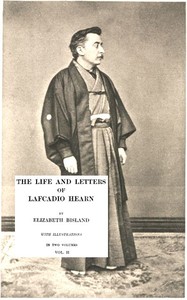
The Life and Letters of Lafcadio Hearn, Volume 2 — Edition Insights
Edition facts
The Life and Letters of Lafcadio Hearn, Volume 2 — Edition Insights can be approached with a clearer sense of reading commitment from its source measurements: 150,988 words, 10 hr 57 min estimated reading time, and 22 detected text sections.
The text analysis averages about 16.5 words per sentence, while the detected sections provide another way to judge how the source is divided.
Project Gutenberg metadata also associates the work with “Authors, American -- 19th century -- Biography,” connecting these edition facts with the source record’s subject description.
Calculated from edition completeness, EPUB availability, text structure and catalogue metadata. Not a user rating.
How this score is calculated
- Description quality20 pts
- Title & short description10 pts
- Source metadata20 pts
- Text length15 pts
- Chapters / structure15 pts
- EPUB file integrity20 pts
Total of 100 points, scaled to a 2.5-5.0 range. Editions with an empty description or a missing EPUB file are not scored.
Read the Text
Hearn was a teacher, is hidden from view by the Prefecture Office Building.
2. The Normal School. Mr. Hearn also taught here.
3. Here on the beach of Lake Shinyi Mr. Hearn lived for some time.
THE SHINTŌ TEMPLE OF KIZUKI DESCRIBED IN "GLIMPSES OF UNFAMILIAR JAPAN" 104
Lafcadio Hearn was the first foreigner who was allowed to enter the inner part of this temple.
A GROUP OF GRADUATES OF THE MIDDLE SCHOOL 162
3. The old teacher of Chinese Classics.
LAFCADIO HEARN'S FAVOURITE DWELLING-HOUSE 192
This house, an old Samurai's residence, is situated in front of a castle. The river before the house is an outer moat of the castle.
MR. HEARN'S GARDEN IN TŌKYŌ 282
WRITING-ROOM IN MR. HEARN'S TŌKYŌ HOUSE 344
His three sons on the verandah. In this house he died.
FACSIMILE OF MR. HEARN'S LATER HANDWRITING 410
KAZUO AND IWAO, LAFCADIO HEARN'S OLDER CHILDREN, EXERCISING AT JŪ-JUTSU 476
LAFCADIO HEARN'S GRAVE 516
LETTERS OF LAFCADIO HEARN
DEAR ELIZABETH,-- ... I feel indescribably towards Japan. Of course Nature here is not the Nature of the tropics, which is so splendid and savage and omnipotently beautiful that I feel at this very moment of writing the same pain in my heart I felt when leaving Martinique. This is a domesticated Nature, which loves man, and makes itself beautiful for him in a quiet grey-and-blue way like the Japanese women, and the trees seem to know what people say about them,--seem to have little human souls. What I love in Japan is the Japanese,--the poor simple humanity of the country. It is divine. There is nothing in this world approaching the naïve natural charm of them. No book ever written has reflected it. And I love their gods, their customs, their dress, their bird-like quavering songs, their houses, their superstitions, their faults. And I believe that their art is as far in advance of our art as old Greek art was superior to that of the earliest European art-gropings--I think there is more art in a print by Hokusai or those who came after him than in a $10,000 painting--no, a $100,000 painting. _We_ are the barbarians! I do not merely _think_ these things: I am as sure of them as of death. I only wish I could be reincarnated in some little Japanese baby, so that I could see and feel the world as beautifully as a Japanese brain does.
And, of course, I am studying Buddhism with heart and soul. A young student from one of the temples is my companion. If I stay in Japan, we shall live together.--Will write again if all goes well.
My best love to you always.
DEAR MISS BISLAND,--Do you think well enough of me to try to get me employment at a regular salary, somewhere in the United States. I have permanently broken off with the Harpers: I am starved out. My average earnings for the last three years have been scarcely $500 a year. Here in Japan prices are higher than in New York,--unless one can become a Japanese employee. I was promised a situation; but it is now delayed until September.
I shall get along somehow. But I am so very tired of being hard-pushed, and ignored, and starved,--and obliged to undergo moral humiliations which are much worse than hunger or cold,--that I have ceased to be ashamed to ask you to say a good word for me where you can, to some newspaper, or some publishing firm, able to give me steady employ, later on.
MY DEAR SISTER ELIZABETH,-- ... Now, as for myself,--I am going to become country school-master in Japan,--probably for several long years. The language is unspeakably difficult to learn;--I believe it can only be learned by ear. Teaching will help me to learn it; and before learning it, to write anything enduring upon Japan would be absurdly impossible. Literary work will not support one here, where living costs quite as much as in New York. What I wish to do, I want to do for its own sake; and so intend to settle, if possible, in this country, among a people who seem to me the most lovable in the world.
I have been living in temples and old Buddhist cemeteries, making pilgrimages and sounding enormous bells and worshipping astounding Buddhas. Still, I do not as yet know anything whatever about Japan. I have nothing else worth telling you to write just now, and no address to give,--as I do not know where I am going or what I shall be doing next month.
Later on, I shall write again.
Best wishes and affection from L. H.
TO BASIL HALL CHAMBERLAIN
DEAR PROFESSOR CHAMBERLAIN,--I am writing to you from the little beach of Inasa, mentioned in the "Kojiki,"--the etymology of which name, as given by Hirata, I think you say is incorrect, or at least fantastic. But I think you may not know that Inasa beach is in some respects the nicest bathing-place imaginable--certainly by far the best I have ever visited in Japan. The hotels face a beach without a pebble in its sand, and when the water is not rough, it is clear as a diamond; when roughened by a west wind, however, the water sometimes becomes dirty with seaweed, drift and such refuse. This is the great bathing resort of Izumo. But it is much more quiet and pleasant than other Japanese bathing resorts I have seen--such as Ōiso. After the bath, moreover, one can have a hot salt water bath or a cold fresh-water douche. And there is plenty of deep water for swimming. Right opposite our window is the "thousand draught rock" which the son of Ohokuni, etc., lifted on the tips of his fingers.
Kaka is famous for its sea cave, and legend of Jizō. I think I wrote you of this beautiful legend of the child ghosts and the fountain of milk. But it is really too pretty to publish in a matter-of-fact record.
The term "arrows of prayer" which I use, might deceive the reader. The arrows put into the rice-fields to scare away crows are very different in appearance and purpose. I hope to send you some of the former from Mionoseki.
I will stay here some weeks--the sea-bathing is too good to lose. Will write again soon.
Most truly ever, LAFCADIO HEARN.
TO BASIL HALL CHAMBERLAIN
DEAR PROFESSOR CHAMBERLAIN,--We are still at Kizuki--enjoying exquisite weather and delicious sea-bathing. Last evening I dined with the Kokuzō; and I never ate so much dinner or drank so much sake anywhere in Japan. It was a royal feast. I also saw some things that would interest you. A series of letters of Motoori's,--also two MSS. of flute-music made by him, and the brushes with which his commentaries were written. One of the Senke family, who was his pupil, received these as bequests, and they are preserved in the family.
The conversation turned upon you; and I was asked many questions about you, which I answered as best as I could. From the extreme interest shown, I am sure that Kizuki would be turned inside out to please you if you come down here.
I asked about the deity of Mionoseki; and the learned priest Sasa and others state positively that deity is not Hiruko. The legend concerning him would prove the same fact. The deity detested the cock, and no hens or chickens or eggs or feathers are allowed to exist in Mionoseki. No vessel would take an egg to Mionoseki. It is wrong even to eat eggs the day before going to Mionoseki. A passenger to Mionoseki was once detected smoking a pipe which had the figure of a cock upon it, and that pipe was immediately thrown into the sea. The dislike of the god for the cock is attributed to some adventure of his youthful days,--when the cock had been instructed to wake him up, or call him at a certain hour. The cock did not perform his duty, and Koto-shiro-nushi-no-Kami, had his hand bitten by a crocodile in hurrying to get back home.
There is a temple of Ebisu in Nishinomiya near Ōsaka, where the deity is believed to be identical with Hiruko, but this is not the case at Mionoseki.
Regarding the Deity of Marriage, I must correct an error in my last. The learned priest Sasa states (quoting many ancient poems and authors to prove the fact) that the ancient Deity of Marriage was the Deity of Kizuki. But at Yaegaki Jinja, where there is a tree with two trunks, or two trees with trunks grown into one, and other curious symbolic things, the popular worship of the Deities Susa-no-o and Inada-Hime gradually centred and finally wrested away the rights and privileges of the Kizuki deity in favour of the gods of Yaegaki.
I have had some fine _shōryō-bune_ made. And I can send you one if you would like. There is a special kind of _shōryō-bune_ made here. Mine, though of straw, is an elaborate model of a junk and could sail for miles. Would you like to send one to Dr. Tylor? Anthropologically, these little boats in which to send the souls home have a rare interest.
TO BASIL HALL CHAMBERLAIN
MATSUE, September, 1890.
DEAR PROFESSOR,--I have just returned from my first really great Japanese experience,--a trip to Kizuki. The two trips were beautiful. From Shōbara the route lies through a superb plain of rice fields, with mountain ranges closing the horizon to left and right.
Reaching Kizuki at night, I sent a letter of introduction from Mr. Nishida of the Chūgakkō to Senke Takamori,--the princely person whose family for 82 generations have been in charge of the great temple. I paid a visit to the grounds the same evening, and was amazed by the great scale and dignity of the buildings, and the nobility of the approaches to them, under succession of colossal _torii_.
Next morning a messenger came from Mr. Senke, announcing that I would be received at the temple. My attendant had, however, to put on _hakamas_ and perform other personal corrections of dress before entering the august presence.
We were then received with a courtesy and kindness impossible to praise sufficiently or to qualify too gratefully. After performing the requisite ablution of hands, we were received into the inner shrine of the chief deity--(my baggage not yet having arrived, I have not your "Kojiki" by me to correct misspelling, but I think the name is Ōnamuji-no-Mikoto). I was told that I was the first European ever allowed to enter the shrine, though seven or eight other foreigners had visited the grounds.
There are some 19 shrines not consecrated to any particular deities,--in which the Kami are supposed to assemble during the Kami-ari-zuki,--after a preliminary visit to a much smaller temple erected on the seashore,--where, it is said, the sovereignty of Izumo was first divinely guaranteed by the great deity.
We were received by the Gūji (Senke) in ceremonial costumes. His robes were white, those of the attendant priests purple with gold figuring--very beautiful. I acknowledge that I felt considerable awe in the presence of these superb Japanese, who realized for me all that I had imagined about the daimyōs, and grandees of the past. He who used to be called the Iki-gami--said to descend from Susa-no-o-no-Mikoto--is a fine portly man, with a full beard. The ceremonial was imposing, and the sense of the immense antiquity and dignity of the cult, and of the generations of its officiants, might have impressed even a more unbelieving mind than my own.
The temple is really very noble, with its huge pillars, and the solidity of its vast beamwork. Since the prehistoric era it has been rebuilt 28 times. It is said to be the oldest of all Shintō places of worship, and holier than Ise. There are many curiosities and valuable historical documents. The chief shrine faces west,--unlike others.
We were shown the primitive method of lighting the sacred fire--a simple board in holes of which a rapidly revolving stick kindles the spark. Also we saw the hierophantic dance, and heard the strange old song sung--_An-un_--to the accompaniment of sticks tapped on curiously shaped wooden boxes, or drums.
Subsequently we were invited to the house of Mr. Senke, where other curious things were shown to us. I have had a rare and delightful experience, and I hope to write of it for one of the English reviews later on.
My attendant--unwarrantably, perhaps--mentioned me as a friend of yours; and the statement provoked a murmur of pleasure. Your name is held, I can assure you, in very great reverence at Kizuki; and I feel assured, should you go there, that you would be received as if you were the chief of the Kami. And I am also sure you would like these really fine and noble men.
I have written enough to tire you perhaps, but I believe the subject may, at least, suggest questions of value from you, if not otherwise interesting. Kizuki is certainly the chief place of interest in Izumo; and I have all details and documents. They will take me some months to digest, but I shall do something pretty.
The jinrikisha ride is a little tiring. Kizuki is very, very pretty. From 200,000 to 250,000 pilgrims go there yearly. All day the sound of the clapping of hands is unbroken, like the sound of a cataract. At least it was when I was there.
TO BASIL HALL CHAMBERLAIN
MATSUE, September, 1890.
DEAR PROFESSOR,--On second thought I have set to work to obtain the information you wish as fully as possible from trustworthy Japanese,--as I fear it could only be gathered by my own exertions alone, too late to be serviceable. I shall send as soon as possible, and if there be time I will supplement the notes with some observations of my own.
I think I shall be very happy in Matsue, and every one assures me it is not so cold as in Tōkyō in winter, although there is more snow.
On the way here I stopped at a very primitive village where there are volcanic springs, and nearly every house has a "natural bathtub" always hot and fresh. And the good old man in whose house I stopped said he only once before in all his life saw a European,--but he did not know whether the European was a man or a woman. The European had very long hair, of a curious colour, and wore a long dress reaching its feet, and its manners were gentle and kind. I found out afterwards it was a Norwegian missionary-girl, having the courage to travel alone.
TO BASIL HALL CHAMBERLAIN
MATSUE, October, 1890.
DEAR PROFESSOR CHAMBERLAIN,--I received your last kind letter just after having posted a note to you. As for what information I could send, I am surprised and delighted to find that it was of some use. I never expected to be so kindly thanked for it,--deeming it too scanty.
I do not think I shall have any difficulty in getting a model made of the fire-drill, which at Kizuki is a thick board of dense white wood, all the holes being drilled near one edge, in an almost parallel line. Perhaps it may take some little time to arrange the matter; but if there be no hurry, I am almost certain I can get the model made. I am a member of the society now for the preservation of the Kizuki buildings, and am sure my request will be kindly considered.
There are coloured prints here enough: _Samurai-no-ehon_ they call the old picture-books here. But they do not relate to Izumo. I hope to procure some soon which will do.
I am more and more impressed with the ascendency of Shintō here. Everybody is a Shintōist; and every house seems to have both its _kamidana_ and its _butsudan._ One street is almost entirely composed of Buddhist temples--the Teramachi; but all the worshippers also attend the Shintō services on certain days. The charms suspended over doors, etc., are Shintō. Most of the _mamori_ on the _kamidana_ of a house are sure to be Shintō. The Gods (1) Ebisu and (2) Daikoku, here respectively identified with (1) Koto-shiro-nushi-no Kami and (2) Oho-kuni-nushi-no-Kami, are monopolized by Shintō. Its signs and mysteries are everywhere: the atmosphere is full of magic.
I suppose some people would think this sort of worship shocking, but I must say I could not laugh at it: the childish naïveté of the prayers and the offerings--the idea of a _kami_ in the tree, able to heal--seemed to me rather touching than absurd, and delightfully natural. One feels what pastoral life in the antique world must have been, on studying the artless notions of these good country-folk, whom no one could live among without loving,--unless he were strangely brutal or bigoted.
I had to make a speech before the educational association of Izumo the other day, and in citing the labours of Darwin, Lubbock, Huxley, and others, I quoted also Tylor's delightful little book on Anthropology. My speech was on the Value of the Imagination as a Factor in Education. The Governor ordered it to be translated and printed;--so that I am being for the moment perhaps much more highly considered than I ought to be.
I have become so accustomed to Japanese food and habits, that it would now be painful to me to change them. The only extras, besides sake, which I take, are plenty of fried and raw eggs. So far I am in better health than I hoped to be in Japan.
I am very sorry you are not quite well. Here the weather is what they call "mad weather"--rain alternating with sun, and chilly winds.
Faithfully yours, LAFCADIO HEARN.
TO BASIL HALL CHAMBERLAIN
DEAR PROFESSOR CHAMBERLAIN,--You will remember having invited humble me to make a few criticisms if I could, about "Things Japanese." I am now going to pray you with all my heart and soul to change that article about Japanese Music in the next edition of the book. I am, and have been for months unspeakably charmed with Japanese music,--I think it is as dainty and playfully sweet and pretty as the Japanese girls who sing it and play it; and I feel sure there is a very fine subtle art-feeling in it. I am sorry to say, however, that while making this plea, I must in honesty confess that I am not an appreciant of Wagner, and that I have always been much impressed and charmed by primitive music. African music, and Spanish-American melodies I am quite infatuated about, and neither of these would be considered as related to the higher musical sense. But I feel sure if you were in Izumo, I could make you hear some music, both instrumental and vocal, which you would acknowledge to be more than "pretty."
I think I will be able to get a model of the fire-drill made in a while. I have arranged for a week at Kizuki during the coming vacation.
The importance of Shintō here as compared with Buddhism impresses me more and more every day. Most of the _kakemono_ in the _tokonomas_ are Shintō rather than Buddhist. The story of the Sun-goddess is a favourite theme with local artists. Here also the gods of Good-Fortune have become after a fashion adopted by Shintō.
I expect to send you some _mamori_ shortly from two places--Ichibata and Sakusa. The Shintō shrine at Sakusa would probably interest you. Lovers in doubt go there to pray to the _kami_ who set the single in family, and who have decided in advance the coupling of all human creatures. In this shrine are the spirits of Susa-no-o-no-Mikoto and his wife enshrined,--his first wife whom he met accompanied by her father before he went to kill the Serpent. The ghost of the father-in-law, "Foot-stroking Elder," is supposed to reside in the same place,--also that of the mother-in-law. Almost every spot in hill or valley here has a shrine marking an act or footstep of Susa-no-o. Every place where the Serpent (Orochi) could possibly have been, still holds a legend of it.
I am no longer in a hotel, but have a very beautiful house, fronting on the lake, and from my window I could see with a telescope almost to Kizuki over a beautiful stretch of blue water. And every peak I see has some divine story attached to it, and several are named after the primæval gods.
Lafcadio Hearn's letters in this volume repeatedly return to a contrast between two Japans: one that feels "holy" and intimate, and another that has been modernized and monetized. Writing to Elizabeth Bisland, he describes Ise as a disappointment because "there is so much money,—such enormous hotels,—such modernization: the place did not feel holy to me, as Kizuki did." This distinction between a domesticated, beloved nature and a commercialized landscape runs through his correspondence, as does his unease with foreign residents in the open ports. Hearn's voice is consistently self-aware, often deflecting praise from English journals while valuing the approval of a single Japanese friend over that of a foreign reviewer.
Domesticated Nature and the Appeal of Matsue
Hearn's letters reveal a writer who felt most at home in places where nature seemed to accommodate human life. He contrasts the "splendid and savage" tropics of Martinique with Japan's "domesticated Nature, which loves man, and makes itself beautiful for him in a quiet grey-and-blue way like the Japanese women." This personification of landscape is not merely decorative; it reflects his preference for Matsue, a city he hopes to make a permanent home. He writes of wanting to "buy one for my own home" a yashiki there, and notes that even Setsu now prefers the interior. The climate, the summer, the possibility of swimming at Kizuki and Mionoseki—these concrete details ground his attachment. He explicitly states he would rather teach in Matsue than in Tōkyō, were it not for the cold winters.
Ambivalence Toward Foreign Audiences and Institutions
Throughout the excerpts, Hearn displays a marked skepticism toward Western recognition. He acknowledges that English journals have been kind, but insists he is "not foolish enough to take the praise for praise of fact,—feeling my own ignorance more and more every day." The approval of a Japanese friend matters more than "the verdict of a foreign reviewer, who, necessarily, knows nothing to speak of about Japan." This tension extends to his professional situation: his engagement with the university is uncertain because his becoming a Japanese citizen "had raised a difficulty." Hearn's response is characteristically detached—"I was not worried about the matter, and had never allowed myself to consider it very seriously"—yet he also hints at a pragmatic concern about salary. His letters to Ellwood Hendri (not excerpted here) likely continue this thread of institutional negotiation.
The Weight of Place: Ōsaka, Kizuki, and the Holy
Hearn's geography is emotional. Ōsaka delights him "beyond words"—he calls it, after Kyōto, "the most interesting city on this side of Japan." The temple Tennōji strikes him as "queer, dear." In contrast, Ise disappoints: the miko (shrine maidens) "won't show their faces for less than five yen," and the cold hurts his lungs. Kizuki, by comparison, retains its holiness. These judgments are not abstract; they are tied to sensory experience—cold, money, the behavior of people. Even a visit to Sakai to buy a sword becomes an occasion for dark humor: he sees the grave of eleven samurai who committed seppuku for killing foreigners and wishes they "could come back again to kill a few more who are writing extraordinary lies about Japan." The letter blends reverence, irritation, and a sharp awareness of how Japan is represented abroad.
Readers approaching this volume will find a portrait of Hearn in transition: a writer who has chosen Japan but remains in dialogue with Western audiences, who values intimacy over scale, and who measures places by their capacity to feel holy rather than modern. The letters are best read with attention to their recurring motifs—domesticated nature, the foreign reviewer's ignorance, the pull of Matsue—and to the way Hearn's voice shifts between warmth, irony, and self-deprecation. Bisland's editorial framing provides context without overwhelming the correspondence.
Sometimes I think about how Hearn wrote to friends from Matsue, aching to explain Japan to a West that kept missing him. A quieter version of that same ache shows up in the essays gathered in The Connecticut Wits, and Other Essays — Text and Context—that pull between belonging and distance. It lingered with me, like an old song half-remembered.
Isabella Hill
1 month agoWilliam Hall
1 month agoCharlotte Young
1 week agoDaniel Hall
2 weeks agoHow will you remember this book?
Save your reaction, strongest insight, and memorable passage.
Leo Nelson
1 month ago