1

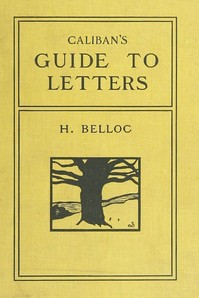
The Aftermath; Or, Gleanings from a Busy Life Called upon the outer cover, for purposes of sale, Caliban's Guide to Letters — A Closer Reading
8
2
Project Gutenberg
2021
Satire; Authorship
Readers of public-domain and historical texts
Project Gutenberg digital edition
en
Edition facts
Words: 43,439
Reading time: 189 min
Text sections: 27
Source:
Project Gutenberg record #67042
Belloc's satirical guide to letters, framed as a mock-editorial aftermath, uses absurd press opinions, a dedication to Mrs. Caliban, and a mock-interview manual to lampoon literary pretension and publishing conventions.
Editorial Edition Score
4.8/5
★★★★★
★★★★★
Calculated from edition completeness, EPUB availability, text structure and catalogue metadata. Not a user rating.
Edition quality
Belloc's The Aftermath opens not with a narrative but with a cascade of mock endorsements, including a fabricated quote from The Times reduced to a dash and an exclamation mark. The dedication to Catherine, Mrs. Caliban, parodies fulsome acknowledgments, crediting her with 'unflinching courage' and 'catholic learning' for a book that might otherwise not exist. The epigraph from Carlyle's Frederick the Great—'O, Man! knowest thou that word Some Other?'—signals the work's ironic posture toward authorship and originality.
The Errata as Paratextual Joke
The book includes an 'Errata and Addenda' section that corrects 'enteric' to 'esoteric' on page 19, a trivial substitution that mocks scholarly pedantry. This prefatory joke primes the reader to expect a work where editorial seriousness is undercut at every turn. The errata list, placed before the main text, functions as a miniature satire of academic precision, hinting that the volume's content will similarly toy with reader expectations.
The Interview as Ritual Performance
The excerpt detailing the proper conduct of an interview reads as a deadpan manual for absurd social rituals. Belloc prescribes holding hat, gloves, and umbrella in the left hand to keep the right 'completely free,' and bowing 'subtly from the central vertebrae.' The advice culminates in two exceptions: for unknown men, the interviewer talks loudly for half an hour; for the wealthy, the same procedure ensures being 'forbidden the house.' This mock-instructional tone reveals the interview as a hollow performance, stripped of genuine exchange.
The Embedded Interview as Meta-Satire
Within the manual, Belloc includes a specimen interview 'Written specially for the Sunday Englishman, by the Rev. James Caliban, D.D.,' complete with a bogus biblical epigraph from 'Deuteronomy xvi. 7.' The interview begins with the interviewer 'leaping into a well-appointed cab,' a detail that parodies the breathless opening of journalistic profiles. By nesting a fictional interview inside a guide to interviewing, Belloc creates a recursive satire where the form itself becomes the target.
The Aftermath as Structural Conceit
The title The Aftermath; Or, Gleanings from a Busy Life frames the collection as leftover material, while the subtitle 'Caliban's Guide to Letters' (added for sale) openly admits the commercial packaging of literary advice. The book's structure—opening with press opinions, a dedication, errata, then a series of sketches—mimics the apparatus of a serious work while emptying it of substance. Readers should attend to how Belloc uses paratexts (titles, epigraphs, footnotes) to undermine the very authority the book pretends to claim.
Belloc's satire works best when read as a performance of literary conventions rather than a guide to them. The mock-interview manual and its embedded specimen reward attention to tonal shifts—from pompous instruction to absurd example. The errata and dedication are not mere decoration but integral to the book's critique of authorship. Approach each sketch as a variation on the theme of hollow form, and the collection coheres as a sustained parody of the literary marketplace.
Reader reflection
What was your reading experience?
Capture what you thought, learned, and would like to remember.
Your progress
0
/
10
2
Was reading this book enjoyable?
3
How likely are you to recommend this book?
4
How easy was the book to follow?
5
Did the book give you something worth debating?
6
Which part made the strongest impression?
7
How would you rate its originality?
8
How understandable was the text?
9
In one sentence, what did you learn?
10