1

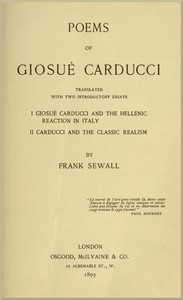
Poems of Giosuè Carducci, Translated with two introductory essays: I. Giosuè Carducci and the Hellenic reaction in Italy. II. Carducci and the classic realism — Key Ideas to Explore
11
1
Project Gutenberg
2018
Italian poetry -- Translations into English; Carducci, Giosuè, 1835-1907 -- Criticism and interpretation
Readers of public-domain and historical texts
Project Gutenberg digital edition
en
Edition facts
Words: 30,581
Reading time: 133 min
Text sections: 48
Source:
Project Gutenberg record #56711
Frank Sewall's 1893 translation of Giosuè Carducci's poems, prefaced by two essays arguing for a Hellenic and classic realist revival in Italian poetry, with translations that emphasize precision and Roman vigor over romantic sentiment.
Editorial Edition Score
4.7/5
★★★★★
★★★★★
Calculated from edition completeness, EPUB availability, text structure and catalogue metadata. Not a user rating.
Edition quality
Frank Sewall's 1893 volume presents Giosuè Carducci's poetry through a dual lens: two introductory essays that frame Carducci as a champion of Hellenic reaction and classic realism, followed by translations of forty-two poems. The preface explicitly states that the work is motivated not solely by literary merit but by the poems' illustration of 'the survival of ancient religious motives beneath the literature of a people old enough to have passed through a succession of religions.' This editorial stance shapes the selection and commentary, making the book as much an argument about literary tradition as a collection of verse.
The Translator's Dual Agenda
Sewall's preface declares a purpose beyond introducing Carducci to English readers: he aims to present 'an unusually interesting example of the survival of ancient religious motives' and a form of realism that is 'eminently refreshing' amid contemporary abuses of the term. This framing colors every translation. The essays—'Giosuè Carducci and the Hellenic Reaction in Italy' and 'Carducci and the Classic Realism'—precede the poems, establishing a critical apparatus that guides interpretation. The translator does not pretend to neutrality; he selects poems that support his thesis, such as 'Hymn to Satan' and 'The Ox,' which embody the classic realism he champions. Readers should note that the translations are filtered through Sewall's own literary and ideological commitments, which he openly acknowledges.
Precision Over Ornament: Sewall's Translation Choices
Sewall's translations aim for what Paul Bourget, quoted in the essays, calls 'the charm of precision which is the distinctive characteristic of the genius of the Romans.' The excerpts show a preference for direct, forceful language: 'Passa la nave mia, sola, tra il pianto' is rendered with stark simplicity. In the essay on 'The Mother,' Sewall praises the poem's 'colossal bronze figure' and notes the difficulty of conveying the phrase 'la giustizia pia del lavoro.' He does not shy from acknowledging the limits of translation—calling his versions 'very inadequate' in the preface. The poems are arranged to highlight thematic contrasts: 'Hymn to Satan' sits alongside 'Hymn to the Redeemer,' and sonnets to Petrarch, Goldoni, and Alfieri form a sequence of literary homage. The translations are literal enough to preserve Carducci's imagery but occasionally archaic in diction, reflecting the 1893 publication date.
Echoes of Dante and Catullus in Carducci's Landscapes
The excerpts reveal Sewall's emphasis on Carducci's intertextual relationship with earlier poets. The 'Summer Dream' is compared to Dante's vision of the Countess Matilda in Purgatory, with 'the bells of Easter-eve' and 'four white sails' evoking a Dantean tenderness. In 'Sermione,' Carducci invokes Catullus directly, addressing 'Quintus Valerius' and referencing the villa where Catullus wrote. Sewall's commentary draws attention to these allusions, positioning Carducci as a poet who blends his own personality with 'great souls of the past.' The poem 'Carnival' is described as Juvenalian satire, exposing 'the corruption and inhumanity of society.' These observations are grounded in the text: the excerpts quote the Sirens' song from 'Sermione' and note the 'moral portraiture' of 'The Mother.' Readers should attend to how Sewall's footnotes and essays construct a lineage from ancient Rome through Dante to Carducci.
This edition rewards readers interested in the intersection of translation, literary criticism, and late-nineteenth-century cultural politics. Sewall's Carducci is a deliberately constructed figure—a classic realist who revives ancient forms to critique modernity. The poems themselves, in their English dress, offer a window into how Italian poetry was received abroad. For the fullest experience, read the essays alongside the poems, noting where Sewall's claims align with or diverge from the verse.
Reader reflection
What was your reading experience?
Capture what you thought, learned, and would like to remember.
Your progress
0
/
10
2
Did this book hold your interest?
3
How likely are you to recommend this book?
4
Did the language feel accessible?
5
How useful did the reading feel?
6
How closely did the book connect with your experience?
7
Was the book what you thought it would be?
8
Which aspect of the book did you value most?
9
Which lesson or insight stayed with you?
10