1

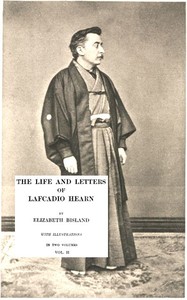
The Life and Letters of Lafcadio Hearn, Volume 2 — Edition Insights
11
3
Project Gutenberg
2013
Authors, American -- 19th century -- Biography; Hearn, Lafcadio, 1850-1904
Readers of public-domain and historical texts
Project Gutenberg digital edition
en
Edition facts
Words: 150,988
Reading time: 657 min
Text sections: 22
Source:
Project Gutenberg record #42313
This volume collects Lafcadio Hearn's letters from 1890-1904, revealing his deepening attachment to Japan, his ambivalence toward foreign reviewers, and his preference for places like Matsue and Ōsaka over Tōkyō. Editor Elizabeth Bisland frames the correspondence with biographical context, highlighting tensions between Hearn's Western origins and his adopted Japanese identity.
Editorial Edition Score
4.9/5
★★★★★
★★★★★
Calculated from edition completeness, EPUB availability, text structure and catalogue metadata. Not a user rating.
Edition quality
Lafcadio Hearn's letters in this volume repeatedly return to a contrast between two Japans: one that feels "holy" and intimate, and another that has been modernized and monetized. Writing to Elizabeth Bisland, he describes Ise as a disappointment because "there is so much money,—such enormous hotels,—such modernization: the place did not feel holy to me, as Kizuki did." This distinction between a domesticated, beloved nature and a commercialized landscape runs through his correspondence, as does his unease with foreign residents in the open ports. Hearn's voice is consistently self-aware, often deflecting praise from English journals while valuing the approval of a single Japanese friend over that of a foreign reviewer.
Domesticated Nature and the Appeal of Matsue
Hearn's letters reveal a writer who felt most at home in places where nature seemed to accommodate human life. He contrasts the "splendid and savage" tropics of Martinique with Japan's "domesticated Nature, which loves man, and makes itself beautiful for him in a quiet grey-and-blue way like the Japanese women." This personification of landscape is not merely decorative; it reflects his preference for Matsue, a city he hopes to make a permanent home. He writes of wanting to "buy one for my own home" a yashiki there, and notes that even Setsu now prefers the interior. The climate, the summer, the possibility of swimming at Kizuki and Mionoseki—these concrete details ground his attachment. He explicitly states he would rather teach in Matsue than in Tōkyō, were it not for the cold winters.
Ambivalence Toward Foreign Audiences and Institutions
Throughout the excerpts, Hearn displays a marked skepticism toward Western recognition. He acknowledges that English journals have been kind, but insists he is "not foolish enough to take the praise for praise of fact,—feeling my own ignorance more and more every day." The approval of a Japanese friend matters more than "the verdict of a foreign reviewer, who, necessarily, knows nothing to speak of about Japan." This tension extends to his professional situation: his engagement with the university is uncertain because his becoming a Japanese citizen "had raised a difficulty." Hearn's response is characteristically detached—"I was not worried about the matter, and had never allowed myself to consider it very seriously"—yet he also hints at a pragmatic concern about salary. His letters to Ellwood Hendri (not excerpted here) likely continue this thread of institutional negotiation.
The Weight of Place: Ōsaka, Kizuki, and the Holy
Hearn's geography is emotional. Ōsaka delights him "beyond words"—he calls it, after Kyōto, "the most interesting city on this side of Japan." The temple Tennōji strikes him as "queer, dear." In contrast, Ise disappoints: the miko (shrine maidens) "won't show their faces for less than five yen," and the cold hurts his lungs. Kizuki, by comparison, retains its holiness. These judgments are not abstract; they are tied to sensory experience—cold, money, the behavior of people. Even a visit to Sakai to buy a sword becomes an occasion for dark humor: he sees the grave of eleven samurai who committed seppuku for killing foreigners and wishes they "could come back again to kill a few more who are writing extraordinary lies about Japan." The letter blends reverence, irritation, and a sharp awareness of how Japan is represented abroad.
Readers approaching this volume will find a portrait of Hearn in transition: a writer who has chosen Japan but remains in dialogue with Western audiences, who values intimacy over scale, and who measures places by their capacity to feel holy rather than modern. The letters are best read with attention to their recurring motifs—domesticated nature, the foreign reviewer's ignorance, the pull of Matsue—and to the way Hearn's voice shifts between warmth, irony, and self-deprecation. Bisland's editorial framing provides context without overwhelming the correspondence.
Reader reflection
How will you remember this book?
Save your reaction, strongest insight, and memorable passage.
Your progress
0
/
10
2
Did this book hold your interest?
3
Is this a title you would suggest to others?
4
How much effort did this book require?
5
Did any part of the book stay with you emotionally?
6
How original did the book feel?
7
How strong was your personal connection to the text?
8
Which aspect of the book did you value most?
9
Which lesson or insight stayed with you?
10