1

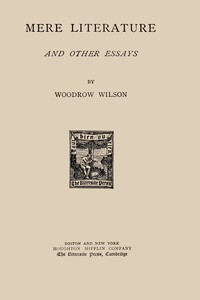
Mere literature, and other essays — Themes and Context
17
4
Project Gutenberg
2021
Literature; Authors; United States -- History
Readers of public-domain and historical texts
Project Gutenberg digital edition
en
Edition facts
Words: 58,837
Reading time: 256 min
Text sections: 12
Source:
Project Gutenberg record #66074
Woodrow Wilson's 1896 collection of essays defends literature against scientific positivism, examines authorship, and profiles figures like Burke, using a formal, periodic style that itself embodies the literary values he champions.
Editorial Edition Score
4.8/5
★★★★★
★★★★★
Calculated from edition completeness, EPUB availability, text structure and catalogue metadata. Not a user rating.
Edition quality
Wilson opens the title essay by dissecting the phrase "mere literature" as a sneer from the scientific age, which dismisses literary creation as "mere talk" and "mere pastime." He argues that this attitude has infected college curricula, forcing literature to adopt the methods of science. The essay sets up a tension between the measurable and the imaginative, a theme that recurs across the collection.
The Scientist’s Sneer and the Literary Reply
Wilson begins by taking the phrase "mere literature" literally, calling it "the irreverent invention of a scientific age." He contrasts the scientist’s respect for "demonstrable knowledge" with the view of literary works as "incalculable vagaries." The essay then turns to how this mindset affects education: literature is "commanded to assume the phrases and the methods of science." Wilson’s own prose—formal, periodic, and deliberately literary—serves as a counterexample. He does not name specific scientists or textbooks, but the critique is pointed: the study of literature in universities risks becoming an agent of "Philistinism." The opening thus frames the entire volume as a defense of literature’s intrinsic value, not as data or entertainment.
Burke’s Grandeur and the Disparity of Station
In the essay on Burke, Wilson examines the gap between Burke’s intellectual authority and his modest political offices. He notes that Burke "never wielded the power of a great statesman" despite uttering statesmanlike thoughts with "unapproachable nobility." Wilson attributes this partly to the era’s practice of keeping "men of insignificant birth" from high office. He also hints at "faults of temper" that may have hindered Burke. The analysis is grounded in specific episodes: Burke’s defense of his pension in the "Letter to a Noble Lord," where he speaks "grandly about himself" without seeming disproportionate. Wilson observes that Burke’s "great authority is over us rather than over the men of his own day," a judgment that positions Burke as a figure whose true stature was recognized only posthumously.
The Burkes and the Web of Connection
Wilson traces how William Burke, a relative, helped Edmund Burke gain entry to Lord Rockingham’s circle. The narrative includes a vivid anecdote: the Duke of Newcastle, mistaking Burke for a low-born adventurer, spread slanders that his real name was O’Bourke and that he was a "rank Papist." Rockingham, however, confronted Burke directly, was satisfied by his denials, and admitted him to "intimate relations of warm personal friendship." Wilson’s account is notable for its specificity—the names, the boroughs, the East India speculations—and for its dry tone. He presents the episode as both a testament to Rockingham’s character and an illustration of the social obstacles Burke faced. The detail that William Burke "seems to have found means of knowing everybody it was to the interest of ‘the Burkes’ to know" hints at a network of ambition and patronage.
Periods and Proportions: Style as Substance
Throughout the collection, Wilson’s own style mirrors the qualities he admires in Burke: formal, balanced, and occasionally majestic. He describes how Burke narrated his "progressions from London to Buriton" in the same "monotonous, majestic periods" used for the fall of states. Wilson himself employs similar periodic sentences, often with a qualifying clause or a turn. For instance, he writes that Burke’s generation saw "a touch of pretension" in his tone, only to add that "his great authority is over us." This self-consciousness about style is part of Wilson’s argument: literature is not mere ornament but a mode of thought. The reader is invited to observe how Wilson’s prose enacts the very literary values he defends—precision, rhythm, and a refusal to reduce expression to information.
Reading with an Eye to Voice and Structure
Wilson’s essays reward attention to their rhetorical architecture. The opening essay establishes a polemical stance that later pieces complicate: the essay on Burke, for example, is as much a character study as a defense of literary style. Readers may note how Wilson shifts between abstract argument and concrete anecdote, and how his periodic sentences build toward a culminating point. The collection’s structure—moving from a general defense of literature to specific portraits—invites comparison between the ideals stated and the examples given. Wilson’s own voice, formal yet engaged, provides a consistent thread.
Wilson’s essays are best approached as performances of the literary values they advocate. The reader who attends to his sentence rhythms, his use of anecdote, and his habit of qualifying bold claims will find a coherent argument about the place of imagination in public life. The collection does not offer a systematic theory; it demonstrates, through its own prose, what literature can do when it is taken seriously.
Reader reflection
Before you leave, reflect on the book
Use these questions to collect your thoughts before moving on.
Your progress
0
/
10
2
Did this book hold your interest?
3
Would you encourage someone else to read it?
4
How much effort did this book require?
5
What did you appreciate most?
6
How useful were the ideas in this book?
7
How closely did the book connect with your experience?
8
How distinctive were its ideas or approach?
9
What is the main idea you are taking away?
10