1

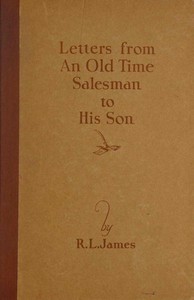
Letters From an Old Time Salesman to His Son — Themes and Context
15
2
Project Gutenberg
2021
Selling
Readers of public-domain and historical texts
Project Gutenberg digital edition
en
Edition facts
Words: 31,211
Reading time: 136 min
Text sections: 27
Source:
Project Gutenberg record #64277
A father writes real, unpolished letters to his son Hal, a traveling salesman, offering blunt advice on loyalty, time management, and reading motives. The author, a sales manager himself, uses anecdotal lessons and direct address, avoiding generic platitudes. The letters reveal a specific professional world of 1920s salesmanship.
Editorial Edition Score
4.8/5
★★★★★
★★★★★
Calculated from edition completeness, EPUB availability, text structure and catalogue metadata. Not a user rating.
Edition quality
The letters in this collection are not fictional exercises but actual correspondence from a father to his son, both in the sales trade. The father, identified only as “Dad,” writes to “Red” or “Hal” with a directness that avoids the polished tone of a how-to manual. The opening letter establishes the boy as “green and gullible but full of pep,” setting a pattern of affectionate but pointed critique. The author, Roy Lester James, was himself a general sales manager, and the letters reflect a working knowledge of the road—small-town retail, branch management, and the tension between home office directives and field realities.
A Father’s Voice and a Son’s Career Arc
The letters trace Hal’s progression from rookie to district manager, but the narrative is driven less by plot than by Dad’s consistent tone. He calls his son “Boy” or “Red,” and his advice is laced with colloquialisms like “get out your old yellow copy” and “I guess not—eh, what?” The father never lectures abstractly; he responds to specific situations Hal reports. For instance, when Hal questions a home-office request, Dad tells a story about a manager who refused to send bean samples, ending with “you can imagine the Golden Text that the Boss thought of.” The voice is intimate, assuming shared experience, and the career arc is inferred from letter headings rather than stated outright.
The Lesson of the Bean Samples: Reading Motives
One of the most detailed anecdotes involves a manager who, asked to buy samples of a competitor’s beans, wrote back complaining that the home office could get the same product locally. The father uses this to illustrate a recurring theme: “don’t look for the holes in every proposition.” He advises Hal to “give the other fellow credit for having a reason.” This emphasis on interpreting intent—rather than simply following orders—runs through several letters. Dad’s method is to present a concrete failure and then extract a principle, often with a wry punchline. The language is plain: “Now, Red, this means only one thing.”
Time Management and the Temptation to Skip Prospects
In a letter titled “Dad Warns of the Evil Spirit That Whispers ‘You Haven’t Time,’” the father critiques Hal’s salesmen for calling only on the best prospects. He observes that they “admitted that they picked out the best and biggest prospects where they were pretty sure to land an order and then rushed on.” Dad does not blame the men but suggests the routing system is at fault. The letter is notable for its diagnostic approach: rather than scold, he identifies a structural cause. The phrase “evil spirit” personifies the excuse, and the advice is practical—rethink the territory, not the effort.
The Unpolished Texture of Real Correspondence
These letters were not written for publication, and that origin shows in their texture. Sentences sometimes run on, and the father’s thoughts circle back: “Mother and I arrived home without mishap and she said I should write you at once.” The advice is embedded in family news and personal asides. There is no systematic structure; each letter responds to a specific event in Hal’s career. The result is a document that feels more like eavesdropping than instruction. Readers interested in the rhythms of early twentieth-century business correspondence, or in the informal transmission of professional knowledge, will find the letters’ authenticity more revealing than any manual.
The letters resist easy summary because they are not a treatise but a series of situated responses. Readers should attend to the specific anecdotes—the bean samples, the skipped prospects, the farm visit—as evidence of how sales wisdom was passed down in a pre-corporate-training era. The father’s voice, with its blend of affection and bluntness, is the real subject.
Reader reflection
Record your reading impressions
A brief reflection can help important ideas stay with you longer.
Your progress
0
/
10
2
How did the book work for you overall?
3
Would you recommend this book to another reader?
4
Did the language feel accessible?
5
Would you like to discuss this book with someone?
6
Which element worked best for you?
7
Did anything about the book feel genuinely new?
8
What was its emotional impact?
9
What changed or sharpened your thinking?
10