1

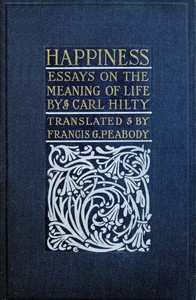
Happiness: Essays on the meaning of life — Reading Notes
14
1
Project Gutenberg
2022
Conduct of life; Happiness
Readers of public-domain and historical texts
Project Gutenberg digital edition
en
Edition facts
Words: 34,429
Reading time: 150 min
Text sections: 16
Source:
Project Gutenberg record #68817
Karl Hilty's 1903 essays on happiness, translated by Francis Peabody, argue that modern life's feverish pace undermines genuine contentment. The author, a Swiss law professor, dissects work habits, time management, and the pursuit of meaning with a blunt, aphoristic style that prizes practical wisdom over academic abstraction.
Editorial Edition Score
4.7/5
★★★★★
★★★★★
Calculated from edition completeness, EPUB availability, text structure and catalogue metadata. Not a user rating.
Edition quality
Karl Hilty, a Swiss professor of constitutional law, opens his 1903 collection with a paradox: the very people who most eagerly pursue happiness often find it eluding them. Writing in a period he diagnoses as marked by a 'fever of commercialism' and a 'pace of living' that smothers the art of life, Hilty does not offer consolation so much as a series of sharp, unsentimental diagnoses. His translator, Harvard theologian Francis Greenwood Peabody, notes in the preface that Hilty's reflections have already brought 'reassurance and composure' to German-speaking readers, and he judges them equally applicable to English and American audiences. The essays that follow—on work, fighting life's battles, good habits, having time, and the meaning of life—are less a systematic philosophy than a collection of bracing, aphoristic provocations.
A Lawyer's Approach to the Art of Living
Hilty writes as a jurist, not a mystic. His first essay, 'The Art of Work,' immediately establishes a tone of brisk, no-nonsense counsel. He warns against what he calls 'spurious thoroughness'—the kind of scholarship that 'absorbs itself in all manner of details and subordinate questions which are not worth investigating.' This is not the voice of a cloistered academic but of a man who believes truth is 'so simple that it often does not look learned enough.' He is impatient with the professional deformation that makes learning 'wholly detached from practical usefulness,' and he mocks the unspoken rule that 'one must first earn his reputation by some piece of work which is of no use to himself or to any one else.' The essay's structure mirrors its argument: it moves quickly, piling up concrete examples rather than abstract principles. Hilty's ideal is the thinker who, like Lassalle, can write a major work on Herakleitos without losing interest in 'the affairs of modern life.' The enemy is not ignorance but a kind of learned paralysis.
The Enemy Within: Superfluity and the Modern Reader
In 'The Art of Having Time,' Hilty turns his critical eye on the habits of the modern reader. He blames newspapers for accustoming people to 'superficial surveys of truth,' noting that the editorial writer who promises to return to a subject 'never returns.' The result is a culture of skimming: readers 'have studied a subject ten times' yet on the eleventh occasion 'must study it again.' Hilty's remedy is characteristically concrete: orderliness, the reading of original sources, and the banishment of 'all superfluities' from one's life. He does not define superfluity abstractly but invites the reader to supplement his own list with 'his own impr'—the sentence breaks off, leaving the reader to supply the conclusion. This rhetorical gesture is typical of Hilty's method: he offers principles, not prescriptions, and trusts the reader to apply them. The essay's pace mirrors its subject: it is itself a model of efficiency, wasting no words on ornament.
Happiness as a Byproduct, Not a Goal
The title essay, 'Happiness,' and the concluding 'The Meaning of Life' form the collection's philosophical core, though the excerpts available are fragmentary. From the preface and the earlier essays, however, a clear pattern emerges: Hilty treats happiness not as something to be pursued directly but as a byproduct of right living. The preface describes a state of mind 'hesitating, restless, and dissatisfied, in the world but not content to be of the world'—a condition Hilty believes can be remedied not by more striving but by a reorientation of attention. He is skeptical of the modern cult of efficiency, yet he is no quietist; his advice is always practical, even tactical. The essays are structured as a series of discrete lectures, each building on the last, but the argument is cumulative rather than linear. Hilty's voice remains consistent: authoritative, slightly sardonic, and deeply convinced that the wisdom of the past—particularly the classical and Christian traditions—has been forgotten in the rush of modern life.
Readers approaching these essays should expect not a systematic treatise but a series of provocations, each designed to unsettle comfortable assumptions about work, time, and happiness. Hilty's Swiss legal training gives his prose a forensic clarity; he is less interested in comforting than in diagnosing. The essays reward slow reading—not because they are difficult, but because their aphoristic density invites reflection. Peabody's translation, while occasionally archaic, preserves the bluntness of the original. For those willing to engage with Hilty's assumptions—particularly his Christian framework and his skepticism toward modern progress—these essays offer a bracing alternative to contemporary self-help literature.
Reader reflection
Take a moment to reflect on this book
Create a short personal record of your experience with this book.
Your progress
0
/
10
2
How much did you enjoy the reading experience?
3
How likely are you to recommend this book?
4
Did the language feel accessible?
5
Did the book deliver what you hoped for?
6
Did the book give you something worth debating?
7
How distinctive were its ideas or approach?
8
What was its emotional impact?
9
What changed or sharpened your thinking?
10