1

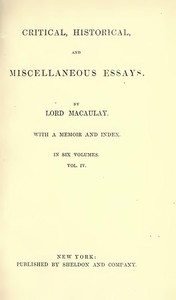
Critical, Historical, and Miscellaneous Essays; Vol. 4 With a Memoir and Index — Inside the Classic
12
2
Project Gutenberg
2017
Great Britain -- History; English literature -- History and criticism
Readers of public-domain and historical texts
Project Gutenberg digital edition
en
Edition facts
Words: 157,529
Reading time: 685 min
Text sections: 29
Source:
Project Gutenberg record #55904
Macaulay's essays on Sir William Temple, Gladstone, Lord Clive, von Ranke, Leigh Hunt, and Lord Holland, with a memoir and index. The opening essay critiques Courtenay's biography of Temple, praising its diligence but noting its lack of readability. The Clive essay details his reforms in Bengal, including his refusal to accept bribes and his confrontation with corrupt officials.
Editorial Edition Score
4.9/5
★★★★★
★★★★★
Calculated from edition completeness, EPUB availability, text structure and catalogue metadata. Not a user rating.
Edition quality
The volume opens with a review of Courtenay's Memoirs of Sir William Temple, where Macaulay immediately establishes a critical tone: he grants the work “diligence, care, good sense, and impartiality” but judges it “not quite sufficient to make it readable.” This distinction between raw material and finished product sets a pattern for the essays that follow—Macaulay consistently evaluates both the subject and the biographer or historian, weighing evidence against narrative skill.
The excerpt from the Lord Clive essay shows a different register: direct, dramatic, and morally charged. Macaulay recounts Clive's return to Bengal in 1765, where he finds “the whole machine of government even more fearfully disorganized than he had anticipated.” Clive's private letter—declaring himself “superior to all corruption”—is quoted, and the Council scene is rendered with tense dialogue. The reader encounters Macaulay as both critic and storyteller, shifting between analytical distance and vivid reconstruction.
The Critic as Judge of Biography
In the Temple essay, Macaulay performs a dual role: he reviews Courtenay's book while also assessing Temple's character and career. He notes that Courtenay “has not sufficiently studied the arts of selection and compression,” implying that a biographer must shape facts into a readable narrative. Macaulay himself demonstrates that art in the Clive essay, where he selects a single episode—the 1765 reform—to illustrate Clive's resolve. The contrast between the two essays reveals Macaulay's method: he expects biography to be both accurate and engaging, and he practices what he preaches.
Macaulay's own prose is anything but raw material. He uses balanced sentences, antitheses, and pointed judgments. For example, he describes Courtenay's Toryism as “such as it is, he has held fast through all changes of fortune and fashion.” The phrasing is precise and slightly ironic, a hallmark of Macaulay's critical voice. Readers should watch how he moves from general praise to specific reservation, a technique that gives his reviews their characteristic bite.
Clive and the Language of Moral Reform
The Clive excerpt is built around a moral crisis: the English name has “sunk,” and Clive must “destroy these great and growing evils, or perish in the attempt.” Macaulay heightens the drama by quoting Clive's private letter, which uses the language of religious accountability—“by that great Being who is the searcher of all hearts.” This is not neutral history; it is a portrait of a man who sees himself as a reformer. Macaulay reinforces this by describing Clive's confrontation with Johnstone: “Clive interrupted him, and haughtily demanded whether he meant to question the power of the new government.” The scene is staged with a clear hero and villain.
Yet Macaulay does not simply praise Clive. He notes that Clive “had it in his power to triple his already splendid fortune” but chose reform instead. The implication is that Clive's virtue is tested by temptation. This moral framework—corruption versus integrity—runs through the essay and gives it a coherent theme. Readers should note how Macaulay uses direct speech and concrete detail to make abstract principles tangible.
Structure and Pacing in the Essays
Macaulay's essays are not uniform in structure. The Temple review begins with a lengthy assessment of Courtenay's character and career before turning to Temple himself. The Clive essay, by contrast, plunges into action: “Such were the circumstances under which Lord Clive sailed for the third and last time to India.” The pacing varies accordingly. In the Temple essay, Macaulay builds his case slowly, layering qualifications. In the Clive essay, he moves quickly from crisis to resolution, with only brief pauses for context.
This variety suggests that Macaulay adapted his method to his subject. For a biography he found dull, he emphasized the need for selection; for a dramatic life, he supplied drama. Readers approaching the volume for the first time may find it useful to sample both types of essay. The opening pages of the Temple essay show Macaulay the critic; the Clive excerpt shows Macaulay the narrator. Together, they demonstrate the range of his historical writing.
Evidence and Inference in the Excerpts
The excerpts provided are incomplete, but they offer clear evidence of Macaulay's methods. In the Temple essay, he quotes Courtenay's preface about “the superiority of literature to politics,” then uses that quotation to frame his own judgment. In the Clive essay, he quotes Clive's letter and the Council dialogue. These quotations are not decorative; they are the evidence from which Macaulay draws his conclusions. He does not invent motives or events; he interprets what his sources say.
However, the excerpts do not reveal the full arc of either essay. The Temple essay may include a detailed analysis of Temple's writings; the Clive essay likely covers Clive's earlier career and later controversies. Readers should be cautious about assuming the essays are purely hagiographic or purely critical. Macaulay's tone in the Clive excerpt is admiring, but the Temple excerpt shows he can be sharply critical. The full text would likely contain more nuance.
These excerpts suggest that Macaulay's essays reward attention to his rhetorical strategies: how he introduces a subject, how he uses quotations, and how he balances praise with criticism. Readers may find it useful to read the opening paragraphs of each essay carefully, as they often contain a thesis or a judgment that the rest of the essay develops. The volume also includes essays on Gladstone, von Ranke, Leigh Hunt, and Lord Holland, each likely offering a different perspective on Macaulay's critical range. Approach the collection as a series of performances, each with its own tone and structure.
Reader reflection
Take a moment to reflect on this book
Create a short personal record of your experience with this book.
Your progress
0
/
10
2
Did this book hold your interest?
3
Would you recommend this book to another reader?
4
What was the reading difficulty like?
5
Did the book give you something worth debating?
6
Is this a title worth rereading?
7
Which aspect of the book did you value most?
8
Could you follow the author’s main argument?
9
In one sentence, what did you learn?
10