1

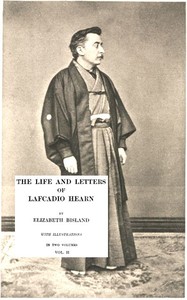
The Life and Letters of Lafcadio Hearn, Volume 2 — Edition Insights
(0 User reviews)
2000
Project Gutenberg
2013
Not confirmed
Authors, American -- 19th century -- Biography; Hearn, Lafcadio, 1850-1904
Readers of public-domain and historical texts
Project Gutenberg digital edition
en
Edition facts
Words
150,988
Reading time
657 min
Text sections
22
The Life and Letters of Lafcadio Hearn, Volume 2 — Edition Insights can be approached with a clearer sense of reading commitment from its source measurements: 150,988 words, 10 hr 57 min estimated reading time, and 22 detected text sections.
The text analysis averages about 16.5 words per sentence, while the detected sections provide another way to judge how the source is divided.
Project Gutenberg metadata also associates the work with “Authors, American -- 19th century -- Biography,” connecting these edition facts with the source record’s subject description.
Source:
Project Gutenberg record #42313
This volume collects Lafcadio Hearn's letters from 1890-1904, revealing his deepening attachment to Japan, his ambivalence toward foreign reviewers, and his preference for places like Matsue and Ōsaka over Tōkyō. Editor Elizabeth Bisland frames the correspondence with biographical context, highlighting tensions between Hearn's Western origins and his adopted Japanese identity.
Editorial Edition Score
4.9/5
★★★★★
★★★★★
Calculated from edition completeness, EPUB availability, text structure and catalogue metadata. Not a user rating.
How this score is calculated
- Description quality20 pts
- Title & short description10 pts
- Source metadata20 pts
- Text length15 pts
- Chapters / structure15 pts
- EPUB file integrity20 pts
Total of 100 points, scaled to a 2.5-5.0 range. Editions with an empty description or a missing EPUB file are not scored.
Edition quality
Read the Text
Hearn was a teacher, is hidden from view by the Prefecture Office Building.
2. The Normal School. Mr. Hearn also taught here.
3. Here on the beach of Lake Shinyi Mr. Hearn lived for some time.
THE SHINTŌ TEMPLE OF KIZUKI DESCRIBED IN "GLIMPSES OF UNFAMILIAR JAPAN" 104
Lafcadio Hearn was the first foreigner who was allowed to enter the inner part of this temple.
A GROUP OF GRADUATES OF THE MIDDLE SCHOOL 162
3. The old teacher of Chinese Classics.
LAFCADIO HEARN'S FAVOURITE DWELLING-HOUSE 192
This house, an old Samurai's residence, is situated in front of a castle. The river before the house is an outer moat of the castle.
MR. HEARN'S GARDEN IN TŌKYŌ 282
WRITING-ROOM IN MR. HEARN'S TŌKYŌ HOUSE 344
His three sons on the verandah. In this house he died.
FACSIMILE OF MR. HEARN'S LATER HANDWRITING 410
KAZUO AND IWAO, LAFCADIO HEARN'S OLDER CHILDREN, EXERCISING AT JŪ-JUTSU 476
LAFCADIO HEARN'S GRAVE 516
LETTERS OF LAFCADIO HEARN
DEAR ELIZABETH,-- ... I feel indescribably towards Japan. Of course Nature here is not the Nature of the tropics, which is so splendid and savage and omnipotently beautiful that I feel at this very moment of writing the same pain in my heart I felt when leaving Martinique. This is a domesticated Nature, which loves man, and makes itself beautiful for him in a quiet grey-and-blue way like the Japanese women, and the trees seem to know what people say about them,--seem to have little human souls. What I love in Japan is the Japanese,--the poor simple humanity of the country. It is divine. There is nothing in this world approaching the naïve natural charm of them. No book ever written has reflected it. And I love their gods, their customs, their dress, their bird-like quavering songs, their houses, their superstitions, their faults. And I believe that their art is as far in advance of our art as old Greek art was superior to that of the earliest European art-gropings--I think there is more art in a print by Hokusai or those who came after him than in a $10,000 painting--no, a $100,000 painting. _We_ are the barbarians! I do not merely _think_ these things: I am as sure of them as of death. I only wish I could be reincarnated in some little Japanese baby, so that I could see and feel the world as beautifully as a Japanese brain does.
And, of course, I am studying Buddhism with heart and soul. A young student from one of the temples is my companion. If I stay in Japan, we shall live together.--Will write again if all goes well.
My best love to you always.
DEAR MISS BISLAND,--Do you think well enough of me to try to get me employment at a regular salary, somewhere in the United States. I have permanently broken off with the Harpers: I am starved out. My average earnings for the last three years have been scarcely $500 a year. Here in Japan prices are higher than in New York,--unless one can become a Japanese employee. I was promised a situation; but it is now delayed until September.
I shall get along somehow. But I am so very tired of being hard-pushed, and ignored, and starved,--and obliged to undergo moral humiliations which are much worse than hunger or cold,--that I have ceased to be ashamed to ask you to say a good word for me where you can, to some newspaper, or some publishing firm, able to give me steady employ, later on.
MY DEAR SISTER ELIZABETH,-- ... Now, as for myself,--I am going to become country school-master in Japan,--probably for several long years. The language is unspeakably difficult to learn;--I believe it can only be learned by ear. Teaching will help me to learn it; and before learning it, to write anything enduring upon Japan would be absurdly impossible. Literary work will not support one here, where living costs quite as much as in New York. What I wish to do, I want to do for its own sake; and so intend to settle, if possible, in this country, among a people who seem to me the most lovable in the world.
I have been living in temples and old Buddhist cemeteries, making pilgrimages and sounding enormous bells and worshipping astounding Buddhas. Still, I do not as yet know anything whatever about Japan. I have nothing else worth telling you to write just now, and no address to give,--as I do not know where I am going or what I shall be doing next month.
Later on, I shall write again.
Best wishes and affection from L. H.
TO BASIL HALL CHAMBERLAIN
Lafcadio Hearn's letters in this volume repeatedly return to a contrast between two Japans: one that feels "holy" and intimate, and another that has been modernized and monetized. Writing to Elizabeth Bisland, he describes Ise as a disappointment because "there is so much money,—such enormous hotels,—such modernization: the place did not feel holy to me, as Kizuki did." This distinction between a domesticated, beloved nature and a commercialized landscape runs through his correspondence, as does his unease with foreign residents in the open ports. Hearn's voice is consistently self-aware, often deflecting praise from English journals while valuing the approval of a single Japanese friend over that of a foreign reviewer.
Domesticated Nature and the Appeal of Matsue
Hearn's letters reveal a writer who felt most at home in places where nature seemed to accommodate human life. He contrasts the "splendid and savage" tropics of Martinique with Japan's "domesticated Nature, which loves man, and makes itself beautiful for him in a quiet grey-and-blue way like the Japanese women." This personification of landscape is not merely decorative; it reflects his preference for Matsue, a city he hopes to make a permanent home. He writes of wanting to "buy one for my own home" a yashiki there, and notes that even Setsu now prefers the interior. The climate, the summer, the possibility of swimming at Kizuki and Mionoseki—these concrete details ground his attachment. He explicitly states he would rather teach in Matsue than in Tōkyō, were it not for the cold winters.
Ambivalence Toward Foreign Audiences and Institutions
Throughout the excerpts, Hearn displays a marked skepticism toward Western recognition. He acknowledges that English journals have been kind, but insists he is "not foolish enough to take the praise for praise of fact,—feeling my own ignorance more and more every day." The approval of a Japanese friend matters more than "the verdict of a foreign reviewer, who, necessarily, knows nothing to speak of about Japan." This tension extends to his professional situation: his engagement with the university is uncertain because his becoming a Japanese citizen "had raised a difficulty." Hearn's response is characteristically detached—"I was not worried about the matter, and had never allowed myself to consider it very seriously"—yet he also hints at a pragmatic concern about salary. His letters to Ellwood Hendri (not excerpted here) likely continue this thread of institutional negotiation.
The Weight of Place: Ōsaka, Kizuki, and the Holy
Hearn's geography is emotional. Ōsaka delights him "beyond words"—he calls it, after Kyōto, "the most interesting city on this side of Japan." The temple Tennōji strikes him as "queer, dear." In contrast, Ise disappoints: the miko (shrine maidens) "won't show their faces for less than five yen," and the cold hurts his lungs. Kizuki, by comparison, retains its holiness. These judgments are not abstract; they are tied to sensory experience—cold, money, the behavior of people. Even a visit to Sakai to buy a sword becomes an occasion for dark humor: he sees the grave of eleven samurai who committed seppuku for killing foreigners and wishes they "could come back again to kill a few more who are writing extraordinary lies about Japan." The letter blends reverence, irritation, and a sharp awareness of how Japan is represented abroad.
Readers approaching this volume will find a portrait of Hearn in transition: a writer who has chosen Japan but remains in dialogue with Western audiences, who values intimacy over scale, and who measures places by their capacity to feel holy rather than modern. The letters are best read with attention to their recurring motifs—domesticated nature, the foreign reviewer's ignorance, the pull of Matsue—and to the way Hearn's voice shifts between warmth, irony, and self-deprecation. Bisland's editorial framing provides context without overwhelming the correspondence.
Sometimes I think about how Hearn wrote to friends from Matsue, aching to explain Japan to a West that kept missing him. A quieter version of that same ache shows up in the essays gathered in The Connecticut Wits, and Other Essays — Text and Context—that pull between belonging and distance. It lingered with me, like an old song half-remembered.
There are no reviews for this eBook.
There are no comments for this eBook.
Reader reflection
How will you remember this book?
Save your reaction, strongest insight, and memorable passage.
Your progress
0
/
10
2
Did this book hold your interest?
3
Is this a title you would suggest to others?
4
How much effort did this book require?
5
Did any part of the book stay with you emotionally?
6
How original did the book feel?
7
How strong was your personal connection to the text?
8
Which aspect of the book did you value most?
9
Which lesson or insight stayed with you?
10