1

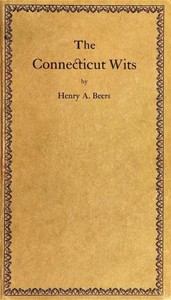
The Connecticut Wits, and Other Essays — Text and Context
(0 User reviews)
114
Project Gutenberg
2016
Not confirmed
English literature -- History and criticism; Connecticut -- Intellectual life
Readers of public-domain and historical texts
Project Gutenberg digital edition
en
Edition facts
Words
56,262
Reading time
245 min
Text sections
7
Before opening The Connecticut Wits, and Other Essays — Text and Context, the edition data offers a quick orientation: 56,262 words, 4 hr 5 min estimated reading time, and 7 detected text sections.
The text analysis averages about 22.4 words per sentence, while the detected sections provide another way to judge how the source is divided.
Project Gutenberg metadata also associates the work with “English literature -- History and criticism,” connecting these edition facts with the source record’s subject description.
Source:
Project Gutenberg record #50915
Essays on early American literary circles, English drama, and letter-writing by a Yale professor, examining the Connecticut Wits, Emerson's journals, Thackeray, Sheridan, and Shakespeare's contemporaries with a focus on historical context and critical analysis.
Editorial Edition Score
4.7/5
★★★★★
★★★★★
Calculated from edition completeness, EPUB availability, text structure and catalogue metadata. Not a user rating.
How this score is calculated
- Description quality20 pts
- Title & short description10 pts
- Source metadata20 pts
- Text length15 pts
- Chapters / structure15 pts
- EPUB file integrity20 pts
Total of 100 points, scaled to a 2.5-5.0 range. Editions with an empty description or a missing EPUB file are not scored.
Edition quality
Public-domain source text
Read the source text
The source text is kept in the dedicated reader, separate from this catalogue record and its commentary.
Henry A. Beers, a Yale professor of English literature emeritus, collects essays that originally appeared in the Yale Review, ranging from the Connecticut Wits—a group of post-Revolutionary Yale graduates who aimed to liberalize American letters—to assessments of English drama and letter-writing. The opening essay situates the Wits within Connecticut's political prominence, naming figures like Roger Sherman and Oliver Ellsworth before turning to the literary ambitions of young tutors and masters. Beers writes with a historian's eye for local detail, noting that the Wits formed a conscious school with definite aims, not merely a casual coterie.
The Connecticut Wits as a Literary School
Beers insists that the Connecticut Wits were a deliberate literary movement, not an accidental gathering. He describes them as a band of Yale graduates who shared similar tastes and principles, united in sympathy and conscious aims. Their first goal was to liberalize and modernize what Beers calls the rigid literary standards of their day. The essay draws on the political backdrop of Connecticut's influence in national councils, but Beers is careful to distinguish the Wits' literary project from the state's political achievements. He notes their efforts to cultivate letters in a commonwealth that had produced soldiers and statesmen but lacked a native literary tradition. The analysis is grounded in the specific context of post-Revolutionary New England, avoiding broad claims about American literature as a whole.
Pinero, Shaw, and the Modern Stage
In a later essay, Beers compares Arthur Wing Pinero and George Bernard Shaw to eighteenth-century playwrights, calling them the Goldsmith and Sheridan of the modern stage. He observes that Pinero's humor is more akin to Goldsmith's—good-natured, with laughter near tears—while Shaw is an Irishman and journalistic free-lance whose plays are accompanied by truculent prefaces. Beers notes that Shaw's stage directions are explicit and profuse, including details of costume, gesture, and character analysis in the manner of Ben Jonson, and that Shaw defends this extra-dramatic method by wishing for Shakespeare's rehearsal notes. Beers also remarks that Shaw's appeal is more intellectual than Pinero's, but his plays are less popular and less satisfying, with critics refusing to take him seriously.
The Problem Play and Ethical Force
Beers discusses a problem play—likely Pinero's—that demonstrates the truth that no one can escape their past. He argues that the play's ethical value and tragical force lie in showing how the past avenges itself through unforeseen consequences and a subtler nemesis: the deterioration of character that makes life under better conditions impossible. The catastrophe comes with the inevitability of Greek fate-tragedies, and in this instance, suicide is the only solution, as in Ibsen's Hedda Gabler or Hauptmann's Vor Sonnenaufgang. Beers defends the play against charges of melodrama, insisting that the dramatist makes the ending feel necessary. He also notes that Pinero has achieved the distinction of a birthday book and a full-length study, indicating his established reputation.
Throughout these essays, Beers maintains a tone of measured critical judgment, often drawing parallels between periods and authors without forcing comparisons. Readers interested in the development of American literary criticism or the reception of English drama in the early twentieth century will find Beers a reliable guide, one who values historical context and textual evidence over impressionistic praise. His focus on the Connecticut Wits as a conscious school offers a corrective to later generalizations about early American literature.
Years among the shelves, I’ve seen Yale’s dry wit and a speaker’s fire rarely keep company. Yet The Connecticut Wits whispers of voices shaped by stage and letter; its sibling, Standard Selections A Collection and Adaptation of Superior Productions from Best Authors for Use in Class Room and on the Platform — Reading Notes, holds those same cadences for the living breath. Both are quiet doorways to how we once performed our thoughts.
There are no reviews for this eBook.
There are no comments for this eBook.
Reader reflection
Before you leave, reflect on the book
Use these questions to collect your thoughts before moving on.
Your progress
0
/
10
2
What was your overall reaction to the book?
3
Would you pass this book on to a friend?
4
How easy was the book to follow?
5
Did this book create an emotional response?
6
How did the reading compare with what you expected?
7
Is this a title worth rereading?
8
Would you like to discuss this book with someone?
9
What is the main idea you are taking away?
10