
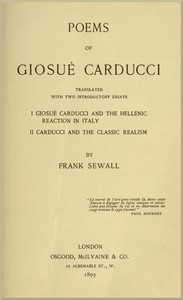
Poems of Giosuè Carducci, Translated with two introductory essays: I. Giosuè Carducci and the Hellenic reaction in Italy. II. Carducci and the classic realism — Key Ideas to Explore

(2 User reviews)   454
Carducci, Giosuè, 1835-1907, Sewall, Frank, 1837-1915 [Contributor] Project Gutenberg 2018 Not confirmed
Italian poetry -- Translations into English; Carducci, Giosuè, 1835-1907 -- Criticism and interpretation Readers of public-domain and historical texts
Project Gutenberg digital edition en

Edition facts

Words 30,581
Reading time 133 min
Text sections 48

This digital edition of Poems of Giosuè Carducci, Translated with two introductory essays: I. Giosuè Carducci and the Hellenic reaction in Italy. II. Carducci and the classic realism — Key Ideas to Explore is described by source-level measurements including 30,581 words, 2 hr 13 min estimated reading time, and 48 detected text sections.

The text analysis averages about 28.4 words per sentence, while the detected sections provide another way to judge how the source is divided.

Project Gutenberg metadata also associates the work with “Italian poetry -- Translations into English,” connecting these edition facts with the source record’s subject description.

Frank Sewall's 1893 translation of Giosuè Carducci's poems, prefaced by two essays arguing for a Hellenic and classic realist revival in Italian poetry, with translations that emphasize precision and Roman vigor over romantic sentiment.
Share
Editorial Edition Score 4.7/5

Calculated from edition completeness, EPUB availability, text structure and catalogue metadata. Not a user rating.

How this score is calculated
  • Description quality20 pts
  • Title & short description10 pts
  • Source metadata20 pts
  • Text length15 pts
  • Chapters / structure15 pts
  • EPUB file integrity20 pts

Total of 100 points, scaled to a 2.5-5.0 range. Editions with an empty description or a missing EPUB file are not scored.

Edition quality

Read the Text

he spiritual _laude_ I detected the Satanic strophe. Meanwhile the image of Dante looked down reproachfully upon me; but I might have answered: ‘Father and master, why didst thou bring learning from the cloister into the piazza, from the Latin to the vulgar tongue? Why wast thou willing that the hot breath of thine anger should sweep the heights of papal and imperial power? Thou first, O great public accuser of the Middle Ages, gavest the signal for the rebound of thought: that the alarm was sounded from the bells of a Gothic campanile mattered but little!’ So my mind matured in understanding and sentiment to the _Levia Gravia_, and thence more rapidly, in questions of social interest, to the _Decennali_. There are those who complain that I am not what I was twenty-four years ago:—good people, for whom to live and develop is only to feed, like the calf _qui largis invenescit herbis_. In the _Juvenilia_ I was the armour-bearer of the classics. In the _Levia Gravia_ I held my armed watch. In the _Decennali_, after a few uncertain preliminary strokes of the lance, I venture abroad prepared for every risk and danger. I have read that the poet must give pleasure either to all or to the few; to cater to many is a bad sign. Poetry to-day is useless from not having learned that it has nothing to do with the exigencies of the moment. The lyre of the soul should respond to the echoes of the past, the breathings of the future, the solemn rumours of ages and generations gone by. If, on the contrary, it allows itself to be swayed by the breeze of society's fans or the waving of soldiers' cockades and professors' togas, then woe to the poet! Let the poet express himself and his artistic and moral convictions with the utmost possible candour, sincerity, and courage; as for the rest, it is not his concern. And so it happens that I dare to put forth a book of verses in these days, when one group of our literati are declaring that Italy has never had a language, and another are saying that for some time past we have had no literature; that the fathers do not count for much, and that we are really only in the beginnings. There let them remain; or, as the wind changes, shift from one foreign servitude to another!”

In my selection of poems for translation, regard has been had not so much to the chronological order of their production as to their fitness for illustrating the three important characteristics of Carducci as a national poet which were enumerated above.

The first of these was his strong predilection for the classics, as evinced not only by his veneration for the Greek and Latin poets, but by his frequent attempts at the restoration of the ancient metres in his own verse. Of his fervent admiration for Homer and Virgil let the two sonnets III and IV testify, both taken from the fourth book of the _Levia Gravia_. Already in the _Juvenilia_, during his “classical knighthood,” he had produced a poem of some length on Homer, and in the volume which contains the one I have given there are no less than three sonnets addressed to the venerated master, entitled in succession, “Homer,” “Homer Again,” and “Still Homer.” I have chosen the second in order. [III]

In the tribute to Virgil [IV] the beauty of form is only equalled by the tenderness of feeling. It shows to what extent the classic sentiment truly lived again in the writer's soul, and was not a thing of mere intellectual contemplation. In reading it we are bathed in the very air of Campania; we catch a distant glimpse of the sea glistening under the summer moon, and hear the wind sighing through the dark cypresses.

Here it will be proper to notice the efforts made by Carducci not only to restore as to their native soil the long-disused metres of the classic poets, but to break loose from all formal restrictions in giving utterance to the poetic impulse. This intense longing for greater freedom of verse he expresses in the following lines from the _Odi Barbare_:

I hate the accustomed verse. Lazily it falls in with the taste of the crowd, And pulseless in its feeble embraces Lies down and sleeps.

For me that vigilant strophe Which leaps with the plaudits and rhythmic stamp of the chorus, Like a bird caught in its flight, which Turns and gives battle.

In the preface of the same volume (1877) he pleads in behalf of his new metres that “it may be pardoned in him that he has endeavoured to adapt to new sentiments new metres instead of conforming to the old ones, and that he has thus done for Italian letters what Klopstock did for the Germans, and what Catullus and Horace did in bringing into Latin use the forms of the Eolian lyric.”

In the _Nuove Rime_ (1887) are three Hellenic Odes, under the titles “Primavere Elleniche,” written in three of the ancient metres, the beauty of which would be lost by translation into any language less melodious and sympathetic than the Italian. We give a few lines from each:

Lina, brumaio turbido inclina, Nell'aër gelido monta la sera; E a me nell'anima fiorisce, O Lina, La primavera.

Muorono gli altri dii: di Grecia i numi Non stanno occaso: ei dormon ne' materni Tronchi e ne' fiori, sopra i monti, i fiumi, I mari eterni.

A Cristo in faccia irrigidi nei marmi Il puro fior di lor bellezze ignude: Nei carme, O Lina, spira sol nei carme Lor gioventude.

Lungi, soavi, profondi; Eolia Cetra non rese più dolci gemiti Mai nei sì molli spirti Di Lesbo un dì tra i mirti.

The second of these examples demands translation as exhibiting perhaps more forcibly than any others we could select the boldness with which Carducci asserts the survival of the Hellenic spirit in the love of nature as well as in art and literature, despite the contrary influences of ascetic Christianity:

The other gods may die, but those of Greece No setting know; they sleep in ancient woods, In flowers, upon the mountains, and the streams, And eternal seas.

In face of Christ,[3] in marble hard and firm, The pure flower of their naked beauty glows; In songs, O Lina, and alone in songs, Breathes their endless youth.

The reader is also here referred to the “Invocation.” [V]

From this glance at the classic form which is so distinct a feature in Carducci's poems, we proceed to examine the feeling and conceptions which constitute their substance, and which will be found to be no less Hellenic than the metres which clothe them. Nothing could stand in stronger contrast with the melancholy of the romantic school of poets, or with the subjective thoughtfulness and austere introspection of the Christian, than the unfettered outbursts of song in praise of the joy of living, of the delights of love and bodily pleasure, and of the sensuous worship of beautiful form, which we find in the poems “Sun and Love” [VI] and the hymn “To Aurora.” [VII]

The latter has in it the freshness and splendour of morning mists rising among the mountains and catching the rosy kisses of the sun. Equally beautiful but full of the tranquillity of evening is the _Ruit Hora_ from the _Odi Barbare_ of 1877. [VIII]

No one will fail to be struck with the beauty of the figure in the last stanza of this poem, nor with the picturesque force of the “green and silent solitudes” of the first, a near approach to the celebrated and boldly original conception of a _silenzio verde_, a “green silence,” which forms one of the many rare and beautiful gems of the sonnet “To the Ox.” [IX]

As an example of a purely Homeresque power of description and colouring, and at the same time of an intense sympathy with nature and exquisite responsiveness to every thrill of its life, this sonnet stands at the summit of all that Carducci has written, if indeed it has its rival anywhere in the poetry of our century. The desire to produce in English a suggestion at least of the broad and restful tone given by the metre and rhythm of the original has induced me to attempt a metrical and rhymed translation, even at the inevitable cost of a strict fidelity to the author's every word, and in such a poem to lose a word is to lose much. Nothing but the original can present the sweet, ever-fresh, and sense-reviving picture painted in this truly marvellous sonnet. The unusual and almost grotesque epithet of the opening phrase will be pardoned in view of the singular harmony and fitness of the original.

We know not where else to look for such vivid examples as Carducci affords us of a purely objective and sensuous sympathy with nature, as distinguished from the romantic, reflective mood which nature awakens in the more sentimental school of poets. We feel that this strong and brilliant objectivity is something purely Greek and pagan, as contrasted with the analysis of emotions and thoughts which occupies so large a place in Christian writing. No one is better aware of the existence of this contrast than Carducci himself. For the dear love of nature—that boon of youth before the shadows of anxious care began to darken the mind, or the queryings of philosophy, the conflicts of doubt, and the stings of conscience to torment it—for this happy revelling of mere animal life in the world where the sun shines, the soul of the poet never ceases to yearn and cry out. The consciousness of the opposite, of a world of thought, of care, and of conscience ever frowning in sheer stern contrast from the strongholds of the present life and the opinions of men—this is what introduces a kind of tragic motive into many of these poems, and adds greatly to their moral, that is, their human interest. For the poetry of mere animal life, if such were poetry, however blissful the life it describes, would still not be interesting.

Something of this pathos appears in the poem “To Phœbus Apollo,” [X] where the struggle of the ancient with the present sentiments of the human soul is depicted. It will interest the reader to know that at the time this poem was written (it appeared in Book II. of the _Juvenilia_) the author had not broken so entirely with the conventional thought of his time and people but that he could consent to write a _lauda spirituale_ [XI] for a procession of the _Corpus Domini_, and a hymn for the Feast of the Blessed Diana Guintini, protectress of Santa Maria a Monti in the lower Valdarno. When called by the _Unità Cattolica_ to account for this sudden transformation of the hymn-writer into the odist of Phœbus Apollo, Carducci replied by reminding his clerical critics that even in his nineteenth year he was given to writing parodies of sacred hymns, and he further offers by way of very doubtful apology the explanation that, being invited by certain priests who knew of his rhyming ability to compose verses for their feasts, the thought came into his head, “being in those days deeply interested in Horace and the thirteenth-century writers, to show that faith does not affect the _form_ of poetry, and that therefore without any faith at all one might reproduce entirely the forms of the blessed laudists of the thirteenth century. I undertook the task as if it were a wager.”

In the lines of the poem _To Phœbus Apollo_ there is traceable a romantic melancholy, the faint remnant of the impression left by those writers through whom, says Carducci, “I mounted to the ancients, and dwelt with Dante and Petrarch,” viz., Alfieri, Parini, Monti, Foscolo, and Leopardi. He has not yet broken entirely with subjective reflection and its gloom, and entrusted himself to the life which the senses realize at the present moment as the whole of human well-being. This sentiment becomes more strongly pronounced in the later poems, where not even a regret for the past is allowed to enter to distract the worship of the present, radiant with its divine splendour and bounty. The one thought that can cast a shadow is the thought of death; but this is not at all to be identified with Christian seriousness in reflecting on the world to come. The poet's fear of death is not that of a judgment, or a punishment for sins here committed, and hence it is not associated with any idea of the responsibility of the present hour, or of the amending of life and character in the present conduct. The only fear of death here depicted is a horror of the absence of life, and hence of the absence of the delights of life. It is the fear of a vast dreary vacuum, of cold, of darkness, of nothingness. The moral effect of such a fear is only that of enhancing the value of the sensual joys of the present life, the use of the body for the utmost of pleasure that can be got by means of it. This more than pagan materialism finds its bold expression in the lines from the _Nuove Odi Barbare_ entitled “Outside the Certosa.” [XII]

In studying the religious or theological tendency of Carducci's muse, it is necessary to bear in mind constantly the inherent national blindness of the Hellenic and, in equal if not greater degree, the Latin mind to what we may call a spiritual conception of life, its duties, and its destiny. But in addition to this blindness towards the spiritual elements or substance of Christianity there is felt in every renascent Hellenic instinct a violent and unrelenting hostility towards that ascetic form and practice which, although in no true sense Christian, the greater religious orders and the general discipline of the Roman Church have succeeded in compelling Christianity to wear. The mortification of nature, the condemnation of all worldly and corporeal delights, not in their abuse, but in their essential and orderly use, the dishonouring of the body in regarding its beauty as only an incentive to sin, and in making a virtue of ugliness, squalor, and physical weakness—these things have the offensiveness of deadly sins to the sensuous consciousness of minds of the Hellenic type. To spiritual Christianity Carducci is not adverse because it is spiritual—as such it is still comparatively an unknown element to Italian minds—but because it is foreign to the national instinct; because it came in with the emperors, and so it is indissolubly associated with foreign rule and oppression. It is the Gothic or Teutonic infusion in the Italian people that has kept alive whatever there is of spiritual life in the Christianity that has been imposed on them by the Roman Church. The other elements of Romanism are only a sensuous cult of beautiful and imposing forms in ritual, music, and architecture on the one hand; and on the other a stern, uncompromising asceticism, which in spirit is the direct contradiction of the former. While the principle of asceticism was maintained in theory, the sincerity of its votaries gradually came to be believed in by no one; the only phase of the church that seized hold of the sympathies and affections of the people was the pagan element in its worship and its festivals; and seeing these, the popes were wise enough to foster this spirit and cater in the most liberal measure to its indulgence, as the surest means of maintaining their hold on the popular devotion. In the ever-widening antagonism between the spirit and the flesh, between the subjective conception of Christianity on the one hand, as represented by the Teutonic race and the empire, and the sensuous and objective on the other, as represented by the Italic race and the pope, may we not discern the reason why the Italian people, in the lowest depths of their sensual corruption, were largely and powerfully Guelph in their sympathies, and why the exiled and lonely writer of the _Divina Commedia_ was a Ghibelline? It is at least in the antagonism of principles as essentially native _versus_ foreign that we must find the explanation of the cooling of Carducci's ardour towards the revered master of his early muse, even while the old spell of the latter is still felt to be as irresistible as ever. This double attitude of reverence and aversion we have already seen neatly portrayed in the reference Carducci makes in the autobiographical notes given above to Dante as the great “accuser of the Middle Ages who first sounded the signal for the reaction of modern thought,” with the added remark that the signal being sounded from a “Gothic campanile” detracted but little from the grandeur of its import. The same contrast of sentiment finds more distinct expression in the sonnet on Dante in Book IV. of the _Levia Gravia_. [XIII]

But nowhere is the contrast between the Christian sense of awe in the presence of the invisible and supernatural and the Hellenic worship of immediate beauty and sensuous pleasure displayed in such bold and majestic imagery as in the poem entitled “In a Gothic Church.” [XIV] Here, in the most abrupt and irreverent but entirely frank transition from the impression of the dim and lofty cathedral nave to the passion kindled by the step of the approaching loved one, and in the epithets of strong aversion applied to the holiest of all objects of Christian reverence, the very shock given to Christian feeling and the suddenness of the awful descent from heavenly to satyric vision tell, with the prophetic veracity and power of true poetry, what a vast chasm still unbridged exists between the ancient inherent Hellenism of the Italian people and that foreign influence, named indifferently by Carducci Semitic or Gothic, which for eighteen centuries has been imposed without itself imposing on them.

The true poet of the people lays bare the people's heart. If Carducci be, indeed, the national poet of Italy we have in this poem not only the heart but the religious sense—we had almost said the conscience—of the Italian people revealed to view. Nor is this all Bacchantic; the infusion of the Teutonic blood in the old Etruscan and Italic stock has brought the dim shadows of the cathedral and its awful, ever-present image of the penalty of sin to interrupt the free play of Italian sunshine. But just as on the canvas of the religious painters of the Renaissance angels as amorous Cupids hover about between Madonna and saints, and as in the ordinary music of an Italian church the organist plays tripping dance melodies or languishing serenades between the intoned prayers of the priests or the _canto firmo_ psalms of the choir, so here we behold the sacred aisles of the cathedral suddenly invaded by the dancing satyr, who, escaping from his native woods, has wandered innocently enough into this his ancient but strangely disguised shrine.

The stanzas that follow describe Dante's vision of the “Tuscan Virgin” rising transfigured amid the hymns of angels. The poet, on the contrary, sees neither angels nor demons, but is conscious only of feeling

the cold twilight To be tedious to the soul,

Farewell, Semitic God: the mistress Death May still continue in thy solemn rites, O far-off king of spirits, whose dim shrines Shut out the sun.

Crucified Martyr! Man thou crucifiest; The very air thou darkenest with thy gloom. Outside, the heavens shine, the fields are laughing, And flash with love.

The eyes of Lidia—O Lidia, I would see thee Among the chorus of white shining virgins That dance around the altar of Apollo In the rosy twilight,

Gleaming as Parian marble among the laurels, Flinging the sweet anemones from thy hand, Joy from thy eyes, and from thy lips the song Of a Bacchante!

Frank Sewall's 1893 volume presents Giosuè Carducci's poetry through a dual lens: two introductory essays that frame Carducci as a champion of Hellenic reaction and classic realism, followed by translations of forty-two poems. The preface explicitly states that the work is motivated not solely by literary merit but by the poems' illustration of 'the survival of ancient religious motives beneath the literature of a people old enough to have passed through a succession of religions.' This editorial stance shapes the selection and commentary, making the book as much an argument about literary tradition as a collection of verse.

The Translator's Dual Agenda

Sewall's preface declares a purpose beyond introducing Carducci to English readers: he aims to present 'an unusually interesting example of the survival of ancient religious motives' and a form of realism that is 'eminently refreshing' amid contemporary abuses of the term. This framing colors every translation. The essays—'Giosuè Carducci and the Hellenic Reaction in Italy' and 'Carducci and the Classic Realism'—precede the poems, establishing a critical apparatus that guides interpretation. The translator does not pretend to neutrality; he selects poems that support his thesis, such as 'Hymn to Satan' and 'The Ox,' which embody the classic realism he champions. Readers should note that the translations are filtered through Sewall's own literary and ideological commitments, which he openly acknowledges.

Precision Over Ornament: Sewall's Translation Choices

Sewall's translations aim for what Paul Bourget, quoted in the essays, calls 'the charm of precision which is the distinctive characteristic of the genius of the Romans.' The excerpts show a preference for direct, forceful language: 'Passa la nave mia, sola, tra il pianto' is rendered with stark simplicity. In the essay on 'The Mother,' Sewall praises the poem's 'colossal bronze figure' and notes the difficulty of conveying the phrase 'la giustizia pia del lavoro.' He does not shy from acknowledging the limits of translation—calling his versions 'very inadequate' in the preface. The poems are arranged to highlight thematic contrasts: 'Hymn to Satan' sits alongside 'Hymn to the Redeemer,' and sonnets to Petrarch, Goldoni, and Alfieri form a sequence of literary homage. The translations are literal enough to preserve Carducci's imagery but occasionally archaic in diction, reflecting the 1893 publication date.

Echoes of Dante and Catullus in Carducci's Landscapes

The excerpts reveal Sewall's emphasis on Carducci's intertextual relationship with earlier poets. The 'Summer Dream' is compared to Dante's vision of the Countess Matilda in Purgatory, with 'the bells of Easter-eve' and 'four white sails' evoking a Dantean tenderness. In 'Sermione,' Carducci invokes Catullus directly, addressing 'Quintus Valerius' and referencing the villa where Catullus wrote. Sewall's commentary draws attention to these allusions, positioning Carducci as a poet who blends his own personality with 'great souls of the past.' The poem 'Carnival' is described as Juvenalian satire, exposing 'the corruption and inhumanity of society.' These observations are grounded in the text: the excerpts quote the Sirens' song from 'Sermione' and note the 'moral portraiture' of 'The Mother.' Readers should attend to how Sewall's footnotes and essays construct a lineage from ancient Rome through Dante to Carducci.

This edition rewards readers interested in the intersection of translation, literary criticism, and late-nineteenth-century cultural politics. Sewall's Carducci is a deliberately constructed figure—a classic realist who revives ancient forms to critique modernity. The poems themselves, in their English dress, offer a window into how Italian poetry was received abroad. For the fullest experience, read the essays alongside the poems, noting where Sewall's claims align with or diverge from the verse.

Reading Carducci’s stern, sunlit verses, I remembered my father’s worn copy of Hints for Lovers — A Reader’s Guide, where he’d underlined a line about patience. That book felt like a quiet hand on my shoulder. Carducci’s Roman hardness stirred that same strange tenderness—not warmth, but steadfastness, as if both authors knew love’s weight and kept walking.

Isabella Garcia
3 weeks ago

Madison Gonzalez
3 weeks ago

4.5
4.5 out of 5 (2 User reviews )

Add a Review

Your Rating *
There are no comments for this eBook.

Reader reflection

What was your reading experience?

Capture what you thought, learned, and would like to remember.

Your progress 0 / 10
1

What is your current status with this title?

2

Did this book hold your interest?

3

How likely are you to recommend this book?

4

Did the language feel accessible?

Related eBooks