1

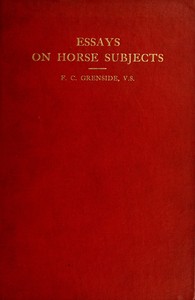
Essays on horse subjects — A Closer Reading
(0 User reviews)
1412
Project Gutenberg
2025
Not confirmed
Horses -- Training; Horses
Readers of public-domain and historical texts
Project Gutenberg digital edition
en
Edition facts
Words
32,856
Reading time
143 min
Text sections
20
The source record for Essays on horse subjects — A Closer Reading measures this digital text at 32,856 words, 2 hr 23 min estimated reading time, and 20 detected text sections.
The text analysis averages about 27.9 words per sentence, while the detected sections provide another way to judge how the source is divided.
Project Gutenberg metadata also associates the work with “Horses -- Training,” connecting these edition facts with the source record’s subject description.
Source:
Project Gutenberg record #75671
A veterinarian with 28 years of experience examines horse quality, mouth education, and action faults through practical essays that bridge horsemanship and veterinary science, emphasizing gradual training over mechanical fixes.
Editorial Edition Score
4.8/5
★★★★★
★★★★★
Calculated from edition completeness, EPUB availability, text structure and catalogue metadata. Not a user rating.
How this score is calculated
- Description quality20 pts
- Title & short description10 pts
- Source metadata20 pts
- Text length15 pts
- Chapters / structure15 pts
- EPUB file integrity20 pts
Total of 100 points, scaled to a 2.5-5.0 range. Editions with an empty description or a missing EPUB file are not scored.
Edition quality
Read the Text
s narrower from before backwards, than it is just above the fetlock. In this condition the tendons behind the knee are not well developed, and are placed too close to the shank-bone at this point. This imperfect tendonous development in a front leg is not usually confined to the tendons behind the leg, called the flexor tendons, as an imperfect development of these tendons is usually associated with an impaired development of the tendons running down the front of the leg called the extensor tendons. Such a condition frequently results in shaky knees, and if the subject experiences hard work, he is likely to become progressively worse. In some cases the flexor tendons appear to be much better developed than the extensors, and in an individual so formed, particularly if he is inclined to stand with his forefeet well back under him, there is an inordinate strain on the extensors, leading to relaxation and a corresponding tendency to contraction of the flexors. Here we have a lack of balance between the extensors and flexors, and the result is a knee-sprung condition. Although shaky-kneed or knee-sprung horses are not frequently incapacitated for work, the breeder should not lose sight of the fact that this condition is apt to considerably depreciate a horse’s value in the market, particularly for some purposes, and he can seldom afford to ignore this fact. It is not intended to advise breeders never to breed to a sire that stands a little over in the knees, especially if sufficient cause can be assigned for it, but we should recommend them to be very wary about using sires and dams that show a congenital tendency to this defect. Purchasers of horses usually look with considerable disfavor on a horse that is at all knee-sprung. Personally, the writer would rather buy a horse for his own use that is a little forward in the knees than one that stands back in them or is what is called calf-kneed. A horse with the former defect is almost sure to be much more elastic in his step than one with the latter and, consequently, will not suffer to the same extent from the ill-effects of concussion. A calf-kneed horse is also much more likely to suffer from strains. Knee-sprung, unlike the other unsoundnesses given in the list of hereditary troubles, is not very infrequently congenital. Swan-necked horses and those with thick, coarse throttles are considered to be of the formations most liable to develop the defect of the wind called “roaring.” In Great Britain and Ireland and on the continent of Europe, breeders are usually very particular about avoiding roarers for breeding purposes. The climatic conditions there seem favorable to its development; but in this country it is not nearly so much to be feared, and one should not hold aloof from an otherwise desirable sire on account of his being a roarer, though it must be admitted that the predisposition to the trouble may be transmitted. The predisposition to periodic ophthalmia or moonblindness is handed down from parent to offspring, but it is not nearly so common in this country as it once was, when the sanitary conditions were not so good; and it may be that some care has been exercised in breeding, so as to avoid its propagation. The only appreciable evidence of a predisposition to this unsoundness, outside of the existence of the disease, is the small or what is called “pig eye.” The writer knew a sire well that had “pig eyes” but sound ones, and they remained sound throughout his long life, but certainly ten per cent. of his progeny developed moonblindness.
The tendency to string-halt is undoubtedly transmissible from parent to offspring. Horses with snappy hock action are most likely to develop it. Nowadays it is not feared nearly so much as it was formerly, for if it should develop, a very large percentage of cases are curable by a not very difficult and by no means dangerous operation, which consists in the cutting of a tendon. A change has taken place in the generally accepted view as to the nature of string-halt. It was considered a purely nervous malady until it was found that the cutting of a tendon would in many instances cure it.
F. C. Grenside, a veterinarian with twenty-eight years of practical experience, opens his collection by confronting a persistent disagreement among horsemen: what exactly constitutes “quality” in a horse. Rather than offering a single definition, he catalogs the competing terms—breeding, conformation, finish, class, symmetry, magnetism—and argues that quality is an abstract, comparative attribute that may or may not accompany other virtues. This refusal to reduce quality to a checklist sets the tone for the essays that follow, which consistently resist simple formulas in favor of nuanced, experience-based judgment.
Defining Quality Through Contrast
Grenside’s opening essay establishes a method he will use throughout: he pits common opinions against one another to isolate what is distinctive about a concept. He notes that some call quality “indefinable and unexplainable,” yet he proceeds to explain it by negation—quality is not merely breeding, because two thoroughbreds of equal pedigree can show different degrees of it; nor is it symmetry or finish, since a horse may have those without quality. The essay’s structure mirrors this analytical habit: it lists what quality is not before suggesting what it might be. The author’s own voice emerges in the careful qualification “in the light classes of horses,” where quality is “very often used synonymously with breeding.” This precision—tying an observation to a specific class of horse—reveals a writer who thinks in categories and exceptions, not absolutes.
The Mouth as a System of Education
In the essay on the horse’s mouth, Grenside shifts from abstract definition to concrete training. He describes the mouth not as a fixed trait but as something that must be “educated” and “cultivated by degrees.” The tongue, he explains, should lie “quietly in the groove formed by the branches of the lower jaw,” acting as a “protective cushion” for the sensitive bars. When a horse develops habits like putting the tongue over the bit, the bars lose protection, causing pain and unsteady movement. Grenside’s remedy is gradual: first accustom the horse to the bit without pressure, then use a straight mouthpiece placed high to prevent tongue-over-bit, and finally attach loose reins to a roller so the horse experiences pressure only when extending its nose. He explicitly rejects “big, thick bit, with keys” and “spoon bits,” calling mechanical contrivances “very unsatisfactory.” The emphasis throughout is on patience and incremental conditioning, not force.
Patterns of Fault and Correction
Several essays share a recurring structure: Grenside names a fault (forging, over-reaching, clicking, interfering), describes its mechanical cause, and then offers a corrective that often involves bitting, shoeing, or conditioning. In the mouth essay, he traces a chain of consequences: faulty management leads to tongue habits, which expose the bars, which cause the horse to “go off his feet, hitch, and go cornerwise instead of straight.” This causal logic—linking a small training error to a cascade of movement problems—is typical of his approach. He also notes that some horses develop the habit of putting the tongue over the bit “as soon as the bit is put in the mouth and before any pressure,” an observation that suggests he has watched horses closely enough to distinguish anticipatory behavior from reaction. His solutions are practical and specific, such as leaving a straight ring bit in all day except during feeding for two or three weeks.
Grenside’s essays reward readers who appreciate systematic observation over quick fixes. He writes from the borderland between veterinarian and horseman, addressing topics he claims have been neglected by both. The reader will find no sweeping theories, only a series of linked arguments that build from definition to diagnosis to remedy. Those who work with horses may recognize in his prose the voice of a clinician who has spent decades watching, comparing, and refining his methods.
Reading these essays, I kept thinking how gently the author insists on patience—that a horse’s mouth isn’t fixed but educated. It reminded me of an old copy of Hints for Lovers — A Reader’s Guide, where the same quiet faith in slow, careful attention appears, just aimed at human hearts instead. Some lessons travel quietly across species.
There are no reviews for this eBook.
There are no comments for this eBook.
Reader reflection
What was your reading experience?
Capture what you thought, learned, and would like to remember.
Your progress
0
/
10
2
How much did you enjoy the reading experience?
3
Would you pass this book on to a friend?
4
How easy was the book to follow?
5
How strong was your personal connection to the text?
6
Did any part of the book stay with you emotionally?
7
How would you rate its originality?
8
Did you gain anything practical from the text?
9
What changed or sharpened your thinking?
10