1

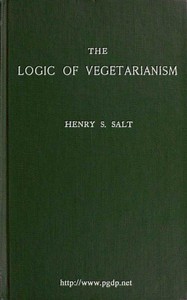
The Logic of Vegetarianism: Essays and Dialogues — Themes and Context
12
4
Project Gutenberg
2015
Vegetarianism
Readers of public-domain and historical texts
Project Gutenberg digital edition
en
Edition facts
Words: 41,738
Reading time: 182 min
Text sections: 28
Source:
Project Gutenberg record #49949
Henry S. Salt's 1906 collection of essays and dialogues argues for vegetarianism through ethical, physiological, and logical reasoning, using satire and direct engagement with contemporary medical and moral objections.
Editorial Edition Score
4.8/5
★★★★★
★★★★★
Calculated from edition completeness, EPUB availability, text structure and catalogue metadata. Not a user rating.
Edition quality
Henry S. Salt opens The Logic of Vegetarianism with a sonnet, “The Moralist at the Shambles,” that sets a combative tone: the “Moral Man” is depicted sanctimoniously justifying slaughter while claiming sympathy for the victims. This poetic salvo immediately signals that Salt will blend moral argument with sharp satire, a strategy sustained throughout the volume. The book is structured as a series of essays and dialogues, a form that allows Salt to anticipate and rebut objections from medical authorities, common sense, and religious sentiment. The excerpts show him engaging closely with specific claims—for instance, the British Medical Journal’s assertion that a mixed diet requires “less cost of energy”—and countering them with practical experience and logical consistency.
Satirical Openings and Rhetorical Strategy
The prefatory sonnet is not mere decoration; it encapsulates Salt’s method. By placing a moralist in a slaughterhouse, he forces a confrontation between abstract ethics and visceral reality. The poem’s final couplet—“His sympathetic soul—by eating more”—inverts the claim that flesh-eating is compassionate. This satirical framing recurs in the dialogues, where Salt invents interlocutors who voice common prejudices, then systematically dismantles them. The excerpts show him quoting opponents at length, from the Spectator’s worry about Esquimaux to the British Medical Journal’s digestibility argument, before dissecting their logic. He does not merely assert; he reproduces their words and then highlights contradictions, such as the medical profession’s past denial that vegetarianism could sustain life.
Engaging Medical Authority on Its Own Ground
Salt devotes considerable space to physiological arguments, but his approach is distinctive. He does not simply list health benefits; he challenges the scientific establishment’s consistency. In the “Digestion” section, he quotes the British Medical Journal admitting that man “can obtain from vegetables the nutriment necessary for his maintenance in health,” yet still recommending meat for efficiency. Salt pounces on this concession, noting that the same journal had earlier implied vegetarianism was impossible. He then offers empirical counter-evidence: vegetarians, he claims, eat less bulk than flesh-eaters and suffer less indigestion. This move—using the opponent’s own data and turning it against them—is central to Salt’s method. He also references “the existence of the elephant and rhinoceros” to mock the idea that meat alone gives strength, a rhetorical tactic that blends science with common sense.
Dialogues as a Tool for Refutation
The dialogue form allows Salt to dramatize the clash of viewpoints. Although the excerpts do not include full dialogues, the preface and essays indicate that Salt uses fictional exchanges to expose fallacies. For instance, he mentions the Spectator’s objection about Esquimaux—a classic tu quoque argument—and dismisses it as unserious. In the dialogues, one can infer, Salt gives voice to the carnivorous opponent, then answers point by point. This technique makes the book more engaging than a straightforward treatise; it forces the reader to follow the logic as it unfolds in conversation. The result is a work that feels less like a lecture and more like a debate, with Salt playing both advocate and judge. The excerpts suggest that the dialogues are tightly focused on specific objections, avoiding digression.
Readers approaching The Logic of Vegetarianism should note that Salt’s arguments are historically situated: he responds to late-Victorian medical orthodoxy and moral complacency. The book’s value lies less in its nutritional science—some claims are dated—than in its rhetorical structure and ethical clarity. Salt’s willingness to quote adversaries at length makes the work a useful primary source for understanding early vegetarian advocacy. The dialogues, though incomplete in the excerpts, reward close reading for their logical precision.
Reader reflection
Before you leave, reflect on the book
Use these questions to collect your thoughts before moving on.
Your progress
0
/
10
2
How did the book work for you overall?
3
Would you encourage someone else to read it?
4
Did the language feel accessible?
5
Did anything about the book feel genuinely new?
6
What did you think about the pace?
7
Did you gain anything practical from the text?
8
How strong was your personal connection to the text?
9
What changed or sharpened your thinking?
10