1

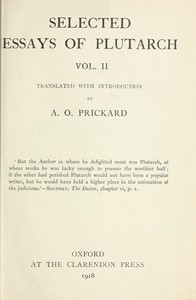
Selected Essays of Plutarch, Vol. II. — Edition Insights
11
2
Project Gutenberg
2020
Ethics -- Early works to 1800
Readers of public-domain and historical texts
Project Gutenberg digital edition
en
Edition facts
Words: 123,783
Reading time: 539 min
Text sections: 28
Source:
Project Gutenberg record #62858
This volume of Plutarch's Moralia contains seven dialogues and a treatise on superstition, translated by A. O. Prickard. The opening, middle, and later excerpts show how the translator's preface, running analyses, and mythic conclusions guide a first reading through complex speaker shifts and philosophical arguments.
Editorial Edition Score
4.9/5
★★★★★
★★★★★
Calculated from edition completeness, EPUB availability, text structure and catalogue metadata. Not a user rating.
Edition quality
The translator's preface immediately alerts the reader to a practical difficulty: in several dialogues, identifying the current speaker can be confusing, as characters are often referred to by pronouns like 'I' or 'he'. Prickard has therefore prefixed short running analyses to four of the dialogues, a decision he admits is a compromise—'always a pity to anticipate what the author puts clearly before us,' he writes, but necessary for clarity. This editorial intervention shapes how a first-time reader approaches the text, providing a roadmap through the conversational turns.
The volume covers about one-eighth of Plutarch's Moralia, all pieces except one being in dialogue form. The exception, the short treatise On Superstition, is included for its 'affinity of thought'. This selection principle hints at a thematic coherence that the reader may trace across the dialogues.
The Translator's Cautious Hand
Prickard's preface reveals a meticulous editorial approach. He follows Wyttenbach's text but incorporates corrections from Hermann, Emperius, Madvig, and others, acknowledging debts to Bernardakis's Teubner edition. His footnotes document every deviation from Wyttenbach, as well as references to quoted authors. This transparency allows the reader to see the textual basis for each passage. The preface also notes that the full index of proper names should help distinguish the many historical and mythological figures that appear. For a first-time reader, these paratexts are not mere apparatus but essential tools for navigating the dense references.
Dialogue as Philosophical Drama
The excerpt from the introduction to On the Instances of Delay in Divine Punishment illustrates how Plutarch structures his dialogues. An Epicurean scoffer leaves abruptly after offending the company, reminiscent of Thrasymachus's exit in Plato's Republic. The remaining group—Plutarch, his brother Timon, son-in-law Patrocleas, and friend Olympicus—then discuss the points raised, with Plutarch supplying the answers. This distribution of parts is unusual; in other long dialogues, there is 'some distribution of parts and an interplay of character'. The reader should note who speaks and when, as the running analyses help track the conversational flow.
The Myth as Structural Capstone
Prickard explains that after establishing his argument 'to demonstration', Plutarch adds a myth—a device borrowed from Plato, intended to give symmetry to the dialogue, 'that it may not go about without a head'. The myth about Thespesius in this dialogue is compared to those of Timarchus in The Genius of Socrates and the Island of Cronus in The Face in the Moon. The translator notes that while the imagery recalls Platonic myths (Er, Gorgias, Phaedo), Plutarch does not merely patch together memories; his 'honesty and his common-sense' prevent imitation. A first-time reader encountering the myth should consider how it functions not as a literal account but as a poetic resolution to the dialectical inquiry.
Tracing Thematic Threads Across Dialogues
The preface mentions a fragment of a lost dialogue with the same speakers, which provides a 'delightful picture of what awaits the just beyond the grave' in calculated contrast to the grim details of the main dialogue. This suggests that Plutarch sometimes pairs dialogues to explore complementary perspectives. The reader of this volume might watch for such contrasts between the pieces collected here. Additionally, the translator's note that the dialogue On Superstition shares a 'certain affinity of thought' with the others invites comparison of tone and argument across the volume, especially between the sustained seriousness of the delay dialogue and the more varied interplay in other pieces.
Because the excerpts are limited to the preface and introduction to one dialogue, the reader should not assume that all pieces follow the same pattern. The translator's running analyses are provided only for four dialogues; the others 'seem to explain themselves sufficiently'. A first-time reader may benefit from consulting the index of proper names early, and from noting the speaker shifts in the un-analyzed dialogues. The volume rewards attention to both the philosophical arguments and the dramatic framing that gives them life.
Reader reflection
Take a moment to reflect on this book
Create a short personal record of your experience with this book.
Your progress
0
/
10
2
Did this book hold your interest?
3
Would you pass this book on to a friend?
4
How easy was the book to follow?
5
How would you describe its reading pace?
6
Would you start a conversation about this book?
7
How clear did the writing feel?
8
Could you see yourself revisiting this book?
9
What did this book teach you most?
10