1

Science and Culture, and Other Essays — Context and Discussion
11
2
Project Gutenberg
2016
Science
Readers of public-domain and historical texts
Project Gutenberg digital edition
en
Edition facts
Words: 97,638
Reading time: 425 min
Text sections: 11
Source:
Project Gutenberg record #52344
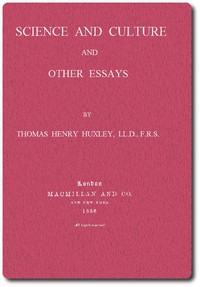
Thomas Henry Huxley's 1881 collection of addresses and essays examines the relationship between scientific inquiry and cultural education, with precise analyses of historical scientific texts, including Aristotle's anatomy and the method of Zadig.
Editorial Edition Score
4.8/5
★★★★★
★★★★★
Calculated from edition completeness, EPUB availability, text structure and catalogue metadata. Not a user rating.
Edition quality
Thomas Henry Huxley's Science and Culture, and Other Essays (1881) collects addresses and lectures delivered over the preceding seven years, each probing the intersections of scientific method, education, and historical interpretation. The volume opens with a defense of science as an essential component of modern culture, delivered at the founding of Sir Josiah Mason's Science College. Throughout, Huxley moves between contemporary debates—such as technical education and the teaching of physiology—and meticulous historical reconstructions, as in his examination of Aristotle's errors on heart structure. The essays share a persistent concern with how knowledge is validated, transmitted, and sometimes misconstrued across generations.
Aristotle's Anatomy Under Scrutiny
In the essay on Aristotle's alleged errors about the heart, Huxley performs a forensic reading of the History of Animals. He quotes Aristotle's description of the lung as a single organ divided into two halves, noting that the separation is "least of all in man." Rather than dismiss this as a mistake, Huxley reconstructs Aristotle's observational context: the close union of bronchi and pulmonary vessels in mammals makes the division less obvious than in birds. He then traces Aristotle's terminology—σύριγγες (tubes), διαφύσεις χονδρώδεις (cartilaginous structures), and τρήματα (passages)—to show that Aristotle correctly identified the bronchial tree and its subdivisions. The error, Huxley argues, lies not in the anatomy but in the assumption that air passes from lung to heart through a single large vessel (κοινὸς πόρος). By comparing multiple passages, Huxley demonstrates that Aristotle's model of air transudation through thin membranes was a reasonable inference given the available evidence.
The Method of Zadig: Inference from Traces
Huxley's lecture "On the Method of Zadig" uses Voltaire's fictional detective to illustrate a scientific reasoning process: reconstructing causes from observable effects. The method, Huxley explains, relies on the principle that "the order of nature is constant"—that similar effects imply similar causes. He applies this to paleontology, where a single bone can indicate the structure of an entire extinct animal. The essay is notable for its explicit analogy between historical criticism and scientific inference: both require the interpreter to weigh probabilities and resist premature conclusions. Huxley emphasizes that the method is not infallible but is the only tool available for investigating past events, whether in geology, biology, or human history. The lecture thus bridges the volume's recurring theme: the unity of rational inquiry across disciplines.
Education as a Field of Tension
Several essays address the practical organization of learning. In "Universities: Actual and Ideal," Huxley contrasts the medieval university's focus on theology and classics with the modern need for scientific training. He argues that a university should be a place where "the intellect may be safely allowed to play freely"—a phrase that captures his commitment to open inquiry. The address on technical education, delivered to working men, advocates for instruction that combines manual skill with scientific principles. Huxley insists that physiology should be part of elementary education, not as a specialized subject but as a foundation for understanding health and hygiene. These pieces reveal a consistent tension: between tradition and reform, between abstract knowledge and practical application, and between the claims of different disciplines to shape the curriculum. Huxley does not resolve these tensions but insists they must be confronted honestly.
Readers approaching this collection will find that Huxley's essays reward attention to his method as much as his conclusions. He habitually returns to primary sources—Aristotle's Greek, the structure of a lung, the logic of a detective story—and builds his arguments from concrete details. The volume is best read not as a unified treatise but as a series of demonstrations, each showing how careful observation and historical awareness can illuminate both scientific and cultural questions. Huxley's voice is that of a teacher who expects his audience to think critically, and his essays remain a model of engaged, evidence-based argument.
Reader reflection
What was your reading experience?
Capture what you thought, learned, and would like to remember.
Your progress
0
/
10
2
Did this book hold your interest?
3
Would you pass this book on to a friend?
4
How easy was the book to follow?
5
How clearly were the main ideas presented?
6
Would a second reading be valuable?
7
Did the book give you something worth debating?
8
Did you relate to its people, ideas, or situations?
9
What is the main idea you are taking away?
10