1

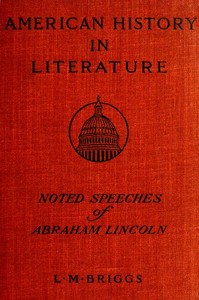
Noted Speeches of Abraham Lincoln, Including the Lincoln-Douglas Debate — Inside the Classic
15
3
Project Gutenberg
2015
Lincoln, Abraham, 1809-1865 -- Oratory
Readers of public-domain and historical texts
Project Gutenberg digital edition
en
Edition facts
Words: 29,129
Reading time: 127 min
Text sections: 13
Source:
Project Gutenberg record #48364
This editorial note examines how the opening biographical sketch, the Cooper Institute speech, and the Lincoln-Douglas debate excerpt guide a first reading of Lincoln's rhetoric, focusing on the editor's framing, Lincoln's argumentative structure, and the debate's dialogic format.
The volume opens with a biographical sketch that presents Lincoln's early life in a log cabin, his move to Indiana, and the loss of his mother, emphasizing his stepmother's encouragement of his reading. This framing positions Lincoln's oratory as emerging from humble, self-educated beginnings. The editor, Lilian Marie Briggs, states the series aims to include speeches that commemorate important events, making this a chronological anthology. Readers first encounter Lincoln's voice in the Cooper Institute speech, where he addresses a political audience with careful historical argumentation.
The Biographical Frame and Its Effect on Reading
The editor's biographical sketch, though brief, shapes expectations. It highlights Lincoln's frontier origins and his stepmother's role in fostering his reading, suggesting that his eloquence arose from self-directed study rather than formal schooling. This narrative of self-improvement may lead readers to view the speeches as products of a determined intellect. However, the sketch does not analyze the speeches themselves; it merely provides context. A first-time reader should note that the biography is a preface, not an interpretive key. The editor's foreword clarifies the series' purpose—to collect best-known American speeches—but offers no critical apparatus. Thus, readers must rely on the texts alone for rhetorical insight.
Argumentative Architecture in the Cooper Institute Speech
The Cooper Institute speech, the first in the anthology, demonstrates Lincoln's method of building an argument through historical evidence. He cites the votes of the original 39 signers of the Constitution regarding federal power over slavery, using precise references to their actions. This forensic approach—grounding a political claim in the founders' intentions—reveals Lincoln's reliance on documented precedent rather than emotional appeal. The speech's structure moves from historical analysis to a direct challenge to his opponents. Readers can observe how Lincoln constructs a case paragraph by paragraph, a technique that recurs in his later addresses. The absence of editorial commentary here allows the speech's logic to stand on its own.
The Lincoln-Douglas Debate as a Dialogic Text
The excerpt from the first joint debate at Ottawa presents Douglas's opening speech, which sets the terms of the discussion. Douglas addresses the crowd as representatives of two great political parties, framing the debate as a clash of principles. His language is direct and confrontational, contrasting with Lincoln's more measured tone in the Cooper Institute speech. The editor includes only Douglas's opening and Lincoln's reply, omitting the full back-and-forth. This selection highlights the debate's structure: each speaker had a set time to present and rebut. Readers should note that the excerpt captures only a fraction of the exchange; the full debate would show how arguments evolved. The biographical sketch of Douglas preceding the debate provides context for his political stance, but the text itself reveals his rhetorical style—assertive and populist.
Recurring Rhetorical Patterns Across the Speeches
Across the excerpts, several patterns emerge. Lincoln frequently uses parallel structure and repetition for emphasis, as seen in the Gettysburg Address and the Second Inaugural. The Emancipation Proclamation, included in full, shows a shift to legalistic language, invoking constitutional authority and military necessity. The editor's chronological arrangement allows readers to trace Lincoln's evolving rhetoric from the deliberative arguments of the Cooper Institute to the executive decree of the Proclamation. A notable feature is Lincoln's tendency to frame his actions as compelled by duty rather than choice, a stance that unifies his public addresses. The biographical sketches, while separate, reinforce this image of a reluctant but resolute leader.
The Editor's Role in Shaping the Anthology
Lilian Marie Briggs, identified as an assistant in the New York Public Library, compiled this volume as the first in a series called American History in Literature. Her selection includes five speeches and one debate, with biographical sketches for both Lincoln and Douglas. The foreword states the series will include only the best-known speeches, implying a canonizing intent. The absence of explanatory notes or footnotes means the texts are presented without modern editorial intervention. This approach gives readers direct access to the primary sources but leaves interpretation entirely to them. The volume's compact format—under 30,000 words—makes it a convenient entry point, but the lack of contextualization may challenge those unfamiliar with the historical issues.
For a first reading, approach this anthology as a primary source collection rather than a guided study. The chronological order invites tracing Lincoln's rhetorical development, but the editor's minimal framing means readers must supply historical context themselves. Pay attention to how Lincoln adapts his language to different audiences—from the scholarly tone of the Cooper Institute to the concise power of the Gettysburg Address. The inclusion of Douglas's biography and debate opening also offers a glimpse into the political opposition Lincoln faced, enriching the reading of his arguments.
Reader reflection
Record your reading impressions
A brief reflection can help important ideas stay with you longer.
Your progress
0
/
10
2
Did this book hold your interest?
3
Is this a title you would suggest to others?
4
What was the reading difficulty like?
5
Did the story or argument move comfortably?
6
How closely did the book connect with your experience?
7
Was the book easy to understand?
8
Would a second reading be valuable?
9
What did this book teach you most?
10