
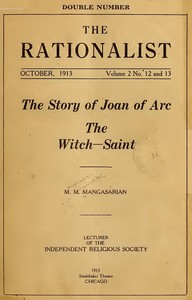
The Story of Joan of Arc the Witch-Saint by M. M. Mangasarian
Most of us know the basic beats: a teenage shepherdess hears divine voices, puts on armor, turns the tide of the Hundred Years' War for France, gets captured by the English, and is burned at the stake for heresy and witchcraft. Centuries later, the Catholic Church declares her a saint. It's a powerful legend of faith and martyrdom.
The Story
M. M. Mangasarian's book doesn't retell that legend. Instead, it takes it apart. Published in 1913, this is less a biography and more a critical essay. Mangasarian walks us through Joan's rise, but his real focus is the aftermath. He presents Joan's trial not as a search for truth, but as a rigged political execution. The English and their French collaborators needed her gone, and heresy was the convenient charge. Then, he turns to the 20th-century canonization, arguing it was a similarly political act by the Church to reclaim a national symbol. The core of the book is this dual examination: first, the destruction of a 'witch,' and then the creation of a 'saint,' asking us to see both as maneuvers in a much longer game of power and control.
Why You Should Read It
I loved this book because it refuses to let Joan be simple. It strips away the layers of myth and asks us to see the human girl caught in an impossible situation. Mangasarian's Joan is a patriot, possibly a genius military tactician, and undoubtedly brave—but his argument is that labeling her as divinely inspired or demonically possessed served other people's agendas. It's a deeply humanist take. Reading it, you're forced to confront how institutions use figures like Joan. It made me angry on her behalf and amazed at how her story has been shaped and reshaped for centuries. This isn't about disproving faith; it's about questioning who gets to define it and why.
Final Verdict
This is the perfect book for anyone who loves history but hates feeling like they're getting just one side of the story. It's for the reader who finishes a biography and thinks, 'Okay, but what's the other angle?' It's not a long, dense academic text—it's a passionate, opinionated, and accessible argument. If you're a devoted Catholic, some parts might frustrate you, but they're worth engaging with. Ultimately, it's for people who believe that the most fascinating stories are the ones where the truth is messy, complicated, and forever debated. You'll come away with a new, and far more intriguing, picture of the Maid of Orleans.
You are viewing a work that belongs to the global public domain. You are welcome to share this with anyone.
Christopher Jackson
6 months agoIt took me a while to process the complex ideas here, but it manages to maintain a consistent flow even when discussing difficult topics. It definitely lives up to the reputation of the publisher.
Kimberly Jackson
1 year agoThis was exactly the kind of deep dive I was searching for, the nuanced approach to the central theme was better than I expected. I'm glad I chose this over the other alternatives.
Jessica Lee
9 months agoRight from the opening paragraph, the critical analysis of current industry standards is very timely. A rare gem in a sea of mediocre content.
Paul Hernandez
1 year agoOne of the most comprehensive guides I've read this year.






Matthew Hernandez
1 week agoThe author provides a very nuanced critique of current methodologies.