1

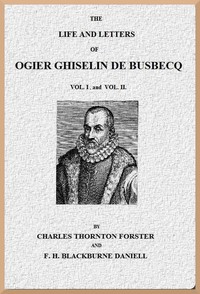
The Life and Letters of Ogier Ghiselin de Busbecq, Volumes 1 and 2 — Text and Context
(0 User reviews)
1657
Project Gutenberg
2016
Not confirmed
Busbecq, Ogier Ghislain de, 1522-1592
Readers of public-domain and historical texts
Project Gutenberg digital edition
en
Edition facts
Words
255,034
Reading time
1109 min
Text sections
28
The catalog record for The Life and Letters of Ogier Ghiselin de Busbecq, Volumes 1 and 2 — Text and Context provides practical reading context through 255,034 words, 18 hr 29 min estimated reading time, and 28 detected text sections.
The text analysis averages about 24.7 words per sentence, while the detected sections provide another way to judge how the source is divided.
Project Gutenberg metadata also associates the work with “Busbecq, Ogier Ghislain de, 1522-1592,” connecting these edition facts with the source record’s subject description.
Source:
Project Gutenberg record #53681
This editorial note examines the language and narrative voice in Busbecq's 16th-century letters, focusing on shifts between diplomatic reportage and personal reflection, as seen in the preface and footnotes.
Editorial Edition Score
4.9/5
★★★★★
★★★★★
Calculated from edition completeness, EPUB availability, text structure and catalogue metadata. Not a user rating.
How this score is calculated
- Description quality20 pts
- Title & short description10 pts
- Source metadata20 pts
- Text length15 pts
- Chapters / structure15 pts
- EPUB file integrity20 pts
Total of 100 points, scaled to a 2.5-5.0 range. Editions with an empty description or a missing EPUB file are not scored.
Edition quality
Read the Text
ust have been _arrested_. On this he grounded the subject of his work, ‘Soliman fait arrêter Busbecq, diplomat Flamand, Constantinople, 1555.’ There is also a striking error in the persons represented in the picture. When Busbecq first arrived at Constantinople Roostem was in disgrace, and Achmet held the post of chief Vizier. The latter had only consented to accept the seal of office on condition that the Sultan undertook never to remove him. The Sultan kept his word. When it was convenient to reinstate Roostem, he did not deprive Achmet of the seal of office, but _of his life_. The execution of Achmet is one of the most striking scenes recorded by Busbecq. Unfortunately, Monsieur Huysmans had not studied his subject sufficiently, for in his picture Roostem is in office, and Achmet stands by as a subordinate.
As to errors of a less recent date, they are, for the most part, such as an intelligent reader of Busbecq’s letters may correct for himself. For instance, it is not hard to prove that the author of the life prefixed to the Elzevir edition is wrong in stating that Busbecq’s father died before the Ambassador went to England, when we find that he had an interview with him after his return from our island. Neither is there much danger of the veriest tiro being led astray by De Foy’s suggestion that, when Busbecq came to England for the marriage of Philip and Mary, he had long conversations with Henry VIII., who tried to induce him to enter his service. There is, however, danger in Howaert’s[9] statement that Busbecq accompanied the younger sons of Maximilian to Spain, and introduced them to Philip. The story is not impossible in itself, nor is it even improbable. But there is this suspicious circumstance about it; those who mention it do not seem to be aware that Busbecq did accompany the two elder sons of Maximilian, Rodolph and Ernest, to Spain in the capacity of ‘_Écuyer trenchant_.’ This latter fact is established on the best of authorities, namely, the Patent of knighthood issued by the Emperor Ferdinand to Busbecq, a copy[10] of which we have, through the kindness of a friend, been enabled to procure from the archives of Vienna.
That Busbecq accompanied the four younger Archdukes to Spain is perhaps doubtful, and still more doubtful is the story grafted on to it by later hands, namely, that Busbecq pleaded the cause of the Netherlands before Philip II., obtained the recall of Alva and the substitution of Requesens in his place. No facts could be more interesting if they should but prove to be true; unfortunately they are at present without authority.
_Bousbecque and its Seigneurs._
It is from the seigneury of Bousbecque that Ogier[11] Ghiselin takes the name by which he is best known, Busbecq (Latin, Busbequius).
Properly of course his name is identical with that of the seigneury, but, by common consent, the Ambassador is known as Busbecq, while the name of the place, after numerous variations—Bosbeke, Busbeke, Bousbeke, &c., has settled down into the form Bousbecque.[12]
It will be necessary therefore to speak of the man by one name and the place by another.
The geographical position of Bousbecque has an important bearing on the biography of the Ambassador; as the place is not marked in English maps, a plan of the district is given in this volume showing the relative positions of Bousbecque, Comines, Wervicq, Halluin, &c. It will be seen that Bousbecque lies on the river Lys, about two miles from Comines. In the times with which we shall have to deal, it formed part of the County of Flanders; it is now part of the French frontier, and is included in the Département du Nord.
The neighbourhood of Bousbecque has a history extending to early times, for close to it stands Wervicq, marking with its name the Roman station of Viroviacum; in Bousbecque itself Roman paving-stones have been dug out on the road now known as the ‘Chemin des Oblaers;’ whence it may be assumed that the road mentioned in the itinerary of Antoninus, as running from Tournay to Wervicq, passed through Bousbecque.
The depth of the river Lys, which is an affluent of the Scheldt, exposed the neighbouring country to the attacks of the Northmen; the hardy pirates sailed up the stream, and built their castles and forts on the banks of the river. Their descendants became the seigneurs, or lords, of the territories which their ancestors had won.
The preface to this edition introduces Busbecq as a 'kind and genial cicerone,' a phrase that immediately signals the editors' desire to frame his letters as both historical record and personal narrative. The voice that emerges from the excerpts is layered: Busbecq himself writes with the precision of a diplomat, yet the editors' footnotes—defending his views on slavery or noting Evelyn's admiration for Turkish horses—create a running commentary that shifts the pace from reportage to reflection. This interplay between original text and editorial gloss is central to the reading experience.
The Diplomat's Register
Busbecq's letters, as presented in the excerpts, maintain a formal, observant tone typical of 16th-century diplomatic correspondence. He describes the Turkish court, military practices, and geography with a detached eye, as when he notes the 'Axylos, a woodless tract in Asia Minor.' The prose is dense with classical allusions—Homer, Suetonius, Xenophon—which anchor his observations in a learned European framework. Yet the pace is deliberate, often slowed by parenthetical asides or citations that invite the reader to pause and consider parallels. This register dominates the Turkish Letters, where Busbecq acts as an eyewitness to Ottoman power.
Editorial Interjections and Tempo
The editors, Forster and Daniell, frequently break into Busbecq's narrative with footnotes that alter the reading tempo. For instance, they defend his suggestion of slavery as 'an anticipation of the more merciful system of modern times,' a claim that halts the historical flow to engage in moral argument. Similarly, they quote Evelyn's diary to corroborate Busbecq's description of Turkish horses, creating a dialogue across centuries. These interjections vary in length—from brief citations to multi-paragraph defenses—and introduce a secondary voice that oscillates between scholarly support and correction. Readers must navigate this dual-layered text, where the pace quickens with Busbecq's narrative and slows with editorial commentary.
Classical Anchors and Shifting Register
Busbecq frequently invokes classical authors to frame his experiences, but the excerpts show how these references shift the register from reportage to erudite reflection. A footnote on the 'Digest or Pandects of Justinian' explains a term, while a comparison to 'Milton, Paradise Lost' links Turkish warfare to epic poetry. This technique creates a layered pace: the reader moves from concrete description (e.g., 'shooting with the crossbow has been a custom at Bousbecque') to abstract commentary. The editors amplify this by adding their own classical citations, such as Vopiscus on Egyptian chicken-hatching. The result is a text that demands attention to both the immediate scene and its wider cultural echoes.
Readers should attend to the footnotes as much as the main text; they are not mere asides but integral to the work's rhythm. The editors' voice—sometimes defensive, sometimes admiring—shapes how Busbecq's observations are received. For those interested in narrative voice, this edition offers a case study in how historical documents are mediated by later scholars, altering pace and perspective at every turn.
I often think of Busbecq’s letters, how his diplomatic tone softens into private wonder between the lines. There is a similar pause in Yeats’s essays—that quiet turning inward when discussing Spenser’s world-weary verse. Both voices speak across centuries, not to us, but near us, like old friends muttering over the same warm embers. The Collected Works in Verse and Prose of William Butler Yeats, Vol. 8 (of 8) Discoveries. Edmund Spenser. Poetry and Tradition; and Other Essays. Bibliography — Reading Notes holds that same gentle, unhurried reflection.
There are no reviews for this eBook.
There are no comments for this eBook.
Reader reflection
Record your reading impressions
A brief reflection can help important ideas stay with you longer.
Your progress
0
/
10
2
How did the book work for you overall?
3
Would you recommend this book to another reader?
4
How demanding did the text feel?
5
How strong was your personal connection to the text?
6
How did the reading compare with what you expected?
7
How useful did the reading feel?
8
Which element worked best for you?
9
What did this book teach you most?
10