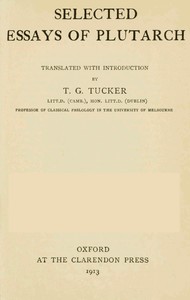
Selected Essays of Plutarch, Vol. I. — Context and Discussion

(0 User reviews)   73
Plutarch, 46-120?, Tucker, T. G. (Thomas George), 1859-1946 [Translator] Project Gutenberg 2020 Not confirmed
Ethics -- Early works to 1800 Readers of public-domain and historical texts
Project Gutenberg digital edition en

Edition facts

Words 101,257
Reading time 441 min
Text sections 23

For Selected Essays of Plutarch, Vol. I. — Context and Discussion, the stored edition analysis reports 101,257 words, 7 hr 21 min estimated reading time, and 23 detected text sections.

The text analysis averages about 23.0 words per sentence, while the detected sections provide another way to judge how the source is divided.

Project Gutenberg metadata also associates the work with “Ethics -- Early works to 1800,” connecting these edition facts with the source record’s subject description.

This volume of Plutarch's essays, translated by T. G. Tucker, presents moral and philosophical discourses from the Moralia, focusing on education, self-control, and the role of reason. The excerpts reveal a practical ethics rooted in classical examples, with recurring emphasis on hearing, speech, and the transition from childhood to adulthood.
Share
Editorial Edition Score 4.9/5

Calculated from edition completeness, EPUB availability, text structure and catalogue metadata. Not a user rating.

How this score is calculated
  • Description quality20 pts
  • Title & short description10 pts
  • Source metadata20 pts
  • Text length15 pts
  • Chapters / structure15 pts
  • EPUB file integrity20 pts

Total of 100 points, scaled to a 2.5-5.0 range. Editions with an empty description or a missing EPUB file are not scored.

Edition quality

Read the Text

, he lived through the reigns of Nero, Galba, Otho, Vitellius, Vespasian, Titus, Domitian, Nerva, and Trajan, and saw at least the first three years of the rule of Hadrian. He must have been nearly fifty before the last tyrant of the early Empire fell, but the remainder of his life was spent under the most beneficent régime, and amid the greatest peace and prosperity, ever experienced in the ancient world. The _pax Romana_ was at its profoundest, the sense of security at its fullest; the fact of general well-being was everywhere most palpable. There was at the same time, or in consequence, a vigorous revival of intellectual life. At no period of antiquity would it have been possible for a man of studious habits and of mild and genial disposition to enjoy a leisure so undisturbed or a society so free from those forms of preoccupation which preclude an engrossing interest in things purely of the mind. For the orator who is fired by the natural heat of democratic politics, for the patriotic poet from whom thrilling verse must be wrung by the wrongs, the decline, or the yet unrealized aspirations of his country, there was indeed no stimulation or scope. But for the cultivation of the humanities, for the indulgence of a taste for art and _belles-lettres_, for the satisfaction of intellectual curiosity, for the search after interesting knowledge—physical, mathematical, antiquarian, historical, philological—and for the thoughtful observation of men and manners, the time was almost ideal. In the absence of anxious and absorbing problems of the present there was leisure for a contemplative and critical survey of the past, and for making acquaintance with ‘the best that had been thought and said’ by it. Since the immediate human environment was no longer distracted and distracting with the clamorous urgencies of external or internal strife and danger, it was possible to look abroad over a wider field, to contemplate the more spacious world of man and his work, of Nature and her facts, beauties, and marvels. It was therefore the age of the encyclopaedist, the traveller, the commentator, the describer, the collector—collector of curiosities, of objects of art, of books, of stories from history, of apophthegms, of pointed and interesting quotations. The prevailing aim was mental and social culture. This was the one object of education, however much its professors might dissent from each other according to the degrees of philistinism in their respective temperaments.

The aim of contemporary education—generally realized with more definiteness than educational aims are wont to be in modern times—was to turn the pupil into a gentleman, to equip him for the art of living and conducting himself as such. There could, of course, hardly fail to be those who regarded this _kalokagathia_ too much from the exterior point of view, while others fixed their attention more decidedly, and often perhaps too exclusively, upon the inward and spiritual grace. There were also considerable differences between the Greek and Roman conceptions of a gentleman. But in the main this end was universally avowed—to turn the raw material of the boy into a man both capable and clubbable, whether from a public or a private standpoint. The things to be sought were the right accomplishments, the right morals, and the right manners. The accomplishments included, beyond all else, literary information and culture, argumentative dexterity, and a capacity for speech. The right morals were based mainly upon reasoned self-command. The right manners were chiefly those of urbanity, dignity, and that care of the person, the voice, the dress, and the deportment upon which all ages have insisted according to their several lights or tastes. It might be that the teaching ‘philosopher’, whose concern was with the soundness of the morals, had his quarrel with the teaching ‘sophist’, whose business was with the rhetoric and its excellence for exhibition purposes or for the gaining of various forms of influence. The philosopher might think the sophist superficial, showy, and often actually pernicious, while the sophist might look upon the philosopher as visionary, pedantic, and often a positive clog upon practical efficiency. Nevertheless no typically cultured person of the day would have questioned that, in order to be complete—or, as Coleridge calls it, ‘orbicular’—education must include its due measure of both forms of teaching.

After his years of infancy the boy, under the supervision of his _paedagogus_—ideally a slave of superior character, but too often a person who was merely useless for harder work—passed into a school, where he was first taught his letters and then proceeded to the reading, learning, and recital of classical poetry, to the study of music, and to some acquaintance with elementary arithmetic and geometry. Next, taken in hand by the rhetorical teacher in a higher school, he was made to write and deliver descriptions and essays, mostly on trite and unreal themes of a historical or pseudo-historical nature, to develop his powers of invention on either side of a chosen topic, and to cultivate a fastidious diction, pointed phrase, and the elocutionary arts and graces. From artificial harangues and the ‘speaking of a piece’ he advanced to the imaginary pleading of forensic cases, in which the law was often as fictitious as the facts. When, upon reaching the age for assuming the _toga virilis_, he was emancipated from the custody of the _paedagogus_ and the discipline of the school, his formal education commonly ceased. If he proceeded further, as many did, to what may be considered as the equivalent of a university course, he might elect to study philosophy, to study ‘sophistic’, or to dally with both in such measure as seemed likely to set off the abilities or consolidate the culture of a gentleman. Even in the more mature years of life the intellectually-disposed grandee had a habit of maintaining near his person a salaried philosopher as a kind of domestic monitor, and audiences of wealth and fashion readily gathered in Rome and elsewhere to listen to lectures on philosophy by professors who properly understood the art of clear and pleasant exposition. For the most part the typical Roman, less genuinely impassioned than the Greek for thought pure and simple, looked upon any ‘specializing’ in philosophy as likely to lead either to too cloistered a virtue or to the acquisition of eccentric, if not dangerous, views. A certain modicum of philosophical knowledge might be an adornment to life, and a certain modicum of philosophical training might impart a steadiness to character, but the study must not be pursued to the point at which the student himself stood in danger of becoming a ‘philosopher’. With the Greeks philosophical specializing was commonly subject to no such reprehension, partly because of the inborn Hellenic ardour for study and esteem of learning, partly because in this domain, even more than in the rhetorical, the Greeks were the accepted teachers throughout the Roman sphere.

This, or nearly this, was the attitude of the educational world in the first decades of the second century, and it was in this world that Plutarch of Chaeronea became a figure of special eminence and distinction. For in whatever light the modern reader may regard Plutarch as a man of letters, to his own times he was first and foremost an educator. It is from this point of view that we must consider both his _Parallel Lives_ and his _Moral Essays_, if we are to perceive in them that unity of character and purpose which he intended all his work to possess.

Plutarch, then, was born about A. D. 48 in the very heart of Greece, at the comparatively small town of Chaeronea, famous as the scene of the decisive victory of the Macedonians over the southern Greeks, and also of that in which the forces of Mithridates were routed by Sulla. His family must have been of high local standing, and the fact that his father—a man of cultivated tastes and refined manners—was the owner of the ‘finest kind of horses’ is enough to show, to those who appreciate the significance of the word _hippotrophia_, that he must have been possessed of considerable means. The same conclusion may be drawn both from what Plutarch himself incidentally reveals concerning his brothers, Lamprias and Timon, as well as other members of the family circle, and also from what is known of his own life and upbringing. That as a boy he passed through the orthodox curriculum, is obvious from his wide acquaintance with literature and his intelligent, if not particularly profound, references to both music and mathematics. When of an age to receive an education in philosophy, he was placed, or placed himself, chiefly under the distinguished Ammonius, an Alexandrian philosopher of a broad semi-Platonist, semi-Peripatetic school, who had become established in a prominent intellectual and public position at Athens. It was the accepted rule for the student to attend, but not necessarily to confine himself to, the lectures of a selected teacher. Often he lived in that teacher’s house, or at least, in intimate connexion therewith. If the philosopher was strictly conscientious he felt it his duty to watch over the developing character of his pupil, to visit him with any deserved reproof,[1] to serve as his father confessor, to answer his questions, and to meet his moral and intellectual difficulties. The familiar phrase ‘guide, philosopher, and friend’ perhaps describes the relations with unusual exactness. We find both Plutarch and his brother in the company of Ammonius at Delphi when Nero, in the year 66, graced that city with his imperial and artistic presence.

His formal education completed, we discover little of the younger manhood of Plutarch, except that he must have been in high local estimation, partly, perhaps, from the position of his family, but doubtless no less on account of his own conspicuous gifts. Had this not been the case, he would hardly have been appointed as one of a delegation of two sent on a mission to the Roman proconsul of the province. At what age he was first entrusted with civic functions as aedile, or with a Delphic priesthood (then merely a ceremonial office open to any layman), or with other public positions, we cannot say. We can only be sure that to his learning he added a recognizable capacity for public business. However many hours he may have devoted to study and to the compilation of those ample commonplace-books which evidently served him in such good stead, he prided himself on carrying his philosophic attainments into the local Chamber or on to the local platform. In his judgement this procedure was not only a vindication of philosophy and a method of keeping the faculties energetic; it was also a patriotic duty.

As has been already said, this was an age of travel. Facilities of transport were plentiful; the seas and main roads were secure from pirate or enemy; journeys were at least as expeditious as at any modern time until the employment of steam. We know of visits made by Plutarch to Alexandria, various parts of Greece, Rome, and the north of Italy. Rome he must have visited at least twice, and in this metropolis and ‘epitome of the world’ he made acquaintance with a large circle of men of distinction, transacted public business (presumably on behalf of his native town, of which he may have been sent as representative), delivered lectures,[2] and apparently acted as a sort of consulting physician to morally perturbed members of Roman society. He must have spoken always in Greek, for he confesses that—like most other Greek writers—he had given almost no attention to Latin; nor is any such avowal needed from a person who, even after looking into the language, believed _sine patris_ to be the Latin for ‘without a father’. Greek, however, was then as much the universal language of the cultured as, until recently, French was the universal accomplishment of fashion, diplomacy, and the traveller.

The Rome with which Plutarch was immediately acquainted was the Rome of Vespasian and of the earlier half of Domitian’s reign. Had his sojourn in the capital taken place some fifteen or twenty years later, it is in the highest degree probable that he would have been further known to us through an acquaintance with Pliny or some other Roman writer of that date. That a Greek, and especially one who had a difficulty in reading Latin, should make no mention of contemporary Latin authors—that in his heart he should rather despise them—is only characteristic of the Hellenic attitude of the time. But that the amiable Pliny, who has an appreciative word to say of almost every one within his social horizon, including comparatively obscure philosophers like Euphrates, should say nothing of so eminent a figure as Plutarch, amounts to evidence that the two had never met. A man who could make close friends of consulars like Sosius Senecio and Mestrius Florus, and who enjoyed an intimacy with Paccius and Fundanus, could not have failed to win the notice of the Horace Walpole of his day. Quintilian, Silius, Statius, Martial, Pliny, Suetonius, and Juvenal were all writing when Plutarch was already the coryphaeus of Greek culture, and if not one of them mentions his name, it is because he was living in remote Chaeronea and forgathering only with his chosen circle of philosophers, men of letters, artists, or musicians in that town or in Athens, Corinth, and other Greek centres near at hand.

To Chaeronea Plutarch must have retired by middle life. There he married Timoxena, a lady of position, but of quiet tastes, had issue four sons and a daughter, identified himself with the civic and religious concerns of his town, delivered lectures, imparted instruction on the lines of a modified or latitudinarian Platonic philosophy, industriously read the books in his moderate but useful library, made copious extracts therefrom, wrote his _Lives_ and those occasional papers known as his _Ethica_ or _Moral Essays_, and enjoyed the discussion of many a knotty question—often perhaps of little or no importance beyond the fact of its forming a problem—in the agreeable society of his relatives or his cultivated friends and guests. At such gatherings he was the leader, doubtless dominating the conversation—though in his more courteous way—somewhat as Johnson dominated the coterie described by Boswell. Often, we gather, he varied this quiet course of life by means of excursions to other Greek cities—Athens, Sparta, Aedepsus—where he most probably delivered an occasional lecture, and where, as we are certain, he thoroughly enjoyed himself in table-talk.[3]

That he gave philosophical education, though apparently not of a systematic and pedagogic kind, to persons of both sexes is known from his own references to the practice. Whether he did so for money or not, we cannot tell. The later Platonists by no means felt bound to adopt the attitude of Socrates and Plato towards the taking of fees. The world had changed, and the _res angusta_ was often more powerful than a principle which had ceased to appear entirely rational. But there is every reason to suppose that Plutarch was a man of independent means; we know further that a genial frugality was the rule of his household, and that he entertained a becoming contempt for the obsequious or the advertiser. The day of the endowed professor, whether of philosophy or sophistic, was still to dawn for Greece under Marcus Aurelius, and it never dawned at all for so small a town as Chaeronea. We may take it therefore that, whether with or without fee or present, Plutarch was able to choose his own pupils—in all likelihood the sons and daughters of his friends—and that, in dealing with them or with a wider audience, he maintained the fullest dignity and independence, and practised all the amiable candour which he explicitly recommends.

For any lack of originality, of speculative audacity, of profundity (or the obscurity which is so often mistaken for that virtue), Plutarch fully compensates. To his generation he served as a milch-cow of practical philosophy on its ethical side. He browsed on literature and thought, secreted the most valuable constituents, and yielded the cream to his hearers or readers. So far as he belonged to a philosophic school, it was that of the Old Academy. In other words, he would have labelled himself a Platonist. It is probable that he was as much attracted by the superb literary style of Plato, the nature of the man, and the nobility of his conceptions, as by anything capable of crystallization into a philosophy. These qualities attracted even the dilettante, while in the more specially philosophic world time had done much to refract the real Plato, to extract dogma from him, and to create a large _Aberglaube_ about his writings. Be that as it may, there is much in Plato that Plutarch does not accept, and there is much outside of Plato to which he gives a welcome. Towards Stoics and Epicureans—whose doctrines, like those of the Christians, would logically withhold men from public activity—he is distinctly, though never virulently, hostile, and when his pen ranges itself against particular schools, it is against these.[4] It is easier, in fact, to say to what sect Plutarch did not belong than to associate him definitively with any other. Nevertheless it is as a Platonist that he would have classed himself, and it is especially by the later Neo-Platonists that he was quoted as a divinely gifted writer who lent literary charm and potency to wisdom. So broad, however, was his teaching, and in many respects so adaptable even to Christianity, that early writers of the Church had no scruple in borrowing liberally from him.[5]

Into whatever shape he may have systematized his views, and however popular his treatment of them, Plutarch ranked with the philosophers. If he was opposed to Stoicism and Epicureanism, he was, like other philosophers, no less opposed to sophistic. To him the representatives of that art were apt to seem shallow and showy.[6]

He held, with the Socratics in general, that the basis of right action is knowledge, and he had no belief in empiricism. Not that he rejected either established moral views or established religion. He was no sceptic, still less an atheist. As Friedländer has well argued, there was no ancient cult of atheism. Plutarch, indeed, is remarkably receptive in the matter of deities. The Egyptian worship of Isis and Osiris, which had made great progress throughout the Roman Empire, appeared to him equally tenable with the worship practised by his own ancestors. In the polytheism in which he acquiesced, such divinities were only other forms of those known in Hellas, and he found no difficulty in reconciling and combining the two sets of notions and cults. He was deeply tinged with Orientalism, though his culture and his natural good taste made him despise corybantic demonstrations and what Friedländer has called ‘dirty mortifications’. He held the Eranian belief in daemonic agencies, which acted upon mankind from the one side as the gods did from the other. If he appears to rise to the conception of ‘God’ in the singular, the word is rather to be taken as denoting the sum of divine wisdom and beneficent dispensation. Like all the best minds of his own and many a previous generation, he found moral difficulties in accepting the characters ascribed to the deities in the best literature of earlier Greece, and therefore, while approving of the established education in poetry, he necessarily felt some qualms as to the possible effects. Poetry served in the schools ‘as introduction to philosophy, history, geography, and astronomy’, and it had much to do with the formation of religious and ethical notions. Homer, Pindar, Sophocles, and Menander were ‘learned and wise’, and boys were brought to regard them as inspired. Hence Plutarch’s treatise on _Poets as Moral Teachers of the Young_. The point of view in that essay is not, indeed, entirely rational. It was not so easy for Plutarch as it is for us to realize that moral and religious ideas in Greek literature had passed through an evolution corresponding to the development of intellect and society. Instead of frankly recognizing the limitations of Homer or the inconsistencies of the dramatists in this respect, he puts a highly ingenious constraint upon the connexion between any dubious sentiment and its context. It is only when he fails in such a _tour de force_ that he consents to censure the poet. In this procedure he was by no means the first. The battle of the ‘takers of objection’ (προβληματικοί) and the ‘solvers of difficulties’ (λυτικοί) was centuries old. That Plutarch should range himself as far as possible with the solvers is a circumstance which would naturally follow both from his love of literature and from his constitutionally reverential temperament.

Plutarch's essays in this volume, translated by T. G. Tucker, are drawn from the Moralia and address ethical conduct through a blend of philosophical argument and historical anecdote. The translator's preface notes that the selection aims to be 'typical examples' of Plutarch's writing, covering a 'tolerably large field of interesting matter' without claiming to represent the very best pieces. The excerpts show a consistent focus on the education of youth, the dangers of flattery, and the importance of reason as a guide.

The catalog subjects list 'Ethics -- Early works to 1800,' which accurately reflects the content, but the excerpts also reveal a strong emphasis on practical advice for young men, drawing on figures like Xenocrates and Bias. The essays are not abstract treatises but are addressed to specific individuals, such as a young man coming of age, and use concrete examples from Greek history and philosophy.

The Role of Hearing and Speech

One of the most striking recurring motifs in the excerpts is the emphasis on hearing as a sense that can both harm and benefit the character. Plutarch cites Theophrastus, who asserts that hearing is 'the most susceptible of all the senses,' capable of causing 'strong emotional disturbance.' He then quotes Xenocrates, who advised that 'ear-guards should be worn by boys more than by athletes,' because words can disfigure character more than blows can disfigure ears. This metaphor is extended with the story of Bias, who sent a tongue as 'the best and the worst' part of a sacrifice, illustrating the dual power of speech. The advice is not to avoid hearing altogether but to ensure that 'right communications' are fostered by philosophy. This focus on auditory education is a specific, recurring detail that distinguishes these essays from more general ethical works.

Coming of Age and the Change of Ruler

Plutarch directly addresses a young man on the threshold of adulthood, arguing that coming of age does not mean 'rejection of rule, but change of ruler.' He contrasts the 'hired or purchased director of conduct' of childhood with a 'divine' substitute—reason. This is not a metaphor for political freedom but for internal self-governance: 'Only those who follow reason deserve to be considered free.' He warns against the misconception that 'absence of restraint is the same thing as freedom,' which in fact makes one a slave to passions. The analogy of naturalized citizens who accept obligations 'with cheerful readiness' is used to encourage the youth to embrace philosophy willingly. This passage shows Plutarch's method of using concrete comparisons to make ethical points accessible.

Translator's Approach and Textual Choices

T. G. Tucker's translation is guided by a principle of fidelity: 'the English version does not seek to be either more formal or more vivacious' than the original. He aims to preserve both 'tone' and 'substance,' and states that no modern version of the Moralia was consulted. The text is based on Bernardakis's Teubner edition, with recourse to Wyttenbach and occasional 'modest emendation' where passages are 'commonly acknowledged to be corrupt.' These emendations are marked with an asterisk and listed in an appendix. Tucker also discusses his approach to spelling Greek proper names, aiming to safeguard pronunciation for readers unfamiliar with Greek (e.g., 'Pheidias' to avoid the 'fiddle' pronunciation). This editorial transparency is a notable feature of the volume.

Readers approaching this volume should expect not a systematic ethical treatise but a series of occasional pieces, each with a specific addressee and occasion. The essays reward attention to Plutarch's use of historical exempla and his recurring concern with the education of the young. Tucker's translation, while early twentieth-century in style, is careful and consistent. The notes on proper names and the appendix on textual emendations provide useful context for those interested in the scholarly apparatus behind the text.

There’s something steadying about Plutarch’s insistence on listening before speaking, that old discipline of waiting. It’s a quiet comfort, like revisiting a familiar walk. Lately I find myself thinking of that same patient attention in the playfulness of another old friend, Wit, Humor, and Shakspeare: Twelve Essays — Story, Setting & Ideas, where cleverness never quite outruns kindness.

There are no reviews for this eBook.

0
0 out of 5 (0 User reviews )

Add a Review

Your Rating *
There are no comments for this eBook.

Reader reflection

Record your reading impressions

A brief reflection can help important ideas stay with you longer.

Your progress 0 / 10
1

Have you finished this book?

2

How did the book work for you overall?

3

Would you pass this book on to a friend?

4

What was the reading difficulty like?

Related eBooks