Literary Byways — Key Ideas to Explore
Edition facts
For Literary Byways — Key Ideas to Explore, the stored edition analysis reports 52,681 words, 3 hr 50 min estimated reading time, and 7 detected text sections.
The text analysis averages about 20.4 words per sentence, while the detected sections provide another way to judge how the source is divided.
Project Gutenberg metadata also associates the work with “Authors,” connecting these edition facts with the source record’s subject description.
Calculated from edition completeness, EPUB availability, text structure and catalogue metadata. Not a user rating.
How this score is calculated
- Description quality20 pts
- Title & short description10 pts
- Source metadata20 pts
- Text length15 pts
- Chapters / structure15 pts
- EPUB file integrity20 pts
Total of 100 points, scaled to a 2.5-5.0 range. Editions with an empty description or a missing EPUB file are not scored.
Read the Text
was a poet of some skill, and wrote a number of popular songs, three of which find a place in "The Celebrated Songs of Scotland." He enjoyed the friendship of Robert Burns. In 1792 he published a prospectus of a paper to be named the _Political Gazetteer_; when it came under the notice of Burns he wrote to him as follows:--"Go on, sir; lay bare with undaunted heart and steady hand that horrid mass of corruption called politics and state-craft." At the time he penned this he was an officer in the Excise, and for this and similar expressions he was rebuked by the Board of Excise. Burns described Tytler as an "obscene, tippling, but extraordinary body; a mortal who, though he drudges about Edinburgh with leaky shoes, a skylighted hat, yet that same drunken mortal is author and compiler of three-fourths of the 'Encyclopædia Britannica,' which he composed at half-a-guinea a week."
We must, before dismissing Tytler, give another anecdote, although it does not relate to literature. We read that "he constructed a huge bag, and filled it full of gas, and invited the inhabitants of Edinburgh to witness his flight through the regions of space." Mr. Tytler, it appears, slowly rose in his bag as high as a garden wall, when something went wrong with the machinery, and he was deposited head foremost "softly on an adjoining dunghill." The "gaping crowd nearly killed themselves with laughter." He was afterwards known as "Balloon Tytler." He wrote a seditious placard, and had to flee to save his neck. He found a home in America, and for some time edited a paper at Salem. After a life of toil and trouble, he died in the year 1803.
Much has been said about the habits and earnings of Sir Walter Scott, and it is only necessary for us to observe that he wrote in his neatly-arranged library, where at any moment he could refer to his books. He was a most methodical man, and never had to waste time hunting up lost papers and books. He usually commenced writing between five and six, and worked until ten in the morning, and during this period it was his practice to fast. When pressed with work, he would often take breakfast at nine, and lounge about until eleven, and then write with a will until two o'clock. During the closing years of Sir Walter Scott's life he employed William Laidlaw as his amanuensis. Laidlaw was a poet and prose writer of some merit, possessed of superior shrewdness, and highly esteemed by Sir Walter and his family. He was for many years steward at Abbotsford.
Another famous son of the North was Professor Wilson, perhaps more widely known as "Christopher North," of _Blackwood's Magazine_. He entered in a large ledger skeletons of intended articles; when he felt in the humour for working, he turned to his skeletons, selected one, and quickly clothed it with flesh and nerve. Wilson in a short time could produce a considerable quantity of original matter. Mr. J. S. Roberts, the editor of the volume of "Scottish Ballads" in the Chandos Classics series, was a boy at Blackwood's when Wilson was the chief contributor to "_Maga_." It was one of Roberts' duties to go to Christopher North for his "copy." He was wont to sit and amuse himself whilst the great, lion-headed man wrote or furnished an article on all manner of scraps of waste paper. One day there was a high wind, and Roberts was indiscreet enough to put Professor Wilson's article in his hat. The result was hugely disastrous. The head-gear was blown off, and Wilson's article was distributed in small portions over all the streets of Edinburgh. It was a frightful thing to have to go to the author and explain the catastrophe. John Wilson would swear, as the boy knew; and for a while he swore most stormily, but eventually calmed his choler, and wrote the article over again.
Professor Wilson was the author of a severe critique on the earlier poems of Alfred Tennyson, and in reply to it the poet wrote the following lines:--
"TO CHRISTOPHER NORTH.
"You did late review my lays, Crusty Christopher; You did mingle blame and praise, Rusty Christopher.
"When I learnt from whom it came, I forgave you all the blame, Musty Christopher; I could _not_ forgive the praise, Fusty Christopher.
After penning the foregoing, the Laureate does not appear to have troubled himself further respecting Professor Wilson.
Let us now look at the method of a famous French author. Like many able writers, Balzac thought out every detail of a story before he commenced writing it. The places he proposed describing were visited, and the special features carefully noted. His note-books were filled with particulars of all classes of characters, for reproduction in his novels. No sooner had he made up his mind to write on a certain subject, and collected materials for his work, than he retired from the haunts of men, and declined to see even his closest friends. Letters might come, but they were not opened; he was dead to the outer world. His blinds were drawn, the sunlight shut out, and candles lighted. His ordinary costume was changed for a loose white monkish gown. The round of his daily toil was as follows:--At two in the morning he commenced writing, and continued it until six; a bath was then indulged in; at eight he took coffee, and rested until the clock marked the hour of nine. He resumed writing until noon, when an hour was occupied over breakfast. He again laboured with his pen from one to six, when his work closed for the day. He dined and conferred with his publisher, and at eight o'clock he retired to rest. This daily round often occupied two months, in which period he furnished the first rough draft of his work. The matter was usually re-written, and even when in type he would frequently alter three or four proofs. We are not surprised to learn "that he was the terror of the printers; few could decipher his 'copy,' and it is said that those few made a stipulation with their employer to work on it for one hour at a time."
He was a most painstaking writer, but was never satisfied with his productions. "I took," he said, "sixteen hours out of twenty-four over the elaboration of my unfortunate style, and I am never satisfied with it when done."
Carlyle's productions gave the printers much trouble, on account of the many alterations he made, and his cramped penmanship. His changes were not confined to his manuscripts; he revised his proofs to such an extent that it was frequently found easier to reset the matter than to alter it. Miss Martineau told a good story anent this subject. "One day," she said, "while in my study, I heard a prodigious sound of laughter on the stairs, and in came Carlyle, laughing aloud. He had been laughing in that manner all the way from the printing office in Charing Cross. As soon as he could, he told me what it was about. He had been to the office to urge the printer, and the man said: 'Why, sir, you really are so very hard upon us with your corrections; they take so much time, you see.' After some remonstrance, Carlyle observed that he had been accustomed to do this sort of thing; that he had got works printed in Scotland, and--'Yes, indeed, sir,' interrupted the printer, 'we are aware of that. We have a man here from Edinburgh, and when he took up a bit of your copy he dropped it as if it had burnt his fingers, and cried out, 'Lord have mercy! Have you got that man to print for? Lord knows when we shall get done all his corrections.'"
Mrs. Gore was the author of many fashionable novels and other works, which won much favourable notice in her day. She did not confine all her attention to story-writing; she contributed very largely to the leading magazines, and wrote successfully for the stage. The list of her works is a long one, yet, in spite of all her tireless toil with the pen, she entered very freely into the pleasures of society. Mr. Planché visited her in Paris in 1837, and in course of a conversation she explained how she managed to find time to write so much. Said Mrs. Gore: "I receive, as you know, a few friends at dinner at five o'clock nearly every evening. They leave me at ten or eleven, when I retire to my own room, and write till seven or eight in the morning. I then go to bed till noon, when I breakfast, after which I drive out, shop, pay visits, and return at four, dress for dinner, and as soon as my friends have departed, go to work again all night as before." Mrs. Gore died in 1861, at the age of sixty-two years. Her first book was issued in 1823, and it was followed by no less than seventy separate works. She lived for many years on the Continent, and supported her family with her pen.
Mrs. Trollope did not commence her career as an author until she had "reached the sober season of married and middle life," yet she managed to produce no less than one hundred and fifteen volumes of fiction. In an autobiographical work, entitled "What I Remember," by her son, Thomas Adolphus Trollope, we get some touching pictures of this wonderful woman writing her books. He speaks of her passing an extended period by the bedside of her invalid son. From about nine in the morning until eight in the evening, with "a cheerful countenance and a bleeding heart," she entertained and nursed her patient. He generally slept about eight, when she went to her desk and wrote her fiction to amuse light-hearted readers. She worked from two to three in the morning. This was all done with the aid of green tea and sometimes laudanum. Mrs. Trollope died at the age of eighty-three years, so that it cannot be said that hard work killed her, although she did an immense quantity.
We believe that hard work seldom kills anyone. Some say that it does, and point to the fate of Southey, one of the most industrious of English men of letters, to support their assertion. The mention of his name brings to the mind scenes of sunshine and shadow. He was a lover of books, and his charming house in Lake-land contained a fine library. Here he read and worked, and life passed happily. Nothing could tempt him to leave it, not even the editorship of _The Times_. When bereft of reason, Southey would linger lovingly amongst the companions of happier days, his beloved books. He would play with them as a child plays with a toy. It is generally believed that hard literary labour killed him. When Dr. Charles Mackay visited Wordsworth he named the matter to him, and was told that there was no truth in it. Said Wordsworth of Southey: "He was a calm and methodical worker, and calm, steady work never kills. It is only worry and hurry that kill. Southey wrote a great deal; but he wrote easily and pleasantly to himself. Besides, only those who have tried know what an immense deal of literary work can be got through comfortably by a man who will work regularly for only four or even three hours a day. Take the case of Sir Walter Scott, for instance. What an immensity of work he got through; and yet he was always idle at one o'clock in the afternoon, and ready for any amusement, or for such change of labour as the garden or the field afforded. Southey was like him in that respect, and, though he worked hard, he always contrived to enjoy abundance of leisure. Scott died of pecuniary trouble, not of work. Southey died of grief for the loss of his wife."
Lord Byron puzzled his friends by continual production whilst appearing to occupy himself with everything else but writing.
Hans Christian Andersen had to be alone when he composed his fairy tales. He was never able to dictate a contribution for the press. All his matter for the printer was in his own handwriting. This circumstance he named to Thiers, by whom he was informed that he dictated to an amanuensis the whole of his "History of the Consulate and the Empire."
Miss Edgeworth wrote her stories in the common sitting-room, surrounded by her family. Some authors are able to concentrate their attention on a task and remain unconscious of anything going on around them. Says a recent writer on this topic: "Dr. Somerville told Harriet Martineau that he once laid a wager with a friend that he would abuse Mrs. Somerville in a loud voice to her face, and she would take no notice; and he did so. Sitting close to her, he confided to his friend the most injurious things--that she rouged, that she wore a wig, and such nonsense uttered in a very loud voice; her daughters were in a roar of laughter, while the slandered lady sat placidly writing. At last her husband made a dead pause after her name, on which she looked up in an innocent manner saying, "Did you speak to me?"
Southey too could write in the presence of his family. A more remarkable method of composition was that of Barry Cornwall. He composed his best poems in the busy streets of London, only leaving the crowd to enter a shop to commit to paper the verses he had made.
The poet Gray usually worked himself into the "mood" by reading some other poet, generally Spenser.
Shelley always composed out of doors sometimes on the roof tops. Trelawney describes how he found him in a grove near Florence by a pool of water; he was gazing unconsciously into the depths. Trelawney did not disturb him, but when Shelley came out of his trance he had written one of his finest lyrics, in a hand-writing that no other man could decipher.
Wordsworth mainly composed his poems during his rural rambles. It was not an unusual circumstance for him to write with a slate pencil on a smooth piece of stone his newly made lines. Surely the hillsides and lovely dales of Lake-land were fitting places for the great high priest of nature to give birth to his poetry. He repeated his poems aloud as he composed them, a practice which greatly puzzled the common people. We cannot perhaps better illustrate the strange impression it made on the country folk than by repeating an anecdote told to Dr. Charles Mackay by an American gentleman. He said--"One of his countrymen had lost his way in a vain attempt to discover Rydal Mount; had taken a wrong turn and gone three or four miles beyond or to the side of the point he should have aimed at. Meeting an old woman in a scarlet cloak, who was gathering sticks, he asked her the way to Rydal Mount. She could not tell him; she did not know. 'Not know,' said the American, 'the house of the great Wordsworth?' 'No.' 'What, not the house of the man whose fame brings people here from all parts of the world?' 'No,' she insisted, 'but what was he great in?--was he a preacher or a doctor?' 'Greater than preacher or doctor--he was a poet.' 'Oh, poet!' she replied; 'and why did you not tell me that before? I know who you mean now. I often meet him in the woods, jabbering his pottery (poetry) to himself. But I'm not afraid of him. He's quite harmless, and almost as sensible as you or me.'" This is the old story--a man, however great, is not much thought of in his own district.
It is generally understood that Lord Tennyson composed much of his poetry during his rural rambles.
Edwin Arnold, the editor of the _Daily Telegraph_, wrote his "Light of Asia" whilst travelling in the railway carriage to and from his newspaper office.
Some authors appear to be able to write at any time and in any place. Anthony Trollope did much writing in a railway train. "It was," he says, "while I was engaged on 'Barchester Towers' that I adopted a system of writing, which for some years afterwards I found to be very serviceable to me. My time was greatly occupied in travelling, and the nature of my travelling was now changed. I could not any longer do it by horseback. Railroads afforded me my means of conveyance, and I found that I passed in railway carriages very many hours of my existence.... If I intended to make a profitable business of writing, and, at the same time, to do my best for the Post Office, I must turn my hours to more account than I could by reading. I made for myself, therefore, a little tablet, and I found after a few days' exercise that I could write as quickly in a railway carriage as I could at my own desk. I worked with a pencil, and what I wrote my wife copied afterwards. My only objection to the practice came from the appearance of literary ostentation, to which I felt myself to be subject when going to work before four or five fellow passengers. But I got used to it."
Trollope never attached any importance to a writing mood; to use his own phrase, he sat down to work just "as a cobbler sits down to make shoes." When at home he rose at from half-past four to five o'clock daily, and, attired in his dressing-gown, he went to his writing-room. During the cold weather his old and favourite Irish servant made a fire in it before he arrived. He placed his watch before him, and he trained himself to write two hundred and fifty words every fifteen minutes, and he says that he was able to perform the feat as regularly as his watch went.
He believed that a serial was spoilt if written month by month as published. Only once during his long career did he commence publishing a story before the manuscript was completed, and that was "Framley Parsonage," in the pages of _Cornhill Magazine_. It is admitted to be one of his best books. He wielded the pen of a ready writer for nearly forty years, and in this period produced an enormous quantity of work. He stands in this respect almost on a level with Sir Walter Scott. No writer of the highest genius writes like Trollope, though it was Keats' habit to write a certain number of lines a day when he was engaged on "Endymion." Emerson remarks "a poet must wait many days in order to glorify one."
The late Bishop Wilberforce managed to write in his chaise even when driven over rough roads, as well as in railway carriages. His lordship appeared to be able to use his pen in most unlikely quarters.
Amongst authors noted as early risers must be included Charles Dickens. He has told us how the solemn and still solitude of the morning had a charm for him. It was seldom that he wrote before breakfast; as a rule he confined his writing between the hours of breakfast and luncheon. Dickens was by no means a rapid writer. When engaged on a novel he regarded three of his not very large pages of manuscript as a good day's work, and four as excellent. He did not recopy his writings, although they contained numerous corrections which, however, were clearly made. Prior to commencing a new story he suffered much from despondency. He spoke of himself as "going round and round the idea, as you see a bird in his cage go about his sugar before he touches it."
Dickens' love of order was very marked; his writing materials were always neatly arranged, and his household was a model of order.
The highways and byways of London were familiar to him, and many happy hours were spent rambling in them. He had a theory that the number of hours engaged in literary labour should have a corresponding time spent in pedestrian exercise, and he frequently enjoyed a twenty miles' walk.
Thackeray was not very particular as to the place or time when he wrote. He liked to perform his literary labours in a pleasant room. It is certain, from the large number of books that he produced in a limited time, that he must have written at a considerable speed. He had also the happy facility of being able to dictate his works when composing them.
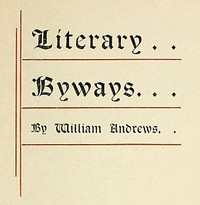
William Andrews opens Literary Byways by disclaiming any intention to add to critical works, instead offering 'leisure-hour studies' on topics that 'do not generally attract the reader’s attention.' The preface, dated July 5, 1898, signals a deliberate turn away from canonical literary history toward the marginal and the anecdotal. The book’s structure—a series of discrete chapters on authors at work, their earnings, epigrams, poetical graces, and curious American punishments—reflects a methodical but unhurried curiosity. Andrews moves from the habits of writers (Carlyle padding his room, Jean Paul Richter writing in the kitchen) to the legal brutalities of colonial Massachusetts, where scolds were gagged or ducked, and Quakers whipped at the cart’s tail. The tone is that of a collector of oddities, not a polemicist.
The Habits of Writers
The opening chapter, 'Authors at Work,' establishes Andrews’s method: he gathers examples of writers’ routines without imposing a thesis. One writer required evening dress to write; another could work only in dressing gown and slippers. Carlyle padded his room against noise, while Richter wrote serenely amid kitchen bustle. Andrews cites a 'great writer of the last generation' who distinguished morning work (the 'literature of knowledge') from evening work (the 'literature of power'). The effect is a mosaic of idiosyncrasies rather than a unified argument. Andrews does not rank these habits or draw moral lessons; he simply presents them as curiosities. The chapter’s appeal lies in its accumulation of detail—the dressing gown, the padded room—which gives texture to the abstract figure of 'the author.' The reader is left to infer that writing is less a profession than a collection of personal compulsions.
Punishments and Oddities in Early America
In 'Curious American Old-Time Gleanings,' Andrews turns to colonial legal records, quoting a 1672 Massachusetts order that 'scolds and railers shall be gagged or set in a ducking stool.' He reports that Philip Ratclif, for speaking against Salem Church, was sentenced to pay forty pounds, be whipped, have his ears cropped, and be banished. The Quakers Josiah Southwick, Mrs. Wilson, and Mrs. Buffum were whipped at the cart’s tail through Salem. Andrews also notes a 1789 prisoner who escaped from a Portsmouth jail and left a rhyming note on the wall: 'If you are well, I am well; Mend the chimney, and all’s well!' The passage is characteristic of Andrews’s method: he juxtaposes brutality with dark humor, never editorializing. The effect is a patchwork of severity and absurdity, drawn from sources like the Annals of Salem and Henry M. Brooks’s 'Olden Time Series.'
Lotteries and the Spinning Wheel
Andrews devotes a section to 'Curiosities of the Lottery,' noting that in early America, selling lottery tickets was considered as respectable as selling Bibles. He traces the first English lottery to 1569, drawn at St. Paul’s Cathedral, with proceeds used to repair harbors. In the United States, lotteries funded bridges, rivers, Faneuil Hall, and colleges like Harvard and Dartmouth. Advertisements were 'extremely quaint,' illustrated with crude pictures, and promised 'a speedy cure for a broken fortune.' Rhymes accompanied the ads. Andrews then pivots to 'Days of the Spinning Wheel,' a volume that records a now-vanished trade. The chapter closes without a grand conclusion; Andrews simply notes that such advertisements 'appeared in all the American newspapers.' The accumulation of examples—lotteries, spinning wheels, ducking stools—creates a sense of a world both remote and oddly familiar.
Forgotten Poets and Their Worlds
Several chapters recover the lives of minor poets: Anne Bradstreet, 'the earliest American poetess'; Catherine Fanshawe, 'a playful poet'; Mrs. John Hunter, 'a popular song writer'; Mary Pyper, 'a poet of the poor'; Susan K. Phillips, 'poet of the fisher-folk'; and Thomas Miller, 'a poet and novelist of the people.' Andrews does not argue for their literary merit; he presents biographical sketches laced with anecdote. The chapter on James Nayler, 'the Mad Quaker who claimed to be the Messiah,' and 'A Biographical Romance: Swan’s Strange Story' extend the range beyond poetry into religious eccentricity and obscure biography. The effect is a democratization of literary history: Andrews treats the forgotten with the same patient curiosity he grants the famous.
Andrews’s Literary Byways rewards a reader willing to follow its digressions. The book is best approached not as a continuous argument but as a cabinet of curiosities, each chapter a separate exhibit. Pay attention to the sources Andrews cites—Chambers’s Journal, the Annals of Salem, Henry M. Brooks—as they reveal the range of his research. The tone is consistently even, neither celebratory nor condemnatory, which allows the material to speak for itself. For those interested in the margins of literary history, the byways Andrews explores remain worth traveling.
Andrews’s little book lingers like a quiet evening spent sorting through someone’s attic—odd earnings, forgotten poets, strange punishments. It made me think of another friend’s shelf, one where such curiosities feel like shared secrets. That gentle, unhurried wonder is exactly what My Literary Passions — A Reader’s Guide awakened in me, a soft companionship with readers long gone.
James Robinson
1 week agoVictoria Ramirez
1 month agoOwen Flores
3 weeks ago-
Patricia Smith - 4 weeks ago
A treasure trove for book lovers and literary explorers! The author takes you on a whimsical journey through obscure authors, forgotten works, and literary curiosities. Each essay is meticulously researched and written with flair, making esoteric topics accessible and entertaining. I couldn't put it down. -
Terry Newton - 4 weeks ago
While the author clearly knows the subject, the essays often feel like dry encyclopedic entries rather than engaging narratives. There's little cohesion, and the 'byways' seem random and unconnected. Hardcore literary historians might find some value, but general readers will likely be bored. -
Scott Rice - 2 weeks ago
This collection of literary tidbits is enjoyable for those who appreciate eccentric facts about writers and books. Some chapters feel more engaging than others, and the flow could be smoother. However, it certainly sparks curiosity and is a great conversation starter for literary circles.
How did this book work for you?
Your answers remain private and are stored only in this browser.
John Martinez
2 weeks ago