1

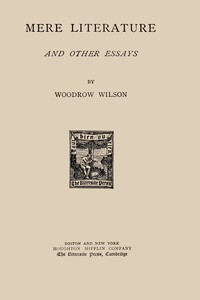
Mere literature, and other essays — Themes and Context
(0 User reviews)
2043
Project Gutenberg
2021
Not confirmed
Literature; Authors; United States -- History
Readers of public-domain and historical texts
Project Gutenberg digital edition
en
Edition facts
Words
58,837
Reading time
256 min
Text sections
12
This digital edition of Mere literature, and other essays — Themes and Context is described by source-level measurements including 58,837 words, 4 hr 16 min estimated reading time, and 12 detected text sections.
The text analysis averages about 25.5 words per sentence, while the detected sections provide another way to judge how the source is divided.
Project Gutenberg metadata also associates the work with “Literature,” connecting these edition facts with the source record’s subject description.
Source:
Project Gutenberg record #66074
Woodrow Wilson's 1896 collection of essays defends literature against scientific positivism, examines authorship, and profiles figures like Burke, using a formal, periodic style that itself embodies the literary values he champions.
Editorial Edition Score
4.8/5
★★★★★
★★★★★
Calculated from edition completeness, EPUB availability, text structure and catalogue metadata. Not a user rating.
How this score is calculated
- Description quality20 pts
- Title & short description10 pts
- Source metadata20 pts
- Text length15 pts
- Chapters / structure15 pts
- EPUB file integrity20 pts
Total of 100 points, scaled to a 2.5-5.0 range. Editions with an empty description or a missing EPUB file are not scored.
Edition quality
Read the Text
riding across a country. Cautious men ... go tremulously, like a timid rider; they turn hither and thither; they do not go straight across a subject, like a masterly mind. A few sentences are enough for a master of sentences. The writing of Sydney Smith is suited to the broader kind of important questions. For anything requiring fine nicety of speculation, long elaborateness of deduction, evanescent sharpness of distinction, neither his style nor his mind was fit. He had no patience for long argument, no acuteness for delicate precision, no fangs for recondite research. Writers, like teeth, are divided into incisors and grinders. Sydney Smith was a molar. He did not run a long, sharp argument into the interior of a question; he did not, in the common phrase, go deeply into it; but he kept it steadily under the contract of a strong, capable, jawlike understanding,--pressing its surface, effacing its intricacies, grinding it down. Yet this is done without toil. The play of the molar is instinctive and placid; he could not help it; it would seem that he had an enjoyment in it.”
One reads this with a feeling that Bagehot both knows and likes Sydney Smith, and heartily appreciates him as an engine of Whig thought; and with the conviction that Bagehot himself, knowing thus and enjoying Smith’s freehand method of writing, could have done the like himself,--could himself have made English ring to all the old Whig tunes, like an anvil under the hammer. And yet you have only to turn back a page in the same essay to find quite another Bagehot,--a Bagehot such as Sydney Smith could not have been. He is speaking of that other militant Edinburgh reviewer, Lord Jeffrey, and is recalling, as every one recalls, Jeffrey’s review of Wordsworth’s “Excursion.” The first words of that review, as everybody remembers, were, “This will never do;” and there followed upon those words, though not a little praise of the poetical beauties of the poem, a thoroughly meant condemnation of the school of poets of which Wordsworth was the greatest representative. Very celebrated in the world of literature is the leading case of Jeffrey _v._ Wordsworth. It is in summing up this case that Bagehot gives us a very different taste of his quality:--
“The world has given judgment. Both Mr. Wordsworth and Lord Jeffrey have received their reward. The one had his own generation, the laughter of men, the applause of drawing-rooms, the concurrence of the crowd; the other a succeeding age, the fond enthusiasm of secret students, the lonely rapture of lonely minds. And each has received according to his kind. If all cultivated men speak differently because of the existence of Wordsworth and Coleridge; if not a thoughtful English book has appeared for forty years without some trace for good or evil of their influence; if sermon-writers subsist upon their thoughts; if ‘sacred poets’ thrive by translating their weaker portions into the speech of women; if, when all this is over, some sufficient part of their writing will ever be found fitting food for wild musing and solitary meditation, surely this is because they possessed the inner nature,--‘an intense and glowing mind,’ ‘the vision and the faculty divine.’ But if, perchance, in their weaker moments, the great authors of the ‘Lyrical Ballads’ did ever imagine that the world was to pause because of their verses, that ‘Peter Bell’ would be popular in drawing-rooms, that ‘Christabel’ would be perused in the city, that people of fashion would make a handbook of ‘The Excursion,’ it was well for them to be told at once that this was not so. Nature ingeniously prepared a shrill artificial voice, which spoke in season and out of season, enough and more than enough, what will ever be the idea of the cities of the plain concerning those who live alone among the mountains, of the frivolous concerning the grave, of the gregarious concerning the recluse, of those who laugh concerning those who laugh not, of the common concerning the uncommon, of those who lend on usury concerning those who lend not; the notion of the world of those whom it will not reckon among the righteous,--it said, ‘This won’t do!’ And so in all time will the lovers of polished Liberalism speak concerning the intense and lonely prophet.”
This is no longer the Bagehot who could “write across a sheet” with Sydney Smith. It is now a Bagehot whose heart is turned away from the cudgeling Whigs to see such things as are hidden from the bearers of cudgels, and revealed only to those who can await in the sanctuary of a quiet mind the coming of the vision.
Wilson opens the title essay by dissecting the phrase "mere literature" as a sneer from the scientific age, which dismisses literary creation as "mere talk" and "mere pastime." He argues that this attitude has infected college curricula, forcing literature to adopt the methods of science. The essay sets up a tension between the measurable and the imaginative, a theme that recurs across the collection.
The Scientist’s Sneer and the Literary Reply
Wilson begins by taking the phrase "mere literature" literally, calling it "the irreverent invention of a scientific age." He contrasts the scientist’s respect for "demonstrable knowledge" with the view of literary works as "incalculable vagaries." The essay then turns to how this mindset affects education: literature is "commanded to assume the phrases and the methods of science." Wilson’s own prose—formal, periodic, and deliberately literary—serves as a counterexample. He does not name specific scientists or textbooks, but the critique is pointed: the study of literature in universities risks becoming an agent of "Philistinism." The opening thus frames the entire volume as a defense of literature’s intrinsic value, not as data or entertainment.
Burke’s Grandeur and the Disparity of Station
In the essay on Burke, Wilson examines the gap between Burke’s intellectual authority and his modest political offices. He notes that Burke "never wielded the power of a great statesman" despite uttering statesmanlike thoughts with "unapproachable nobility." Wilson attributes this partly to the era’s practice of keeping "men of insignificant birth" from high office. He also hints at "faults of temper" that may have hindered Burke. The analysis is grounded in specific episodes: Burke’s defense of his pension in the "Letter to a Noble Lord," where he speaks "grandly about himself" without seeming disproportionate. Wilson observes that Burke’s "great authority is over us rather than over the men of his own day," a judgment that positions Burke as a figure whose true stature was recognized only posthumously.
The Burkes and the Web of Connection
Wilson traces how William Burke, a relative, helped Edmund Burke gain entry to Lord Rockingham’s circle. The narrative includes a vivid anecdote: the Duke of Newcastle, mistaking Burke for a low-born adventurer, spread slanders that his real name was O’Bourke and that he was a "rank Papist." Rockingham, however, confronted Burke directly, was satisfied by his denials, and admitted him to "intimate relations of warm personal friendship." Wilson’s account is notable for its specificity—the names, the boroughs, the East India speculations—and for its dry tone. He presents the episode as both a testament to Rockingham’s character and an illustration of the social obstacles Burke faced. The detail that William Burke "seems to have found means of knowing everybody it was to the interest of ‘the Burkes’ to know" hints at a network of ambition and patronage.
Periods and Proportions: Style as Substance
Throughout the collection, Wilson’s own style mirrors the qualities he admires in Burke: formal, balanced, and occasionally majestic. He describes how Burke narrated his "progressions from London to Buriton" in the same "monotonous, majestic periods" used for the fall of states. Wilson himself employs similar periodic sentences, often with a qualifying clause or a turn. For instance, he writes that Burke’s generation saw "a touch of pretension" in his tone, only to add that "his great authority is over us." This self-consciousness about style is part of Wilson’s argument: literature is not mere ornament but a mode of thought. The reader is invited to observe how Wilson’s prose enacts the very literary values he defends—precision, rhythm, and a refusal to reduce expression to information.
Reading with an Eye to Voice and Structure
Wilson’s essays reward attention to their rhetorical architecture. The opening essay establishes a polemical stance that later pieces complicate: the essay on Burke, for example, is as much a character study as a defense of literary style. Readers may note how Wilson shifts between abstract argument and concrete anecdote, and how his periodic sentences build toward a culminating point. The collection’s structure—moving from a general defense of literature to specific portraits—invites comparison between the ideals stated and the examples given. Wilson’s own voice, formal yet engaged, provides a consistent thread.
Wilson’s essays are best approached as performances of the literary values they advocate. The reader who attends to his sentence rhythms, his use of anecdote, and his habit of qualifying bold claims will find a coherent argument about the place of imagination in public life. The collection does not offer a systematic theory; it demonstrates, through its own prose, what literature can do when it is taken seriously.
Rain fell against the windows that afternoon, and Wilson’s formal cadences filled the quiet room, his faith in words as a bulwark against blunt fact. Later, turning pages idly, I found myself recalling his earnest trust in conviction. That same earnestness surfaces elsewhere, in a young aviator’s letters from 1917 — Above the French Lines Letters of Stuart Walcott, American Aviator: July 4, 1917, to December 8, 1917 — Text and Context, where duty speaks plainly, unadorned by ornament.
There are no reviews for this eBook.
There are no comments for this eBook.
Reader reflection
Before you leave, reflect on the book
Use these questions to collect your thoughts before moving on.
Your progress
0
/
10
2
Did this book hold your interest?
3
Would you encourage someone else to read it?
4
How much effort did this book require?
5
What did you appreciate most?
6
How useful were the ideas in this book?
7
How closely did the book connect with your experience?
8
How distinctive were its ideas or approach?
9
What is the main idea you are taking away?
10