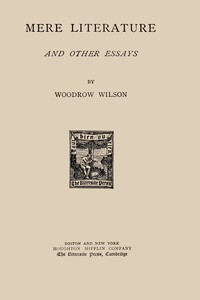
Mere literature, and other essays — Themes and Context

(6 User reviews)   2016
Wilson, Woodrow, 1856-1924 Project Gutenberg 2021 Not confirmed
Literature; Authors; United States -- History Readers of public-domain and historical texts
Project Gutenberg digital edition en

Edition facts

Words 58,837
Reading time 256 min
Text sections 12

This digital edition of Mere literature, and other essays — Themes and Context is described by source-level measurements including 58,837 words, 4 hr 16 min estimated reading time, and 12 detected text sections.

The text analysis averages about 25.5 words per sentence, while the detected sections provide another way to judge how the source is divided.

Project Gutenberg metadata also associates the work with “Literature,” connecting these edition facts with the source record’s subject description.

Woodrow Wilson's 1896 collection of essays defends literature against scientific positivism, examines authorship, and profiles figures like Burke, using a formal, periodic style that itself embodies the literary values he champions.
Share
Editorial Edition Score 4.8/5

Calculated from edition completeness, EPUB availability, text structure and catalogue metadata. Not a user rating.

How this score is calculated
  • Description quality20 pts
  • Title & short description10 pts
  • Source metadata20 pts
  • Text length15 pts
  • Chapters / structure15 pts
  • EPUB file integrity20 pts

Total of 100 points, scaled to a 2.5-5.0 range. Editions with an empty description or a missing EPUB file are not scored.

Edition quality

Read the Text

riding across a country. Cautious men ... go tremulously, like a timid rider; they turn hither and thither; they do not go straight across a subject, like a masterly mind. A few sentences are enough for a master of sentences. The writing of Sydney Smith is suited to the broader kind of important questions. For anything requiring fine nicety of speculation, long elaborateness of deduction, evanescent sharpness of distinction, neither his style nor his mind was fit. He had no patience for long argument, no acuteness for delicate precision, no fangs for recondite research. Writers, like teeth, are divided into incisors and grinders. Sydney Smith was a molar. He did not run a long, sharp argument into the interior of a question; he did not, in the common phrase, go deeply into it; but he kept it steadily under the contract of a strong, capable, jawlike understanding,--pressing its surface, effacing its intricacies, grinding it down. Yet this is done without toil. The play of the molar is instinctive and placid; he could not help it; it would seem that he had an enjoyment in it.”

One reads this with a feeling that Bagehot both knows and likes Sydney Smith, and heartily appreciates him as an engine of Whig thought; and with the conviction that Bagehot himself, knowing thus and enjoying Smith’s freehand method of writing, could have done the like himself,--could himself have made English ring to all the old Whig tunes, like an anvil under the hammer. And yet you have only to turn back a page in the same essay to find quite another Bagehot,--a Bagehot such as Sydney Smith could not have been. He is speaking of that other militant Edinburgh reviewer, Lord Jeffrey, and is recalling, as every one recalls, Jeffrey’s review of Wordsworth’s “Excursion.” The first words of that review, as everybody remembers, were, “This will never do;” and there followed upon those words, though not a little praise of the poetical beauties of the poem, a thoroughly meant condemnation of the school of poets of which Wordsworth was the greatest representative. Very celebrated in the world of literature is the leading case of Jeffrey _v._ Wordsworth. It is in summing up this case that Bagehot gives us a very different taste of his quality:--

“The world has given judgment. Both Mr. Wordsworth and Lord Jeffrey have received their reward. The one had his own generation, the laughter of men, the applause of drawing-rooms, the concurrence of the crowd; the other a succeeding age, the fond enthusiasm of secret students, the lonely rapture of lonely minds. And each has received according to his kind. If all cultivated men speak differently because of the existence of Wordsworth and Coleridge; if not a thoughtful English book has appeared for forty years without some trace for good or evil of their influence; if sermon-writers subsist upon their thoughts; if ‘sacred poets’ thrive by translating their weaker portions into the speech of women; if, when all this is over, some sufficient part of their writing will ever be found fitting food for wild musing and solitary meditation, surely this is because they possessed the inner nature,--‘an intense and glowing mind,’ ‘the vision and the faculty divine.’ But if, perchance, in their weaker moments, the great authors of the ‘Lyrical Ballads’ did ever imagine that the world was to pause because of their verses, that ‘Peter Bell’ would be popular in drawing-rooms, that ‘Christabel’ would be perused in the city, that people of fashion would make a handbook of ‘The Excursion,’ it was well for them to be told at once that this was not so. Nature ingeniously prepared a shrill artificial voice, which spoke in season and out of season, enough and more than enough, what will ever be the idea of the cities of the plain concerning those who live alone among the mountains, of the frivolous concerning the grave, of the gregarious concerning the recluse, of those who laugh concerning those who laugh not, of the common concerning the uncommon, of those who lend on usury concerning those who lend not; the notion of the world of those whom it will not reckon among the righteous,--it said, ‘This won’t do!’ And so in all time will the lovers of polished Liberalism speak concerning the intense and lonely prophet.”

This is no longer the Bagehot who could “write across a sheet” with Sydney Smith. It is now a Bagehot whose heart is turned away from the cudgeling Whigs to see such things as are hidden from the bearers of cudgels, and revealed only to those who can await in the sanctuary of a quiet mind the coming of the vision.

Single specimens of such a man’s writing do not suffice, of course, even as specimens. They need their context to show their appositeness, the full body of the writing from which they are taken to show the mass and system of the thought. Even separated pieces of his matter prepare us, nevertheless, for finding in Bagehot keener, juster estimates of difficult historical and political characters than it is given the merely exact historian, with his head full of facts and his heart purged of all imagination, to speak. There is his estimate of the cavalier, for example: “A cavalier is always young. The buoyant life arises before us, rich in hope, strong in vigor, irregular in action: men young and ardent, ‘framed in the prodigality of nature;’ open to every enjoyment, alive to every passion, eager, impulsive; brave without discipline, noble without principle; prizing luxury, despising danger; capable of high sentiment, but in each of whom the

‘addiction was to courses vain; His companies unlettered, rude, and shallow; His hours filled up with riots, banquets, sports, And never noted in him any study, Any retirement, any sequestration From open haunts and popularity.’

The political sentiment is part of the character; the essence of Toryism is enjoyment.... The way to keep up old customs is to enjoy old customs; the way to be satisfied with the present state of things is to enjoy the present state of things. Over the cavalier mind this world passes with a thrill of delight; there is an exultation in a daily event, zest in the ‘regular thing,’ joy at an old feast.”

Is it not most natural that the writer of a passage like that should have been a consummate critic of politics, seeing institutions through men, the only natural way? It was as necessary that he should be able to enjoy Sydney Smith and recognize the seer in Wordsworth as that he should be able to conceive the cavalier life and point of view; and in each perception there is the same power. He is as little at fault in understanding men of his own day. What would you wish better than his celebrated character of a “constitutional statesman,” for example? “A constitutional statesman is a man of common opinions and uncommon abilities.” Peel is his example. “His opinions resembled the daily accumulating insensible deposits of a rich alluvial soil. The great stream of time flows on with all things on its surface; and slowly, grain by grain, a mould of wise experience is unconsciously left on the still, extended intellect.... The stealthy accumulating words of Peel seem like the quiet leavings of some outward tendency, which brought these, but might as well have brought others. There is no peculiar stamp, either, on the ideas. They might have been any one’s ideas. They belong to the general diffused stock of observations which are to be found in the civilized world.... He insensibly takes in and imbibes the ideas of those around him. If he were left in a vacuum, he would have no ideas.”

What strikes one most, perhaps, in all these passages, is the realizing imagination which illuminates them. And it is an imagination with a practical character all its own. It is not a creating, but a conceiving imagination; not the imagination of the fancy, but the imagination of the understanding. Conceiving imaginations, however, are of two kinds. For the one kind the understanding serves as a lamp of guidance; upon the other the understanding acts as an electric excitant, a keen irritant. Bagehot’s was evidently of the first kind; Carlyle’s, conspicuously of the second. There is something in common between the minds of these two men as they conceive society. Both have a capital grip upon the actual; both can conceive without confusion the complex phenomena of society; both send humorous glances of searching insight into the hearts of men. But it is the difference between them that most arrests our attention. Bagehot has the scientific imagination, Carlyle the passionate. Bagehot is the embodiment of witty common sense; all the movements of his mind illustrate that vivacious sanity which he has himself called “animated moderation.” Carlyle, on the other hand, conceives men and their motives too often with a hot intolerance; there is heat in his imagination,--a heat that sometimes scorches and consumes. Life is for him dramatic, full of fierce, imperative forces. Even when the world rings with laughter, it is laughter which, in his ears, is succeeded by an echo of mockery; laughter which is but a defiance of tears. The actual which you touch in Bagehot is the practical, operative actual of a world of workshops and parliaments,--a world of which workshops and parliaments are the natural and desirable products. Carlyle flouts at modern legislative assemblies as “talking shops,” and yearns for action such as is commanded by masters of action; preaches the doctrine of work and silence in some thirty volumes octavo. Bagehot points out that prompt, crude action is the instinct and practice of the savage; that talk, the deliberation of assemblies, the slow concert of masses of men, is the cultivated fruit of civilization, nourishing to all the powers of right action in a society which is not simple and primitive, but advanced and complex. He is no more imposed upon by parliamentary debates than Carlyle is. He knows that they are stupid, and, so far as wise utterance goes, in large part futile, too. But he is not irritated, as Carlyle is, for, to say the fact, he sees more than Carlyle sees. He sees the force and value of the stupidity. He is wise, along with Burke, in regarding prejudice as the cement of society. He knows that slow thought is the ballast of a self-governing state. Stanch, knitted timbers are as necessary to the ship as sails. Unless the hull is conservative in holding stubbornly together in the face of every argument of sea weather, there’ll be lives and fortunes lost. Bagehot can laugh at unreasoning bias. It brings a merry twinkle into his eye to undertake the good sport of dissecting stolid stupidity. But he would not for the world abolish bias and stupidity. He would much rather have society hold together; much rather see it grow than undertake to reconstruct it. “You remember my joke against you about the moon,” writes Sydney Smith to Jeffrey; “d--n the solar system--bad light--planets too distant--pestered with comets--feeble contrivance; could make a better with great ease.” There was nothing of this in Bagehot. He was inclined to be quite tolerant of the solar system. He understood that society was more quickly bettered by sympathy than by antagonism.

Bagehot’s limitations, though they do not obtrude themselves upon your attention as his excellencies do, are in truth as sharp-cut and clear as his thought itself. It would not be just the truth to say that his power is that of critical analysis only, for he can and does construct thought concerning antique and obscure systems of political life and social action. But it is true that he does not construct for the future. You receive stimulation from him and a certain feeling of elation. There is a fresh air stirring in all his utterances that is unspeakably refreshing. You open your mind to the fine influence, and feel younger for having been in such an atmosphere. It is an atmosphere clarified and bracing almost beyond example elsewhere. But you know what you lack in Bagehot if you have read Burke. You miss the deep eloquence which awakens purpose. You are not in contact with systems of thought or with principles that dictate action, but only with a perfect explanation.

You would go to Burke, not to Bagehot, for inspiration in the infinite tasks of self-government; though you would, if you were wise, go to Bagehot rather than to Burke if you wished to realize just what were the practical daily conditions under which those tasks were to be worked out.

Moreover, there is a deeper lack in Bagehot. He has no sympathy with the voiceless body of the people, with the “mass of unknown men.” He conceives the work of government to be a work which is possible only to the instructed few. He would have the mass served, and served with devotion, but he would trouble to see them attempt to serve themselves. He has not the stout fibre and the unquestioning faith in the right and capacity of inorganic majorities which make the democrat. He has none of the heroic boldness necessary for faith in wholesale political aptitude and capacity. He takes democracy in detail in his thought, and to take it in detail makes it look very awkward indeed.

And yet surely it would not occur to the veriest democrat that ever vociferated the “sovereignty of the people” to take umbrage at anything Bagehot might chance to say in dissection of democracy. What he says is seldom provokingly true. There is something in it all that is better than a “saving clause,” and that is a saving humor. Humor ever keeps the whole of his matter sound; it is an excellent salt that keeps sweet the sharpest of his sayings. Indeed, Bagehot’s wit is so prominent among his gifts that I am tempted here to enter a general plea for wit as fit company for high thoughts and weighty subjects. Wit does not make a subject light; it simply beats it into shape to be handled readily. For my part, I make free acknowledgment that no man seems to me master of his subject who cannot take liberties with it; who cannot slap his propositions on the back and be hail-fellow well met with them. Suspect a man of shallowness who always takes himself and all that he thinks seriously. For light on a dark subject commend me to a ray of wit. Most of your solemn explanations are mere farthing candles in the great expanse of a difficult question. Wit is not, I admit, a steady light, but ah! its flashes give you sudden glimpses of unsuspected things such as you will never see without it. It is the summer lightning, which will bring more to your startled eye in an instant, out of the hiding of the night, than you will ever be at the pains to observe in the full blaze of noon.

Wit is movement, is play of mind; and the mind cannot get play without a sufficient playground. Without movement outside the world of books, it is impossible a man should see aught but the very neatly arranged phenomena of that world. But it is possible for a man’s thought to be instructed by the world of affairs without the man himself becoming a part of it. Indeed, it is exceedingly hard for one who is in and of it to hold the world of affairs off at arm’s length and observe it. He has no vantage-ground. He had better for a while seek the distance of books, and get his perspective. The literary politician, let it be distinctly said, is a very fine, a very superior species of the man thoughtful. He reads books as he would listen to men talk. He stands apart, and looks on, with humorous, sympathetic smile, at the play of policies. He will tell you for the asking what the players are thinking about. He divines at once how the parts are cast. He knows beforehand what each act is to discover. He might readily guess what the dialogue is to contain. Were you short of scene-shifters, he could serve you admirably in an emergency. And he is a better critic of the play than the players.

Had I command of the culture of men, I should wish to raise up for the instruction and stimulation of my nation more than one sane, sagacious, penetrative critic of men and affairs like Walter Bagehot. But that, of course. The proper thesis to draw from his singular genius is this: It is not the constitutional lawyer, nor the student of the mere machinery and legal structure of institutions, nor the politician, a mere handler of that machinery, who is competent to understand and expound government; but the man who finds the materials for his thought far and wide, in everything that reveals character and circumstance and motive. It is necessary to stand with the poets as well as with lawgivers; with the fathers of the race as well as with your neighbor of to-day; with those who toil and are sick at heart as well as with those who prosper and laugh and take their pleasure; with the merchant and the manufacturer as well as with the closeted student; with the schoolmaster and with those whose only school is life; with the orator and with the men who have wrought always in silence; in the midst of thought and also in the midst of affairs, if you would really comprehend those great wholes of history and of character which are the vital substance of politics.

THE INTERPRETER OF ENGLISH LIBERTY.

In the middle of the last century two Irish adventurers crossed over into England in search of their fortunes. Rare fellows they were, bringing treasure with them; but finding it somehow hard to get upon the market: traders with a curious cargo, offering edification in exchange for a living, and concealing the best of English under a rich brogue. They were Edmund Burke and Oliver Goldsmith.

They did not cross over together: ’twas no joint venture. They had been fellow students at Trinity College, Dublin; but they had not, so far as we can learn, known each other there. Each went his own way till they became comrades in the reign of Samuel Johnson at the Turk’s Head Tavern. Burke stepped very boldly forth into the exposed paths of public life; Goldsmith plunged into the secret ways about Grub Street. The one gave us essays upon public questions incomparable for their reach of view and their splendid power of expression; the other gave us writings so exquisite for their delicacy, purity, and finish as to incline us to love him almost as much as those who knew him loved him. We could not easily have forgiven Ireland if she had _not_ given us these men. The one had grave faults of temper; the other was a reckless, roystering fellow, with a most irrepressible Irish disposition; but how much less we should have known without Burke, how much less we should have enjoyed without Goldsmith! They have conquered places for themselves in English literature from which we neither can nor would dislodge them. For their sakes alone we can afford to forgive Ireland all the trouble she has caused us.

Wilson opens the title essay by dissecting the phrase "mere literature" as a sneer from the scientific age, which dismisses literary creation as "mere talk" and "mere pastime." He argues that this attitude has infected college curricula, forcing literature to adopt the methods of science. The essay sets up a tension between the measurable and the imaginative, a theme that recurs across the collection.

The Scientist’s Sneer and the Literary Reply

Wilson begins by taking the phrase "mere literature" literally, calling it "the irreverent invention of a scientific age." He contrasts the scientist’s respect for "demonstrable knowledge" with the view of literary works as "incalculable vagaries." The essay then turns to how this mindset affects education: literature is "commanded to assume the phrases and the methods of science." Wilson’s own prose—formal, periodic, and deliberately literary—serves as a counterexample. He does not name specific scientists or textbooks, but the critique is pointed: the study of literature in universities risks becoming an agent of "Philistinism." The opening thus frames the entire volume as a defense of literature’s intrinsic value, not as data or entertainment.

Burke’s Grandeur and the Disparity of Station

In the essay on Burke, Wilson examines the gap between Burke’s intellectual authority and his modest political offices. He notes that Burke "never wielded the power of a great statesman" despite uttering statesmanlike thoughts with "unapproachable nobility." Wilson attributes this partly to the era’s practice of keeping "men of insignificant birth" from high office. He also hints at "faults of temper" that may have hindered Burke. The analysis is grounded in specific episodes: Burke’s defense of his pension in the "Letter to a Noble Lord," where he speaks "grandly about himself" without seeming disproportionate. Wilson observes that Burke’s "great authority is over us rather than over the men of his own day," a judgment that positions Burke as a figure whose true stature was recognized only posthumously.

The Burkes and the Web of Connection

Wilson traces how William Burke, a relative, helped Edmund Burke gain entry to Lord Rockingham’s circle. The narrative includes a vivid anecdote: the Duke of Newcastle, mistaking Burke for a low-born adventurer, spread slanders that his real name was O’Bourke and that he was a "rank Papist." Rockingham, however, confronted Burke directly, was satisfied by his denials, and admitted him to "intimate relations of warm personal friendship." Wilson’s account is notable for its specificity—the names, the boroughs, the East India speculations—and for its dry tone. He presents the episode as both a testament to Rockingham’s character and an illustration of the social obstacles Burke faced. The detail that William Burke "seems to have found means of knowing everybody it was to the interest of ‘the Burkes’ to know" hints at a network of ambition and patronage.

Periods and Proportions: Style as Substance

Throughout the collection, Wilson’s own style mirrors the qualities he admires in Burke: formal, balanced, and occasionally majestic. He describes how Burke narrated his "progressions from London to Buriton" in the same "monotonous, majestic periods" used for the fall of states. Wilson himself employs similar periodic sentences, often with a qualifying clause or a turn. For instance, he writes that Burke’s generation saw "a touch of pretension" in his tone, only to add that "his great authority is over us." This self-consciousness about style is part of Wilson’s argument: literature is not mere ornament but a mode of thought. The reader is invited to observe how Wilson’s prose enacts the very literary values he defends—precision, rhythm, and a refusal to reduce expression to information.

Reading with an Eye to Voice and Structure

Wilson’s essays reward attention to their rhetorical architecture. The opening essay establishes a polemical stance that later pieces complicate: the essay on Burke, for example, is as much a character study as a defense of literary style. Readers may note how Wilson shifts between abstract argument and concrete anecdote, and how his periodic sentences build toward a culminating point. The collection’s structure—moving from a general defense of literature to specific portraits—invites comparison between the ideals stated and the examples given. Wilson’s own voice, formal yet engaged, provides a consistent thread.

Wilson’s essays are best approached as performances of the literary values they advocate. The reader who attends to his sentence rhythms, his use of anecdote, and his habit of qualifying bold claims will find a coherent argument about the place of imagination in public life. The collection does not offer a systematic theory; it demonstrates, through its own prose, what literature can do when it is taken seriously.

Rain fell against the windows that afternoon, and Wilson’s formal cadences filled the quiet room, his faith in words as a bulwark against blunt fact. Later, turning pages idly, I found myself recalling his earnest trust in conviction. That same earnestness surfaces elsewhere, in a young aviator’s letters from 1917 — Above the French Lines Letters of Stuart Walcott, American Aviator: July 4, 1917, to December 8, 1917 — Text and Context, where duty speaks plainly, unadorned by ornament.

Olivia Lee
1 month ago

Sophia Johnson
2 weeks ago

Amelia Lewis
4 weeks ago

Isaac Clark
2 weeks ago

Ava Anderson
1 week ago

4.5
4.5 out of 5 (6 User reviews )

Add a Review

Your Rating *
  • ...
    Cory Mary Terry - 1 month ago
    These essays feel like a chore to get through. Wilson's language is dense and pompous, and the subjects are too niche. While historically interesting, they offer little to the general reader today. The book is more of a museum piece than a compelling read.

  • ...
    Nicole Carr - 1 month ago
    Wilson's essays are intellectually stimulating, but they can be dry and formal. His focus on classical literature may not engage all modern readers. Nevertheless, for those interested in early 20th-century criticism and the mind of a president, this collection offers a rewarding read.

  • ...
    Alexander Robinson - 3 weeks ago
    A brilliant collection of essays that prove Woodrow Wilson was not only a great statesman but also a gifted writer and thinker. His insights into literature and culture are sharp and elegantly expressed. This book offers a unique perspective from a historical figure, enriching our understanding of both literature and politics.


Reader reflection

Before you leave, reflect on the book

Use these questions to collect your thoughts before moving on.

Your progress 0 / 10
1

How far have you progressed with this book?

2

Did this book hold your interest?

3

Would you encourage someone else to read it?

4

How much effort did this book require?

Related eBooks