1

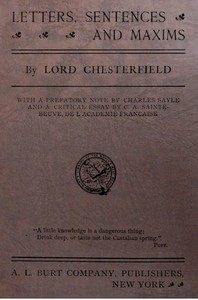
Letters, sentences and maxims — Edition Insights
(0 User reviews)
188
Project Gutenberg
2023
Not confirmed
Conduct of life; Maxims
Readers of public-domain and historical texts
Project Gutenberg digital edition
en
Edition facts
Words
81,413
Reading time
354 min
Text sections
12
Before opening Letters, sentences and maxims — Edition Insights, the edition data offers a quick orientation: 81,413 words, 5 hr 54 min estimated reading time, and 12 detected text sections.
The text analysis averages about 23.7 words per sentence, while the detected sections provide another way to judge how the source is divided.
Project Gutenberg metadata also associates the work with “Conduct of life,” connecting these edition facts with the source record’s subject description.
Source:
Project Gutenberg record #69855
An editorial note on Lord Chesterfield's letters, focusing on his epistolary style, use of maxims, and shifts between intimate advice and worldly observation.
Editorial Edition Score
4.8/5
★★★★★
★★★★★
Calculated from edition completeness, EPUB availability, text structure and catalogue metadata. Not a user rating.
How this score is calculated
- Description quality20 pts
- Title & short description10 pts
- Source metadata20 pts
- Text length15 pts
- Chapters / structure15 pts
- EPUB file integrity20 pts
Total of 100 points, scaled to a 2.5-5.0 range. Editions with an empty description or a missing EPUB file are not scored.
Edition quality
Public-domain source text
Read the source text
The source text is kept in the dedicated reader, separate from this catalogue record and its commentary.
Lord Chesterfield's letters to his son are often read as a manual of worldly conduct, but their literary texture rewards closer attention to the writer's voice. The letters move between brisk, aphoristic advice and more leisurely reflections on character, revealing a mind that values both precision and ease. Chesterfield's prose is notably terse and elegant, as Lord Mahon observed, yet it also accommodates sudden shifts in tone—from the stern admonition to the wry aside. This editorial note examines three features of that voice: the rhythm of his maxims, the strategic use of French phrases, and the way he modulates pace between instruction and anecdote.
The Maxim as a Structural Unit
Chesterfield frequently compresses his advice into self-contained maxims that function almost as epigrams. Sentences such as “Dissimilation is a shield, as secrecy is armor” or “A young fellow ought to be wiser than he should seem to be” are not merely decorative; they serve as anchors for longer paragraphs. The reader can observe how a maxim often opens or closes a paragraph, giving the argument a memorable shape. This habit creates a rhythm of assertion and elaboration: the maxim states a principle, and the following sentences unpack its application. The effect is a style that feels both authoritative and conversational, as if the writer is handing down rules while still engaging in dialogue.
French Borrowings and Social Texture
Chesterfield peppers his English with French terms—les manières nobles, bons diables, pic-nic—that signal his cosmopolitan ideal. These borrowings are not random; they often mark concepts he considers untranslatable or especially refined. For instance, he contrasts les manières nobles with the behavior of “low people,” using the French phrase to denote a quality he believes English lacks a precise word for. This code-switching also establishes a shared cultural shorthand with his son, implying that true breeding includes fluency in French social vocabulary. The reader should note how these insertions affect the prose’s texture: they introduce a slight foreign rhythm, breaking the English cadence and reminding us that Chesterfield’s world is deliberately European.
Shifts in Pace: From Precept to Portrait
Not all letters maintain the same tempo. When Chesterfield turns to character sketches—as in his portrait of the Duke of Marlborough—the prose relaxes into a more narrative mode. He describes the Duke as “eminently illiterate” yet possessing “an excellent good plain understanding,” and he attributes the Duke’s success to “the graces” rather than to learning. This anecdotal passage slows the reader down, offering a concrete example of the abstract advice given elsewhere. The contrast is instructive: the maxim-driven paragraphs feel urgent and prescriptive, while the portraits invite reflection. By alternating these modes, Chesterfield prevents his instruction from becoming monotonous and gives his son (and the reader) breathing room.
Readers approaching these letters as a unified work will benefit from attending to these shifts in voice and pace. Chesterfield’s style is not uniform; it adapts to purpose, audience, and subject. The maxims, the French phrases, and the anecdotal interludes each contribute to a prose that is at once didactic and urbane. To read with an ear for these variations is to see why the letters have outlasted their author’s political achievements.
Reading Chesterfield’s maxims, I remembered my grandfather’s cramped handwriting on half-folded letters, each lesson wrapped in worldly weariness. That same hush of inherited wisdom came back when I found My Literary Passions — A Reader’s Guide, where old voices sound almost like whispered asides. Some books simply hold the shape of a quiet hour spent listening.
There are no reviews for this eBook.
There are no comments for this eBook.
Reader reflection
Record your reading impressions
A brief reflection can help important ideas stay with you longer.
Your progress
0
/
10
2
Did this book hold your interest?
3
Would you encourage someone else to read it?
4
What was the reading difficulty like?
5
Did it raise ideas you would like to talk about?
6
Which part made the strongest impression?
7
Would you read this book again?
8
Was the book easy to understand?
9
Which lesson or insight stayed with you?
10