
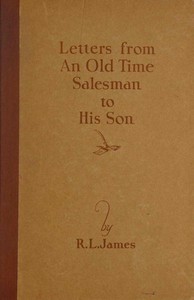
Letters From an Old Time Salesman to His Son — Themes and Context
Edition facts
Before opening Letters From an Old Time Salesman to His Son — Themes and Context, the edition data offers a quick orientation: 31,211 words, 2 hr 16 min estimated reading time, and 27 detected text sections.
The text analysis averages about 32.3 words per sentence, while the detected sections provide another way to judge how the source is divided.
Project Gutenberg metadata also associates the work with “Selling,” connecting these edition facts with the source record’s subject description.
Calculated from edition completeness, EPUB availability, text structure and catalogue metadata. Not a user rating.
How this score is calculated
- Description quality20 pts
- Title & short description10 pts
- Source metadata20 pts
- Text length15 pts
- Chapters / structure15 pts
- EPUB file integrity20 pts
Total of 100 points, scaled to a 2.5-5.0 range. Editions with an empty description or a missing EPUB file are not scored.
Read the Text
in your throat and called it a meal? After sitting around the lobby making out a few reports and listening to the senseless patter of a dumb-bell in a checked suit and a pink tie, you took your little pitcher with the broken handle, filled it at the faucet and went up to a sea-going bed that humped up in the middle like William S. Hart's pet broncho?
Remember, Red, how you worried yourself to sleep--sick of the whole bloomin' mess, but determined that if others could succeed, you could? You got up in the morning, shaved in ice water, but stuck out your chin and strode to the dining room? Remember the gum-chewing waitress whom someone had told she looked like Theda Bara, who brought in a murky glass of water and exclaimed in a breath, “Steakhamliver'nbacon an' how'd you want yer aigs?” You wouldn't have known the coffee if it hadn't been in a cup, but you picked around like an old hen and sauntered out into the lobby still unbeaten when the fresh squirt behind the register handed you three letters.
Ah, Red--how you smiled! The first one was written in a round girlish hand and told of the good time she was planning with you when you got back to “headquarters.” The next one was written in an old-fashioned hand, now a little scrawly and nervous from age, but it carried the “mother message” of hope and pride in the success she knew was bound to come to “her boy.” Things weren't so black after all--you'd show those hard-shell merchants you would. You were almost normal when you opened the last letter, which from the envelope you knew was from “the Boss.” It read--“Why don't you send us some orders--we didn't send you out to write up weather reports; we don't pay your salary to allow you to loll in good hotels. Unless you do better next week, we'll have to make a change.”
Bam! How'd you feel, Red? Now, honest--hasn't it happened to you? Did it fill you full of pep and enthusiasm and cause you to go out and just knock the cover off the ball? You bet it didn't and such things never will. That kind of letter was written by a graduate hack-driver, not a real man manager.
New, Red, listen--you were made Branch Manager because of your experience, not alone in the product--not alone in selling, but experience in Life. Your company thinks you have seen so much of conditions that you know how to “help” the weaker brother over the rough places. Teach 'em, Red, lead 'em! The only place for a driver is on the south end of a pair of mules. A kind word here, a helpful suggestion there, will make your men want to take off their coats to help you, Boy, and it is the cheapest way in the world to buy loyalty.
And Red, don't spend all your time telling the other fellow how to do it. All men are not “from Missouri,” but the “show me” method carries a healthier kick than volumes of sales talks.
You're going to be a busy man in the new job, Boy, but Mother and I have decided now that we're glad we didn't insist on your finishing your musical education, for some day we know you'll be a Sales Manager and I tell Mother that if she had her way, you would now be playing the snare drum in a jazz orchestra.
Let's go, Boy, let's go!
_The Boy Is Having His Troubles as a Branch Manager_
Mother and I received your letter several days ago and I have given quite some thought to the problems you mention, because I wanted to advise you right, if at all.
Note you say you are not meeting with the success you expected to, in your present campaign and you attribute it to several causes, among them a consumers' hunger strike, conservative buying and lack of effort on the part of the salesmen.
Well--now, of course, the Old Man may not know as much about it as you do, but from several other statements you made in your letter, I'm wondering if you have really struck the _real reason_.
I don't want to misjudge you, Boy, but those reasons you give are becoming so much of a chestnut to me--I've heard 'em so often that I'm pretty sure I know their origin. I know that during the holidays--just before Christmas--you could hear those records being played on almost any talking machine that you cared to listen to, but I thought surely, with the coming of the New Year you'd forget the “Stove League Chatter” and chase “Old Man Gloom” out into the sunshine.
You know, I'm reminded of a fellow I used to know when I wore knee breeches. Tom Foreman was a boy who was raised in our town and who never knew what it was to run off to go swimming, rob a melon patch or play hookey. His folks always dressed him nice and he was a fair student in school, but he never batted over about a hundred and twenty-six in the back alley league, so, of course, there was no farewell reception tendered him by “the gang” when his folks decided to send him away to college.
Tom would come back to town for vacations for a brief visit, but somehow or other his schooling didn't seem to humanize him any and each time he came he seemed to be just a little more “uppish” than the time before, but he was very fond of airing his superior wisdom--sort of casting his pearls before swine, as it were, even though we didn't give him any encores.
In this particular vicinity the only game that was available was a few cotton-tails and an occasional Jack Rabbit in the winter time, so that hunting had become a lost art and the sportively inclined always looked to some other sort of amusement.
We never knew exactly how it happened, but it seemed like the boys of the Eata Bita Pie Fraternity or whatever it was, got to talking about hunting big game over their pipes one night and Tom suddenly developed one of his bright ideas which had been heretofore extinct and he took to bragging to his fellow pie-biters about the exceptionally good hunting that was available in the vicinity of his old home town. Although this was in the days before prohibition, Tom had never seriously gone in for tonsil irrigation, yet it must have been something that made him wax eloquent, for the first thing we knew he had brought four embryo captains of industry down to our town, all dressed up like a Roosevelt African party and they announced their intention of going out on a big hunt. Tom, of course, was too learned to ask any of the home-guard any questions, so they started out one spring morning in full regalia.
The boys caused quite a little excitement among the fellows whose full dress uniform consisted of a canvas cap with a coffee advertisement printed on it, a pair of overalls and a fifty-cent shirt, but we held that excitement in bounds until they came home in the evening. Of course, we never knew the grewsome details, but along about seven o'clock that night, the hunting party returned. The total bag of the day consisted of three ground squirrels, a hawk, one rabbit and Lafe Benson's tom-cat--and say, you should have heard the profane vocabulary that those city chaps spilled every time Tom came near them. Of course, Tom was their host and all that and they had to end their remarks with an apology, but to sit around and listen you couldn't help but gather the idea that Tom graded a good deal lower than water goods in fruits, when they classified him as a huntsman.
Now, I just mention this story in passing, because it brings out the fact that Tom and his party hadn't analyzed the situation. Their intentions were good and they had plenty of equipment, but the dumb-bell that was leading the party, Tom, hadn't given the matter any thought and had no definite plan. He was just hoping that through some miracle all the game for miles around would just come up and plead to be shot.
You know, Red, some Branch House Managers employ similar tactics. They have the product, the samples, the salesmen and the enthusiasm, but they don't analyze the possibilities--they don't compare the sales with the available prospects in a territory--they allow their salesmen to take a turn-down from a buyer who should buy big, without attempting to make another trial. You know an amateur hunter sometimes shoots into a flock of ducks and wings a couple and you can sometimes stick a shotgun under a corncrib and pull the trigger without looking and maybe kill a rabbit, but the thinking hunter sees the game and does his best to pick 'em off, one by one, and generally comes in at night with a full bag. A manager who allows his salesmen to come out of a town that has five prospects, with two orders and three excuses, hasn't _taught_ 'em right.
The hunger strike was in Ireland--Red--not in your territory! Conservative buying can be overcome, by not being a conservative seller--_SELL MORE OF 'EM and OFTENER_.
Your salesmen's effort will not worry you if you don't waste it--direct 'em, Boy, _ANALYZE--HAVE A PLAN!_
Remember, if your next letter don't tell of your being a top-notcher in your campaign, it's going to hurt the pride of
_Dad Tells the Boy Why It Pays to Advertise_
The letter Mother and I received from you just last night proved very interesting to me and I've been thinking about it all day, for you unconsciously wrote quite an essay on advertising.
From the general tone of your letter, I imagine that you have not given any serious consideration to the many ramifications of advertising and the true meaning of the word, for you seem to think that those in charge of your business have a brother-in-law in the advertising game whom they have to support and that therefore, they're spending a lot of money uselessly, that they had better put into salesmen's salaries.
Now, I'm not an advertising expert, or very much up on the line of argument that a real advertising man would turn loose on you under similar circumstances. All I know about it has been learned in just the old-fashioned school of common-sense plus what I see around me every day and I am more than surprised to think that a red-headed scamp with horn-rimmed goggles couldn't see certain signs as clearly as I do.
You seem to have the idea that because your line of goods is the finest thing in cans on the market, and has been so for fifty years, that the world and some parts of Missouri know it, never will forget it and chant it as an ode before breakfast every morning and that therefore, the constant advertising that your company keeps up is all unnecessary. I further gather that you think the glib tongues of yourself and salesmen, plus the glibness of your predecessors are entirely responsible for the business you enjoy.
Now, I'm not denying for an instant the insistent urge of the contents of the can on the appetite of the consumers or the efforts--_Real Sales Efforts_--of the hard-hitting salesmen on your company's payroll, both now and in the by-gone days, but I would like you to appreciate that those things were nothing more than ADVERTISING and the other kind of advertising that you are talking about is but another form that augments the other and that all of it working together has been able to produce this present result and to attempt to minimize the effect of any of it is as foolish as the argument of the backwoods hill billy who argued against giving his son an education because he had never had one.
Now, Red, you've traveled some and still do and I wonder if you ever got acquainted with that black bound book with the red edges that lies on the table in most hotel rooms. On the back of the book is a picture of a water-pitcher and underneath it says something about being placed there by the Gideon Society and if you ever looked in it, you'd find it was that (almost obsolete to some salesmen) gem of literature known as The Holy Bible. No, I'm not starting to preach--fact is, preachers are not the only ones who read the Bible. I'll admit that it isn't always as lively reading as Ade or Ibanez, but strange as it may seem to you, you heathen, this Book is not only found in hotel rooms, but on the reading desks of our best citizens--and there's a reason.
You know, Red, the Bible isn't an old moth-eaten account of prehistoric people, as some might think, but it really contains some of the best business stories that you can pick up.
Speaking again of advertising, if you'll just open up that Book the next time you're in a hotel room, or can borrow one from the neighbors, turn to the latter part of the Book of Genesis and begin to read about Joseph. For fear you will not get to your hotel room from the pool hall soon enough, or your own Bible is in the trunk in the storeroom, I'll just tell you about it.
It seems that this fellow Joseph was kind of a hard luck individual in the early days and he got off on the wrong foot with his brethren and was sold into bondage and carried down into Egypt. He sparred around in Egypt for several years, just like lots of others do in these days, without being taken very seriously--sort of working the retail trade, as it were, when by some clever bit of personal advertising, like stepping on a fellow's foot or something, he got acquainted with Pharaoh, who was the Woodrow Wilson of the party in power at that time. It seems that Pharaoh had some kind of a dream (this same thing still happens you know) and Joe had the good Fortune to be allowed to interpret it. He predicted that there would be a famine in the land following several years of plenty and he sold the idea to Pharaoh so well that Pharaoh set up a Food Administration and appointed Joseph as the Herbert Hoover of it and he immediately started a corner on the grain market.
Well, to make a long story short--Joe had the right “dope” and just as he predicted there was a famine fell upon the land, but due to Joseph's foresight, which was unhampered by politicians, there was plenty of food for all and Joe became a great man. Joseph's brothers who had mistreated him when he wore knee pants, came down to see him and brought Dad along and they were quite surprised to find him the Big Noise in Egypt, but they were hungry.
Now, Joe had been raised right--was a decent sort of chap and all that, so he welcomed them and persuaded 'em to go back and bring the rest of the “gang.” They did so and the first thing they knew Egypt looked like Coney Island on Sunday afternoon--just full of Jews, and the people treated them fine because they were Joseph's relatives.
Then, if you'll skip on to the first few verses in Exodus, you'll find a sentence that speaks volumes. It says “And there arose a new king in the land who knew not Joseph.” Now, get that Red--“There arose a new king in the land who knew not Joseph.” What can be plainer than that? Did you ever hear a better advertising argument? You see, Joseph got to thinking just like you talk--he thought he didn't need ADVERTISING.
The rest of the story goes on to tell how the Jews fell in popular favor--they failed to keep their name, their merits and their accomplishments before the people and a new king arose who knew not Joseph.
Now I only tell you this story in passing and tell it in the language I do because it's the only language you seem to understand. There are lots of other good stories in the Bible--dig 'em out Red--they're good for you.
Boy, listen! Advertising doesn't mean just so much printer's ink in the newspapers, or magazines. That's the most familiar form and it's necessary and produces big, but there are other kinds. You know the majority of your trade never knew the founders of your company personally. When they think of your company they think of you. You're the point of contact. What kind of an advertisement are you for the firm? Did you ever think of the responsibility you are carrying as a manager of your company? Do you know that every move, every letter you write, every position you take means that you are portraying your company to someone?
In business a new king arises in the land every day. There's a new retail grocer--a new jobber--or jobber's buyer on a thousand corners. They know not Joseph--regardless of how good your product is, or how long you've been on the territory, IT TAKES ADVERTISING TO PUT YOU ACROSS IN A BIG WAY.
I'm going to bed, Red, hoping I haven't bored you. Just remember that the Old Man is always hoping that your personal label means as much as the label on your company's can--if it does--ADVERTISE.
_Dad Counsels the Boy to Throw Away His Knickers and Put on Long Pants_
Mother just finished reading your last letter aloud to me and while I know my quick reply will sort of shock you, I cannot help but unload a few pet ideas I have along the lines suggested in your letter.
If the proverbial innocent bystander, or casual observer were to pick up your letter in the street and would take it seriously (which I don't) he'd certainly pick you up as hopeless, for the whole wail of your letter, in criticising the way the home office is handling you in particular and the sales organization in general, reminds me so much of the kind and constructive verbal barrage that a Republican Senator lays down every time a Democratic colleague intimates in public that his party won the World War.
A little over a week ago, I found time hanging a little heavily on my hands so I thought I'd take a run out to the Stock Yards and visit a little in your company's office. I don't know why I did it--guess it was a little touch of parental pride, or sentiment that must have come over me and I thought I'd go out and let 'em kid me along about that red-headed son of mine. Anyway, knowing them so well out there, I thought I'd enjoy the trip and I wasn't disappointed. Things have changed quite a little since my time, but if I'm any judge they haven't forgotten the Old Man's admonition to “_keep up the quality_” not only in the product, but also in the caliber of the men who are running the business from the “boss” himself, clear down to the office boy.
Then I sat down at the boss' desk and just as I expected he had some very nice things to say about you which, of course, were hard to take. After talking to him as long as I thought I dared, I went over and sat down at the desk where all the General Sales Department mail was being sorted and I summoned up enough courage to ask to see the open files they had with you. Don't know why I did it--guess it was just because I was curious to see how well you handled things and I suppose they thought they'd gratify an old man's whim by allowing it--anyway, they handed me a big bunch of correspondence and I went over and sat down in one of the private offices so I could digest it.
The first letter I picked up from the pile ran something like this, “Attached please find a letter from Salesman Hooiszis, asking that we purchase an automobile. What do you want to do with it?” And, as I expected, the salesman's letter was typical of what could be expected from your letter. It merely said he “thought” he could get more business working with an automobile than he could by walking--no data--no estimates--no logical reasons, in fact no nothing on which anyone could base an intelligent opinion as to whether the request was justified.
The letters in this collection are not fictional exercises but actual correspondence from a father to his son, both in the sales trade. The father, identified only as “Dad,” writes to “Red” or “Hal” with a directness that avoids the polished tone of a how-to manual. The opening letter establishes the boy as “green and gullible but full of pep,” setting a pattern of affectionate but pointed critique. The author, Roy Lester James, was himself a general sales manager, and the letters reflect a working knowledge of the road—small-town retail, branch management, and the tension between home office directives and field realities.
A Father’s Voice and a Son’s Career Arc
The letters trace Hal’s progression from rookie to district manager, but the narrative is driven less by plot than by Dad’s consistent tone. He calls his son “Boy” or “Red,” and his advice is laced with colloquialisms like “get out your old yellow copy” and “I guess not—eh, what?” The father never lectures abstractly; he responds to specific situations Hal reports. For instance, when Hal questions a home-office request, Dad tells a story about a manager who refused to send bean samples, ending with “you can imagine the Golden Text that the Boss thought of.” The voice is intimate, assuming shared experience, and the career arc is inferred from letter headings rather than stated outright.
The Lesson of the Bean Samples: Reading Motives
One of the most detailed anecdotes involves a manager who, asked to buy samples of a competitor’s beans, wrote back complaining that the home office could get the same product locally. The father uses this to illustrate a recurring theme: “don’t look for the holes in every proposition.” He advises Hal to “give the other fellow credit for having a reason.” This emphasis on interpreting intent—rather than simply following orders—runs through several letters. Dad’s method is to present a concrete failure and then extract a principle, often with a wry punchline. The language is plain: “Now, Red, this means only one thing.”
Time Management and the Temptation to Skip Prospects
In a letter titled “Dad Warns of the Evil Spirit That Whispers ‘You Haven’t Time,’” the father critiques Hal’s salesmen for calling only on the best prospects. He observes that they “admitted that they picked out the best and biggest prospects where they were pretty sure to land an order and then rushed on.” Dad does not blame the men but suggests the routing system is at fault. The letter is notable for its diagnostic approach: rather than scold, he identifies a structural cause. The phrase “evil spirit” personifies the excuse, and the advice is practical—rethink the territory, not the effort.
The Unpolished Texture of Real Correspondence
These letters were not written for publication, and that origin shows in their texture. Sentences sometimes run on, and the father’s thoughts circle back: “Mother and I arrived home without mishap and she said I should write you at once.” The advice is embedded in family news and personal asides. There is no systematic structure; each letter responds to a specific event in Hal’s career. The result is a document that feels more like eavesdropping than instruction. Readers interested in the rhythms of early twentieth-century business correspondence, or in the informal transmission of professional knowledge, will find the letters’ authenticity more revealing than any manual.
The letters resist easy summary because they are not a treatise but a series of situated responses. Readers should attend to the specific anecdotes—the bean samples, the skipped prospects, the farm visit—as evidence of how sales wisdom was passed down in a pre-corporate-training era. The father’s voice, with its blend of affection and bluntness, is the real subject.
Those letters stayed with me—the way a father’s blunt honesty about reading people lingers long after you close the book. It reminded me of watching characters wrestle with quiet choices in Moral Deliberations in Modern Cinema — Inside the Classic, where every glance carries weight. There’s something tender in seeing motives laid bare, whether in 1920s sales or on screen.
There are no reviews for this eBook.
Record your reading impressions
A brief reflection can help important ideas stay with you longer.
Kelly Lopez - 1 month ago
Sean Vega - 1 month ago
Anna Harris - 1 week ago