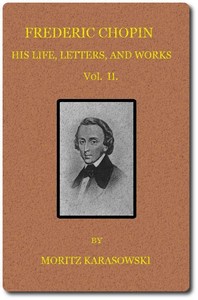
Frederic Chopin: His Life, Letters, and Works, v. 2 (of 2) — Key Ideas to Explore
Edition facts
For Frederic Chopin: His Life, Letters, and Works, v. 2 (of 2) — Key Ideas to Explore, the stored edition analysis reports 50,717 words, 3 hr 41 min estimated reading time, and 6 detected text sections.
The text analysis averages about 19.1 words per sentence, while the detected sections provide another way to judge how the source is divided.
Project Gutenberg metadata also associates the work with “Chopin, Frédéric, 1810-1849,” connecting these edition facts with the source record’s subject description.
Calculated from edition completeness, EPUB availability, text structure and catalogue metadata. Not a user rating.
How this score is calculated
- Description quality20 pts
- Title & short description10 pts
- Source metadata20 pts
- Text length15 pts
- Chapters / structure15 pts
- EPUB file integrity20 pts
Total of 100 points, scaled to a 2.5-5.0 range. Editions with an empty description or a missing EPUB file are not scored.
Read the Text
Nicholas Chopinʼs Family and Friends. Zywny. Elsner. 1.
Fredericʼs Childhood. His First Appearance in Public. Polish National Songs. 17.
Chopinʼs Early Manhood. His First Journey. His Relations with Prince Anton Radziwill 33.
The Journey to Berlin. Chopinʼs Letters. An Incident of the Return to Warsaw 40.
Journey to Vienna, Prague, Teplitz, Dresden. Chopinʼs Performance at two Concerts in Vienna 59.
Influence of the Last Journey on Chopin. Letters to Titus Woyciechowski. Farewell Concert in Warsaw. Chopin leaves his Native City 87.
The Classic and Romantic Elements in Polish Literature. Influence of the Romantic School on Chopin. His First Compositions 123.
German and Italian Music in the years 1827—1831. Johann Matuszynski 140.
Chopinʼs Stay in Breslau, Dresden, Prague, and Vienna 152.
The Insurrection in Warsaw and its disastrous effect on Chopinʼs sojourn in Vienna 170.
Further sojourn in Vienna. The journey to Munich. 193.
Destruction of Chopinʼs letters and other mementos in Warsaw. Stay in Munich. Departure for Paris. 212.
Stay in Paris. Chopin proposes to receive instruction from Kalkbrenner. Correspondence about this with Elsner. Letter to Titus Woyciechowski. Chopinʼs desire to go to America not realized. He resolves to return to Warsaw. Soirée at Rothschildʼs 219.
Improvement of Chopinʼs position in Paris. Elsnerʼs letter. Moschelesʼs and Fieldʼs opinions of Chopin. Trip to Aix-la-Chapelle, Carlsbad, Marienbad, Dresden, and Leipsic. Visit to Mendelssohn and Schumann 241.
Chopinʼs Acquaintance with George Sand. His life among his friends. Winter sojourn in the Island of Majorca (1838-1839.) 259.
Return to Paris. Moscheles and Liszt. Chopin as a Pianoforte Teacher 274.
Domestic Sorrows. Two Letters of George Sand. Breach with George Sand. Journey to England. Return to Paris. Chopinʼs illness and death 295.
Chopin as a Composer 334.
_FURTHER SOJOURN IN VIENNA. THE JOURNEY TO MUNICH._
FREDERIC CHOPIN TO ELSNER.
_Vienna, January 16th, 1831._
DEAR MONSIEUR ELSNER,
I much regret that your kindness, of which I have had so many proofs during my journey, has once more made me feel ashamed of myself, and that you have anticipated me with a letter.
I should have felt it my duty to write to you immediately on my arrival, but I put off doing so from day to day, feeling almost certain that my parents would not delay sending you all the news about me, as I am vain enough to think this would interest you.
I wanted also to wait till I could tell you something definite about myself; but since the day on which I heard of the terrible events in the fatherland, I have had but one thought—anxiety and yearning about my country and my dear ones.
Herr Malfatti has been vainly endeavouring to persuade me that an artist is, or ought to be, a cosmopolitan. Supposing this to be so, although I was an artist in the cradle, I am, as a man, a Pole, and liable to serve as a soldier, so I hope that you will not blame me for not having thought seriously as yet about arranging for a concert.
Obstacles surround me on all sides; not only has a succession of the most miserable concerts quite ruined good music, and rendered the public distrustful, but the recent affairs in Poland have a prejudicial effect on my position.
I think, however—and Würfel fully approves my intention—of giving my first concert during the Carnival. The worthy Würfel is a constant sufferer. I often see him, and find that he has a pleasant recollection of you.
I should feel little satisfied with my stay here but for the interesting acquaintances I have made among the first talent in the place, such names as Slawick, Merk, Bocklet, &c. The opera is good, and the Viennese are enchanted with Wildt and Fräulein Heinefetter; but it is a pity that Duport brings out so few new operas, and is more careful of his pocket than of art.
Abbé Stadler[1] is loud in his complaints, and says that Vienna is not what it used to be. He is publishing his Psalms at Mechettiʼs; I saw the work in manuscript and admired it.
As to your quartet, Joseph Czerny promised faithfully that it should be ready on St. Josephʼs day. He assured me that up till now it had been impossible for him to put it in hand, as he is just bringing out Schubertʼs works, many of which are still in the press. So I am afraid that yours will be delayed.
As I observed, Czerny is not one of the wealthiest publishers in this city, and cannot so easily take the risk of printing a work that is not performed either at “Sperlʼs” or at the “Römische Kaiser.”
[Sidenote: DEGENERATION OF PUBLIC TASTE.]
Waltzes are here called “works” and Lanner and Strauss, who play first violin at the performances of these dances, “capellmeister” (bandmasters.)
I do not mean to say that this is the universal way of speaking, for there are many who ridicule it; however, scarcely anything but Waltzes are printed. It seems to me that Mechetti is of an enterprising turn of mind, and that he will be more likely to take your Masses, for he intends to publish the scores of the famous church composers. I spoke about those glorious Masses of yours to Mechettiʼs book-keeper—an impressible and enlightened Saxon—he seemed to think something of them, and, according to what I hear, he does quite as he likes in the business. I am invited out to dinner to-day to meet Mechetti. I shall talk the matter over seriously with him, and will write to you about it soon. Haslinger is now publishing Hummelʼs last Mass, for he lives only for and by Hummel; but it is said that these latest compositions do not sell well; and Haslinger, who gave him a large honorarium for them, puts aside all manuscripts now, and only prints Straussʼs compositions.
Yesterday I was with Nidecki, at Steinkellerʼs, who has written a libretto for Nidecki. He hopes for great things from this opera, in which the famous comedian, Schuster, is to appear. In this case, Nidecki may make a name for himself. I hope that this news will please you.
You ask, dear Mons. Elsner, why Nidecki studied my second concerto? He did so solely by his own wish. Knowing that he would have to play in public before his departure from Vienna, and having nothing suitable of his own, except the beautiful variations, he asked for my manuscripts. Meanwhile things have greatly changed; he no longer appears as a pianoforte _virtuoso_, but as an orchestral composer. He will be sure to tell you of it himself. I shall take care that his overture is performed at my concert. You will be proud of us yet; at any rate you shall not be ashamed of us. The pianist, Aloys Schmitt, has been cut up by the critics, although he is past forty, and has been composing for eighteen years.
Kindest remembrances to all the collegians, and to your own circle. For yourself, I beg you to receive the assurance of the unbounded respect with which I always remain,
Your grateful and faithful pupil,
_Vienna, May 14th, 1831._
MY BELOVED PARENTS AND SISTERS,
I have to go on short commons this week, as regards letters, but I console myself with the thought that I shall hear from you again next week, and wait patiently, trusting that you are as well in the country as you were in town. As to myself, I am in excellent spirits, and feel that good health is the best comforter in misfortune.
[Sidenote: MALFATTI.]
Perhaps it is Malfattiʼs soups which have given me such strength that I really feel better than ever. If so it is a two-fold regret to me that Malfatti and his family are gone into the country. You cannot imagine what a beautiful villa he lives in; I was there a week ago with Hummel. Having taken us over his house, he showed us his garden, and when we were at the top of the hill we had such a splendid view that we did not want to come down again. Malfatti has the honour of a visit from the court every year, and I should not wonder if the Duchess of Anhalt-Cöthen, who is a neighbour of his, envies him his garden.
On one side you see Vienna lying at your feet, and looking as if Schönbrunn were joined to it; on the other, high hills picturesquely dotted with convents and villages. This romantic panorama makes you quite oblivious of the nearness of the noisy, bustling Kaiserstadt.
Yesterday I was at the Imperial library with Handler.[2] Do you know this is my first inspection of what is, perhaps, the richest collection of musical manuscripts in the world? I can scarcely imagine that the library in Bologna can be larger and more systematically arranged than this one.
Now, my dearest ones, picture to yourselves my astonishment at beholding among the new manuscripts a book entitled “Chopin.”
It was a pretty large volume, elegantly bound; I thought to myself, I have never heard of any other musician named Chopin, but there was a certain Champin, and perhaps there has been a mistake in the spelling. I took out the manuscript and saw my own handwriting. Haslinger had sent the original of my variations to the library. This is an absurdity worth remembering.
[Sidenote: FIREWORKS AND RAIN.]
Last Sunday there was to have been a grand display of fireworks, but the rain spoilt it. It is a remarkable fact that it almost always rains here when they are going to have fireworks. This reminds me of the following story: “A gentleman had a handsome bronze-coloured coat, but whenever he wore it, it rained; so he went to his tailor to ask him the reason. The tailor was very much astonished, shook his head, and asked the gentleman to leave the coat with him for a day or two, as, possibly, the hat, waistcoat or boots might be the cause of the misfortune. However, it was not so, for when the tailor went out for a walk in the coat the rain suddenly poured down, and the poor man was obliged to take a cab, for he had forgotten his umbrella. Some people thought his wife had taken it to a coffee-party; but, however that may have been, the coat was wringing wet. After thinking over this strange occurrence for a long time it occurred to the tailor that perhaps there was something strange hidden in the coat. He took out the sleeves, but found nothing; he undid the tails, then the front, when, lo and behold! under the lining was a piece of a hand-bill about some fireworks. This explained all; he took out the paper, and the coat never brought down any more rain.” Forgive me for again having nothing new to tell you about myself; I shall hope to have some more interesting news bye and bye. I most sincerely desire to fulfil your wishes; hitherto, however, I have found it impossible to give a concert. What do you think of General Dwernickiʼs victory at Stoczek?
May God continue to fight for us!
_Vienna, May 28th 1831._
I have just returned from the post, but once more there is no letter for me! I received one on Wednesday from Madame Jarocka, with a postscript from dear Papa, which though very short was very precious to me. It told me, at least, that you were all well. As to Marcel and Johann, I beg that they will not write to me at all, if they are so stingy, that in spite of my request they can only send a word or two. I am so angry that I feel as if I could send back their letters without opening them. Of course they will make the old excuse of want of time! I am the only one who has time to write so fully every week. But how quickly this precious time passes. It is already the end of May, and I am still in Vienna, and probably shall be through June, for Kumelski[3] has been ill and must lay by again.
I can see already that this letter will be a very wearisome one, but you have no reason to fear that this is a sign of indisposition. On the contrary, I am quite well and amusing myself capitally. To-day I was playing from early in the morning till two in the afternoon, when I went out to dine and met the worthy Kandler, who kindly offered to give me letters to Cherubini and Paër.
I shall visit my invalid in the evening and go to the theatre, where there is to be a concert at which the violinist Herz is to perform. He is an Israelite, and made his _débût_ at Fräulein Henriette Sonntagʼs concert in Warsaw, when he was almost hissed off the stage. The pianist, Döhler, is also to play some of Czernyʼs compositions, and in conclusion Herz will give his own variations on Polish airs. Poor Polish motives, you little think how they will over-lard you with “Majufes” (Jewish melodies), giving you the title of “Polish music” to attract the public.
[Sidenote: POLISH MUSIC AND ITS IMITATIONS.]
If you are honest enough to distinguish between real Polish music and these imitations of it, and to assign a higher position to the former, you are thought crazy, more especially as Czerny, who is the oracle of Vienna, has not, as yet, in the manufacture of his musical tit-bits, included any variations on a Polish theme.
Yesterday afternoon I went with Thalberg to the Evangelical church, where Hesse, a young organist from Breslau, was to perform before the most select of Viennese audiences. The _élite_ of the musical world were present: Stadler, Kiesewetter, Mosel, Seyfried, and Gyrowitz. Hesse has talent, and understands the management of the organ; he left an album with me, but I donʼt feel as if I had originality enough to write anything in it.
On Wednesday I was at Beperʼs with Slawick till 2 oʼclock in the morning. He is one of the artists here with whom I am really on friendly and confidential terms. He plays like a second Paganini, whom, in time, he gives promise of surpassing. I should not think so, had I not already heard him several times. I am very sorry that Titus has not made Slawickʼs acquaintance, for he bewitches his hearers, and moves them to tears; he even made Tiger weep; Prince G. and Jskr. were much affected by his playing.
How are things going on with you? I am always dreaming of you. Has not the bloodshed ceased yet? I know what your answer will be: “Patience.” I constantly console myself with the same thought.
On Thursday there was a _soirée_ at Fuchsʼs, when Limmer, one of the best artists here, introduced some of his own compositions for four violoncellos. Merk, as usual, made them more beautiful than they really were by his playing, which is so full of soul. We stayed there till 12 oʼclock, for Merk enjoyed playing his Variations with me. He told me so himself, and it is always a great pleasure for me to play with him. I think we suit each other very well.[4] He is the only violoncellist I really respect.
I am curious to know how I shall like Norblin;[5] please do not forget the letter to him.
[Sidenote: PASSPORT DIFFICULTIES.]
_Vienna, June 25th, 1831._
I am quite well, and that is all that I have to be happy about, for my departure seems as far off as ever. I have never been in such a state before. You know how undecided I am, and then obstacles meet me at every step. I am promised a passport every day, and I run from Herod to Pontius Pilate simply to get back what I gave the police to take care of. I received a delightful piece of news to-day, that my passport had been mislaid somewhere and could not be found, so I must try to procure a new one. It is strange that every possible misfortune happens just now to us poor Poles. Although I am quite ready to start, I cannot.
I have followed Herr Beyerʼs advice and had my passport _viséd_ for England, although I am only going to Paris. Malfatti will give me a letter of introduction to his friend, Paër; Kandler has already mentioned me in the “_Leipziger Musikzeitung_.”
I was not home until midnight yesterday, for it was St. Johnʼs Day, and Malfattiʼs birth-day. Mechetti wished to give him a surprise, and had engaged Mlles. Emmering and Lutzer, and Messrs. Wildt, Cicimara, and your Frederic to give a musical performance in his honour. This almost deserved to be described as perfect (“parfait.”) I never heard the Quartet from “Moses” given better; although Fräulein Gladkowska sang “Oh quante lacrime” with far more feeling at my farewell concert at Warsaw. Wildt was in excellent voice, and I acted as _quasi_ conductor.[6]
A considerable crowd was on the terrace of our house, listening to the concert. The moon shone marvellously, the fountains rose like columns of pearls, the air was filled with the perfume of the orange grove; in short, it was an enchanting night, the surroundings glorious!
I will now describe the room in which we performed. Windows, reaching from the ceiling to the floor, open on to the terrace, from whence there is a magnificent view over the whole of Vienna. Large mirrors hung on the walls; but the room was dimly lighted which heightened the effect of the moonlight streaming through the windows; and the roominess of the “cabinet” adjoining the _salon_ on the left gave to the whole dwelling an air of grandeur. The open-heartedness and politeness of the host, the gay and elegant company, the sparkling wit, and the excellent supper, made it late before we separated. I live as frugally as possible, and look at every penny as I did at the ring[7] when I was in Warsaw. You may as well sell it, for I have cost you enough already.
The day before yesterday we were on the Kahlen and Leopoldsberg with Kumelski; and Czapek, who visits me every day and gives me most substantial proofs of his friendship; he offered to lend me money for travelling, if I wanted it. It was a magnificent day, and I never took a more beautiful walk. From the Leopoldsberg you see the whole of Vienna, Agram, Aspern, Pressburg, and even Kloster-Neuburg, the castle in which Richard Cœur de Lion was for some time imprisoned. We had a view also of all the upper part of the Danube. After breakfast we went to the Kahlenberg, where King John Sobieski pitched his camp and sent up the rockets which were to announce to Count Starhemberg, Commandant of Vienna, the approach of the Polish army. There, too, is the monastery of the Kamedules, where, before the attack of the Turks, the King knighted his son Jacob, and himself officiated in the Mass. I have gathered a leaf for Isabella from the spot which is now covered with vegetation.
[Sidenote: AN “EASTER-KING.”]
From thence we went, in the evening, to the beautiful valley of Krappenwald, where we saw a ridiculous boyish frolic, a number of urchins had covered themselves, from head to foot, with leaves, and, looking like walking-bushes, crawled from inn to inn. A boy, covered with leaves, his head adorned with branches, is called “Easter-king.” This is a customary jest at Easter-tide.
A few days ago I was at a _soirée_ at Aloys Fuchsʼs.[8] He showed me his rich collection of autograph works (circa 400.) My Rondo[9] for two pianos was among them. Some of the company present were desirous of becoming personally acquainted with me. Fuchs gave me a specimen of Beethovenʼs handwriting.
Your last letter gave me great pleasure, for I saw the handwriting of all my nearest and dearest ones on one piece of paper. Let me kiss your hands and feet, which are more charming than any to be found in Vienna.
_Vienna, Saturday, July 1831._
I saw from your last letter, my dearests, that you have already learnt to bear misfortune with fortitude. You may be assured that neither am I so readily cast down. Hope, oh, sweet perennial hope!
[Sidenote: THE CHOLERA.]
Karasowski's biography of Chopin is structured as a chronological narrative interspersed with letters and documents, creating a layered account that shifts between the author's voice and primary sources. The second volume opens with a preface and table of contents that outline chapters from Chopin's childhood to his death, but the text itself moves between biographical summary and extended quotations, such as George Sand's letters, which offer a contrasting perspective. This structure allows the reader to observe how Karasowski uses documents to support his narrative, while also revealing gaps where the subject's own voice is mediated through others.
Movement Between Narrative and Document
The biography alternates between Karasowski's prose and inserted letters, creating a rhythm that shifts from third-person summary to first-person testimony. For instance, Chapter XIII includes a letter from Chopin to Titus Woyciechowski, while later chapters feature George Sand's correspondence. This movement is not merely decorative; it allows Karasowski to present Chopin's thoughts indirectly, often through the filter of others. The reader must navigate these shifts, noting how the author's framing of events—such as the Warsaw insurrection—contrasts with the emotional immediacy of the letters. The result is a biography that feels both authoritative and fragmented, as the subject's inner life is glimpsed through documents rather than direct analysis.
Recurring Images of Illness and Decline
Throughout the volume, illness functions as a recurring image that structures the narrative. Early chapters mention Chopin's health only in passing, but by Chapter XV, his physical condition becomes a central concern. George Sand's letter describes his "dreadful visions" and the need to "dispel the spectres of his dreaming and waking hours." Karasowski notes that "month by month the disease made rapid strides," using the progression of illness to mark time. This image is not merely biographical; it shapes the pacing of the narrative, as periods of activity are followed by relapses. The reader observes how illness becomes a lens through which Chopin's creative output and personal relationships are interpreted, though the excerpts do not reveal the full extent of its impact.
The Role of Letters in Shaping Perspective
Letters in this volume serve multiple structural functions: they provide evidence, introduce new voices, and create dramatic tension. George Sand's letter, written in French, offers a direct, unmediated perspective on Chopin's condition, contrasting with Karasowski's more measured tone. The letter's content—discussing faith, suffering, and the impossibility of "health, well-being, and glory"—adds a philosophical dimension to the biography. Karasowski uses such letters to support his claims, but he also allows them to stand as independent texts, inviting the reader to compare his interpretation with the source. This technique enriches the narrative but also raises questions about selection: which letters are included, and why? The excerpts suggest that Karasowski prioritizes documents that illuminate Chopin's character and relationships over those that detail his musical work.
Shifts in Setting and Their Narrative Effect
The biography moves geographically from Warsaw to Vienna, Paris, Majorca, and England, with each location marking a phase in Chopin's life. These shifts are not merely descriptive; they structure the narrative by creating contrasts between public and private spheres. For example, the chapter on Majorca (1838-1839) is placed between accounts of Parisian social life and domestic sorrows, emphasizing the isolation of that period. Karasowski often uses setting to imply emotional states: the "dismal imaginations" of Chopin's final years are set against the backdrop of Parisian salons. However, the excerpts do not provide detailed descriptions of these places; instead, they function as markers of change, guiding the reader through Chopin's trajectory without dwelling on atmosphere.
Readers of this volume should attend to how Karasowski constructs his narrative through juxtaposition: between his own voice and the letters, between health and illness, between public success and private decline. The biography does not offer a unified portrait but rather a mosaic of documents and commentary. By observing these structural choices, one can better understand how the author shapes Chopin's legacy, even as the subject remains partially obscured by the very sources meant to illuminate him.
That rainy afternoon, I kept returning to Karasowski’s image of Chopin’s letters—how illness shadowed every phrase, even the cheerful ones. The book felt less like a biography, more like a quiet room with the windows shut. Later, almost without deciding, I picked up the Baconian Essays — Text and Context, and found that same hushed attention to hidden structures, to what words carry beneath themselves.
There are no reviews for this eBook.
Before you leave, reflect on the book
Use these questions to collect your thoughts before moving on.
William Santana - 1 month ago
Gloria Wilson - 1 month ago
Charles Medina - 2 weeks ago