1

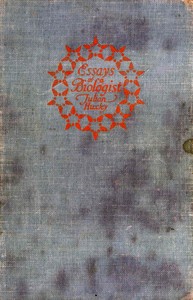
Essays of a Biologist — Text and Context
(0 User reviews)
1567
Project Gutenberg
2021
Not confirmed
Biology
Readers of public-domain and historical texts
Project Gutenberg digital edition
en
Edition facts
Words
76,399
Reading time
333 min
Text sections
8
The source record for Essays of a Biologist — Text and Context measures this digital text at 76,399 words, 5 hr 33 min estimated reading time, and 8 detected text sections.
The text analysis averages about 27.8 words per sentence, while the detected sections provide another way to judge how the source is divided.
Project Gutenberg metadata also associates the work with “Biology,” connecting these edition facts with the source record’s subject description.
Source:
Project Gutenberg record #65145
Julian Huxley's 1923 essay collection applies biological thinking to psychology, sex, and religion, arguing that hierarchical mental organization is ideal and critiquing both repression and over-analysis of sex.
Editorial Edition Score
4.7/5
★★★★★
★★★★★
Calculated from edition completeness, EPUB availability, text structure and catalogue metadata. Not a user rating.
How this score is calculated
- Description quality20 pts
- Title & short description10 pts
- Source metadata20 pts
- Text length15 pts
- Chapters / structure15 pts
- EPUB file integrity20 pts
Total of 100 points, scaled to a 2.5-5.0 range. Editions with an empty description or a missing EPUB file are not scored.
Edition quality
Read the Text
osed, in the first instance, of individual cells? Further, the investigation of the evolutionary process seemed to reveal certain general laws of its march: beings of the same original constitution, exposed to the environmental forces of the same planet, had reacted in similar ways, developing along parallel lines, and arriving at similar types of organization as end-result. Thus it might reasonably be supposed that we should find the same general organization and mode of development in one type of organism as in another, in human society as in a vertebrate.
On these bases, Spencer and his followers drew elaborate comparisons of the two, and apparently believed that they were reaching the same degree of accuracy as that found in comparative anatomy when they compared the circulatory system of a mammal with the transport facilities of a State, or drew parallels between the brain and the cabinet.
It was speedily seen, however, that such generalizations were so broad and vague as not to be of much service: that the resemblances were in fact often no more than symbolical or metaphorical, instead of being based upon detailed similarity of constitution or of evolutionary development. With this, evolutionary theorizing on sociological matters fell somewhat into disrepute. The earlier jubilant certainty gave place to later doubt; and the half-century whose beginnings had roused Haeckel and Herbert Spencer to their imaginative flights closed suitably enough with that remarkable document, T. H. Huxley’s Romanes Lecture, in which the greatest protagonist of Darwinism confesses to seeing between man and the rest of the cosmic process, in spite of man’s genesis from that same cosmic process, an insuperable and essential opposition, a difference of aim or direction which had turned the original bridge into a barrier.[18]
As a result, not only did the particular comparison between society and an organism fall into disrepute, but also all attempts to draw far-reaching conclusions from biology to human affairs.
But the original contention still remains, and is logically unassailable. Man is an organism descended from lower organisms; his communities are composed of units bound together for mutual good in a division of labour in the same way as are the cells of a metazoan: he can no more escape the effects of his terrestrial environment than can other organisms. There _is_ therefore reason to suppose that the processes of evolution in man and man’s societies on the one hand, and in lower organisms on the other, must have something important and indeed fundamental in common, something which if we could but unravel would help us in the study of both.
The correlation of biology with sociology is important not only in itself, but also as part of a more general correlation of all the sciences. The correlation of the sciences is of particular importance to-day for a double set of reasons. The rise of evolutionary biology and of modern psychology have not only changed our outlook on specially human problems, but have altered the whole balance, if I may so put it, of science. There was a time when the basic studies of physics and chemistry seemed not only basic but somehow more essentially scientific than the sciences dealing with life. Distinctions were drawn between the experimental and the observational sciences--often half-consciously implying a distinction between accurate, scientific, self-respecting sciences and blundering, hit-or-miss, tolerated bodies of knowledge. Biological phenomena are now, however, seen to be every whit as susceptible of accurate and experimental analysis; and indeed to present so many problems to the physicist and chemist that in fifty years or so, I venture to prophesy, the wise virgins in those basic sciences will be those who have laid in a store of biological oil.
But the main point is this--the study of evolution, of animal behaviour and of human psychology makes it clear that in the higher forms of animals at least we are dealing with a category not touched on at all by the physicist and chemist--the category of mind and mental process. Sir Charles Sherrington, with admirable lucidity, drew for us, in his recent address to the British Association, the problem of the relation between mind and matter as it presents itself to the biologist.
Julian Huxley opens his 1923 collection with a culinary metaphor, calling the first and last essays the "meat courses" and the rest "lesser variations upon the same themes." This framing signals a deliberate structure: the book is not a systematic treatise but a set of occasional pieces united by a biological perspective. Huxley explicitly compares biology's state to that of physics and chemistry a century ago, asserting that biology is moving from observation to experimental analysis and principle-grasping. He predicts that biological control will alter human experience itself, not merely multiply experiences—a claim that sets the stakes for the essays that follow.
Biology as a Source of Principles
Huxley's preface establishes a clear intellectual program: biology is not just a technical science but a source of general ideas. He writes that the biologist "cannot fail to be impressed" that his science is reaching "from observation to experimental analysis, and from experimental analysis to grasp of principle." This is not a modest claim. Huxley positions biology as the next great driver of human understanding, following physics and chemistry. The excerpts show him applying this lens to psychology and sex, treating mental organization as a biological problem of energy efficiency and hierarchical control. He uses evolutionary language—"the correct type of organization is one of the type which has been developed over and over again in the course of evolution"—to argue for a dominant-subordinate structure in the mind. The biological vocabulary is not decorative; it is the argument's engine.
Sex, Repression, and the Hierarchical Mind
Huxley engages directly with psychoanalysis, praising Freud for introducing "new ideas and new methods" while rejecting "all or even the majority of his conclusions." He describes two extreme parental attitudes toward sex: the "horror-stricken" hushing-up and the over-analytical encouragement of sexual interpretation. Both, he argues, produce unsatisfactory minds. The ideal is a "hierarchical" organization where some parts are dominant and others subordinate, with "a minimum of waste of energy" and "a maximum realization of potentiality." This is a biological model of mental health: the mind as an organism whose parts must cooperate efficiently. Huxley's language is precise and clinical, avoiding moralizing. He treats repression not as a sin but as a biological disadvantage, a "refusal to face any portion of reality" that puts the organism at a disadvantage.
The Limits of the Excerpts
The available excerpts cover only the preface and a later passage on sex and mental organization. They do not include the first or last essays that Huxley calls the "meat courses," nor do they reveal the full range of topics. The catalog lists the book under "Adventure & Picaresque Fiction"—a category that seems mismatched with the serious biological and psychological content visible here. The excerpts show no adventure or fiction; they are expository and argumentative. Readers should note that the catalog subject "Biology" is accurate, but the fiction classification may be an error or reflect a broader definition in the Project Gutenberg system. The essays likely cover evolution, heredity, and other biological topics, but the excerpts do not confirm this.
Huxley's essays reward readers who attend to his biological metaphors and his willingness to engage with contemporary psychology on his own terms. The preface's culinary metaphor is a useful guide: start with the first and last essays, then read the middle ones as variations. The book is not a popular science summary but a work of intellectual ambition, aiming to reshape how we think about mind and society using biological principles. Readers interested in the history of science, early 20th-century psychology, or the intersection of biology and culture will find much to consider.
There’s something tender in how Huxley, ninety years ago, tried to keep mind and body on speaking terms. That same gentle grappling with wholeness—work, beauty, and the everyday—runs through William Morris to Whistler Papers and addresses on art and craft and the commonweal. — Key Ideas to Explore. Both books feel like letters from a quieter century, asking not for answers, but for attention. I find myself rereading them slowly, like old photographs.
There are no reviews for this eBook.
There are no comments for this eBook.
Reader reflection
Take a moment to reflect on this book
Create a short personal record of your experience with this book.
Your progress
0
/
10
2
How much did you enjoy the reading experience?
3
Is this a title you would suggest to others?
4
Did the language feel accessible?
5
Did the story or argument move comfortably?
6
How distinctive were its ideas or approach?
7
Which element worked best for you?
8
Did it raise ideas you would like to talk about?
9
What changed or sharpened your thinking?
10