1

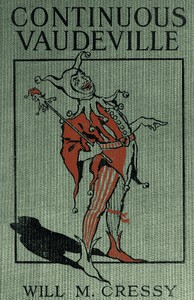
Continuous Vaudeville — A Closer Reading
(0 User reviews)
2632
Project Gutenberg
2009
Not confirmed
American wit and humor
Readers of public-domain and historical texts
Project Gutenberg digital edition
en
Edition facts
Words
29,384
Reading time
128 min
Text sections
5
Continuous Vaudeville — A Closer Reading can be approached with a clearer sense of reading commitment from its source measurements: 29,384 words, 2 hr 8 min estimated reading time, and 5 detected text sections.
The text analysis averages about 16.5 words per sentence, while the detected sections provide another way to judge how the source is divided.
Project Gutenberg metadata also associates the work with “American wit and humor,” connecting these edition facts with the source record’s subject description.
Source:
Project Gutenberg record #28327
Will M. Cressy's 1914 collection of vaudeville sketches and anecdotes, illustrated by Hal Merritt, uses a rapid-fire, conversational voice to capture backstage life, stage-door philosophy, and the absurdities of touring performers.
Editorial Edition Score
4.7/5
★★★★★
★★★★★
Calculated from edition completeness, EPUB availability, text structure and catalogue metadata. Not a user rating.
How this score is calculated
- Description quality20 pts
- Title & short description10 pts
- Source metadata20 pts
- Text length15 pts
- Chapters / structure15 pts
- EPUB file integrity20 pts
Total of 100 points, scaled to a 2.5-5.0 range. Editions with an empty description or a missing EPUB file are not scored.
Edition quality
Read the Text
Tompkins looked at his watch; it was ten minutes of twelve. "Well, Con," he said, "when you go out to dinner, you stay out; don't come back until to-morrow morning. Then come and tell me what you did."
Con put on his coat and went out; out to the first vacation he had had in sixteen years; the first opportunity to see what this city he lived in looked like. The first chance he had had in sixteen years to get out into the country; to hear the birds sing; to see the green fields; the trees; the flowers growing.
And what do you suppose he did?
He walked across the narrow alley and visited with the Stage Door Tender of the Tremont Theater all the afternoon.
I asked the Stage Door Tender of Proctor's Twenty-third Street Theater in New York once what he considered the best act that ever played the house; unhesitatingly he replied,
"Joe Maxwell's Police Station act."
I asked him why he considered that the best.
"Ain't no women in it."
An agent for some fangled kind of typewriter was trying to interest the Stage Door Tender of Keith's Theater in Philadelphia in the machine:
"Now this is just what a man in your position wants and needs. You have a lot of writing to do here, and nowhere to do it; now with this machine you don't require any table or desk; you can hold this typewriter right in your lap."
"Not me, Mister," said the Door Man hastily; "I'm married."
There used to be a door man at Keith's Boston House who could tell more in less words than any man I ever saw. One Monday morning some actors came in who had never been in Boston before, and they were asking this old fellow about the different hotels:
"How is the Rexford?" asked the Lady.
"Burlesque," grunted the old fellow.
"What is the Touraine?"
"How about the So-and-so House?" naming quite a notorious hotel.
"Been open eleven years and had three trunks."
"Where have I seen you before?" And the Judge at the prisoner leers; "Why, I taught your daughter singing." "You did?" said the Judge; "_ten years_."
Nat Haines was playing Keith's, Providence, R. I. The act on ahead of Nat was Professor Woodward's Trained Seals. One afternoon Nat, hearing a noise, looked around and there was one of the seals coming out under the curtain behind him. It took Nat just two jumps to get off the stage. An attendant came out and captured the seal. Nat came back. "Well," he said, scratching his head; "I have followed every animal on earth but a skunk and a lizard, and now I have got that. Humph; Professor Woodward's Trained Shad. I think I will learn dressmaking."
I once asked Ezra Kendal how he ever kept track of those seven children of his.
"I use the card-index system," he replied solemnly.
The Depths of Degradation: A man that plays second violin and double alto in the band.
Mary Richfield (Ryan & Richfield) had a headache; the Los Angeles sun had been too much for her. She went in to a drug store and asked the clerk for a headache powder. This clerk was not a first-class drugger; he was just a student; but he knew where the headache powders were, so he got one for her; got his ten cents and started away. Mary looked around; there was no soda fountain, no water tank.
"Well, here," she said; the young man stopped and looked back at her. "Where am I supposed to take this powder?"
"In your mouth, Mam."
One cold, blustery day several of us were sitting in the stage door tender's little room at the Orpheum, Denver, when the door was thrown open and in hurried a boy of fifteen or sixteen.
"Where's Cressy?" he asked briskly.
"Right here," I answered in the same manner.
"What do you charge?"
"Five hundred dollars."
And he was out the door and gone.
At the Minneapolis Orpheum a chap with a jag came weaving his way out from the auditorium and over to the box-office window.
"Shay," he said thickly; "wha' do you want to hire such bad acters for? They're rotten."
The ticket seller asked which ones he objected to.
"Why, tha' ol' Rube, and that gal in there; they're rotten."
"What are you talking about?" said the ticket seller; "that is Cressy and Dayne; they are the Headliners; they are fine."
The man looked at him a moment, as if to see if he really meant it; then he asked earnestly,
For another moment he studied, then as he turned away, he shook his head sadly and said,
"I shall never go to another vaudeville show as long as I live."
Will M. Cressy opens Continuous Vaudeville with a stage-door tender who “has heard actors talk so much that he has got discouraged.” That deadpan, weary voice sets the tone for a book that moves through vaudeville’s ecosystem in short, punchy sketches. Cressy does not build sustained narratives; he collects observations, one-liners, and small scenes, much like a continuous show where acts follow one another without pause. The prose shifts between dry reportage—a sign reading “Small Steak, 20 cents. Extra Small Steak, 25 cents”—and wry commentary on performers, audiences, and the business of entertainment. Hal Merritt’s illustrations add visual punch to the verbal gags.
The Stage Door as a Narrative Frame
The book’s first sketch establishes the stage-door tender as a silent observer who “seldom speaks, but when he does, he generally says something.” That figure becomes a structural device: Cressy uses him to introduce the backstage world without committing to a single protagonist. The tender’s passivity mirrors the author’s own stance—Cressy reports what he sees, rarely editorializing. In later pieces, the narrative voice remains that of a seasoned insider who knows the routines: “the same questions, the same complaints, the same kicks.” This framing allows Cressy to jump between topics—hotel complaints, orchestra quirks, the difference between New York and Canandaigua—without needing a plot. The stage door is less a location than a permission slip for digression.
Pacing Through Punch Lines and Anecdotes
Cressy controls tempo by alternating short bursts of dialogue with longer set pieces. A typical passage might run: a one-line restaurant sign, then a newspaper clipping, then a quick joke about a check arriving in Salt Lake City. The rhythm mimics vaudeville itself—quick acts followed by blackouts. In “How Mike Donlin Shrunk,” the comedy depends on misdirection: a sign announces next week’s headliners, but the audience misreads it, and a tall performer is mistaken for a shrunken star. The punch line lands in a single gasped line: “My God, how Mike has fallen away.” Cressy often builds toward such moments, then cuts away immediately. The effect is a staccato pace that rewards attention to timing.
Voice and Vernacular in the Sketches
Cressy’s narrators shift registers freely. In “Union Labor,” the voice is colloquial and aggrieved; in “A Social Session,” it mimics dialect and reported speech. One sketch includes a character who “called all actors and actresses by their first names, and can tell you (incorrectly) all about their private affairs.” That parenthetical “incorrectly” is typical of Cressy’s dry asides. He also reproduces signs, newspaper items, and overheard remarks verbatim, letting the vernacular do the comic work. The result is a patchwork of voices—stagehands, managers, performers, audience members—held together by Cressy’s own laconic, observant tone. The book’s language is never elevated; it stays close to the floorboards of the theater.
Because Continuous Vaudeville is built from discrete sketches, readers can enter at any point. The book rewards those who read for voice and timing rather than plot. Pay attention to how Cressy uses silence—the stage-door tender who says little, the punch line that arrives after a pause. The illustrations by Hal Merritt often underscore the same deadpan humor. Treat each sketch as a separate turn on the bill, and the collection’s structure becomes part of the joke.
Leafing through Continuous Vaudeville, I kept circling back to the old question of why some stories stay with us. Cressy's performers, so absurd and human, reminded me of a gentler anthology I once owned. I thought of The Book-Lovers' Anthology — Context and Discussion, its quiet pleasure in simply loving books. Both feel like remembering a warm room where everyone is telling stories.
There are no reviews for this eBook.
There are no comments for this eBook.
Reader reflection
Record your reading impressions
A brief reflection can help important ideas stay with you longer.
Your progress
0
/
10
2
How much did you enjoy the reading experience?
3
Would you recommend this book to another reader?
4
Did the language feel accessible?
5
What was its emotional impact?
6
Would you start a conversation about this book?
7
How would you rate its originality?
8
How did the pace of the book feel?
9
What is the main idea you are taking away?
10