
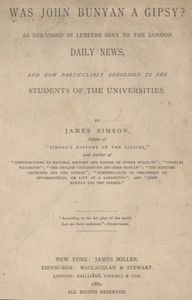
Was John Bunyan a Gipsy? by James Simson
Most people know John Bunyan as the Puritan preacher who wrote one of the most famous books in the English language, The Pilgrim's Progress, while imprisoned for his beliefs. His story is a classic: the humble tinker turned spiritual giant. But in the late 19th century, a curious question was being asked in some circles: Was there more to Bunyan's 'humble' origins? Specifically, was he, or his family, of Romani (often called Gypsy) heritage?
The Story
James Simson's book isn't a traditional narrative. Think of it as a historical investigation presented in book form. Simson lays out the persistent rumors and claims from Bunyan's own time and afterward that suggested his family might have been itinerant Romani people, not just settled English tinkers. The book acts like a lawyer's brief, presenting evidence from old documents, analyzing Bunyan's surname and its variants, and examining the lifestyle and trades of his father. Simson also looks at the language and metaphors Bunyan uses in his writing, searching for possible Romani influences. A big part of the story is the social context—why being labeled a 'Gypsy' carried such heavy stigma in 17th-century England, and how that might have affected Bunyan's life and how others saw him.
Why You Should Read It
What's really compelling here isn't necessarily a smoking gun about Bunyan's ancestry (Simson himself is careful and often skeptical). It's the window into how history and biography get made. This book shows how legends grow around famous figures and how the biases of later eras shape the questions we ask about the past. The 1800s were obsessed with origin stories and racial categories in a way that feels very foreign now. Reading Simson's arguments is like watching a historical mystery unfold with the tools of the Victorian age. It makes you think about Bunyan not just as a distant icon, but as a real man whose background was complex and perhaps deliberately obscured, either by himself or by history.
Final Verdict
This is a niche but intriguing read. It's perfect for history buffs who enjoy deep dives into obscure corners of the past, or for fans of John Bunyan who think they know everything about him. It's also great for anyone interested in the history of the Romani people in Britain. Be warned: it's a product of its time (1882), so the language and some assumptions are dated. But if you approach it as a primary source—a snapshot of a historical debate—it's absolutely fascinating. You won't get a neat answer, but you'll get a much richer sense of the mysteries that still cling to even the most well-known lives.
The copyright for this book has expired, making it public property. Distribute this work to help spread literacy.
Kimberly Flores
1 year agoThanks for the recommendation.
Joseph Davis
1 year agoI started reading out of curiosity and it challenges the reader's perspective in an intellectual way. A true masterpiece.



Jackson Brown
1 year agoTo be perfectly clear, the content flows smoothly from one chapter to the next. I would gladly recommend this title.