
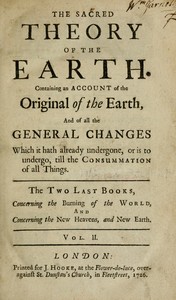
The sacred theory of the Earth, Volume 2 (of 2) : Containing an account of the…
Let's be clear: this isn't a novel. There's no protagonist in the traditional sense, unless you count the Earth itself. The 'plot' is the Earth's biography, as imagined by a 17th-century scholar.
The Story
Thomas Burnet picks up where his first volume left off, but you can think of this as a standalone 'how it all went wrong' story. He starts with the idea of a perfect, smooth, paradisiacal 'Original Earth.' Then, he introduces the crisis: the Biblical Flood. For Burnet, this wasn't just a lot of rain. It was a planet-shattering event. He proposes that the Earth's crust cracked and collapsed into a watery abyss below, the oceans surged forth, and the once-smooth surface was wrecked, creating all the mountains, valleys, and ragged coastlines we see today. The world we live in, according to Burnet, is literally the broken ruins of a more perfect creation. He spends this volume meticulously (and I mean meticulously) describing this process, trying to make the physics and geology of his time fit this grand, sacred narrative.
Why You Should Read It
You read this for the audacity of it. Burnet's writing isn't cold or clinical; it's charged with a sense of awe and sometimes horror at the cataclysm he's describing. When he writes about mountains as 'the ruins of a broken world,' it's strangely poetic. This book is a breathtaking example of pre-scientific storytelling. It shows us how a deeply intelligent person tried to reconcile faith, observation, and reason before we had the framework of plate tectonics or deep time. You're not reading to learn about the Earth's real history; you're reading to get inside the head of someone trying to invent that history from scratch. It’s humbling and mind-expanding.
Final Verdict
This is a niche read, but a rewarding one. It's perfect for history buffs, philosophy nerds, or anyone fascinated by the history of ideas. If you've ever enjoyed reading about how people in the past understood their world—like the way they mapped terra incognita or imagined the heavens—you'll find a kindred spirit in Burnet. It's also great for writers looking for wildly creative world-building inspiration. Just don't go in expecting a geology textbook. Go in expecting a grand, flawed, and utterly human act of imagination.
There are no legal restrictions on this material. You are welcome to share this with anyone.
Edward Lewis
1 year agoEnjoyed every page.
Andrew Torres
2 years agoThe fonts used are very comfortable for long reading sessions.
Lucas White
7 months agoI started reading out of curiosity and it creates a vivid world that you simply do not want to leave. Highly recommended.