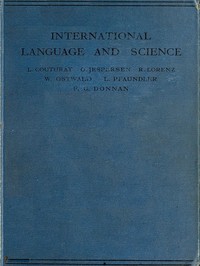
International Language and Science by Leopold Pfaundler von Hadermur et al.
Ever get frustrated when you can't understand the instructions for something you just bought? Now imagine you're a scientist in 1909, and the breakthrough you need to cure a disease or build a new engine is published in a language you can't read. That's the core problem this book tackles. Edited by Nobel laureate Wilhelm Ostwald, it's a collection of essays from leading thinkers of the day. They weren't just complaining; they were proposing a bold, practical solution: a single, neutral, easy-to-learn second language for all global scientific communication.
The Story
There's no traditional plot with characters, but the 'story' is the argument itself. The book lays out the case that language barriers are actively harming scientific progress. Papers get lost, ideas are duplicated, and collaboration is stifled. The contributors then make their pitch for Ido, a simplified offshoot of Esperanto, as the chosen 'auxiliary language.' They walk through its logic, its grammar, and why it's better than the alternatives (including just using a major national language). It's a step-by-step campaign to get the global academic community to sign on to their linguistic peace treaty.
Why You Should Read It
What grabbed me was the sheer optimism. These were hard-nosed chemists and physicists looking at a fractured world and saying, 'We can fix this with a tool.' Today, with English as the de facto language of science, their specific solution feels quaint. But their diagnosis is more relevant than ever. We still struggle with siloed information and the 'tyranny of the major language.' Reading this is like finding a 100-year-old blueprint for a problem we're still trying to solve. It's a powerful reminder that even the most technical fields are built on human communication, and that sometimes, the biggest obstacles aren't in the lab, but in how we talk to each other.
Final Verdict
This isn't a beach read. It's for the curious reader who loves ideas and history. Perfect for history buffs, language nerds, or anyone in STEM who's ever thought about how knowledge spreads. If you enjoy books about forgotten futures or the social side of science, you'll find this a gem. It's a short, dense, and surprisingly hopeful look at a time when people believed a shared language could literally build a better world.
This text is dedicated to the public domain. Knowledge should be free and accessible.
George Jackson
1 year agoBeautifully written.
Susan Anderson
1 year agoRead this on my tablet, looks great.
Susan Davis
9 months agoHigh quality edition, very readable.
Daniel Walker
7 months agoThis is one of those stories where the narrative structure is incredibly compelling. Truly inspiring.


Steven Hernandez
1 year agoHonestly, the storytelling feels authentic and emotionally grounded. I will read more from this author.