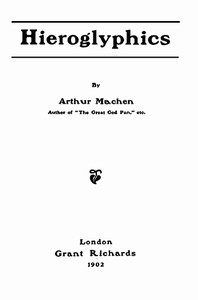
Hieroglyphics — A Reader’s Guide

(0 User reviews)   88
Machen, Arthur, 1863-1947 Project Gutenberg 2012 Not confirmed
Literature -- History and criticism; Criticism Readers of public-domain and historical texts
Project Gutenberg digital edition en

Edition facts

Words 48,062
Reading time 209 min
Text sections 5

The catalog record for Hieroglyphics — A Reader’s Guide provides practical reading context through 48,062 words, 3 hr 29 min estimated reading time, and 5 detected text sections.

The text analysis averages about 32.7 words per sentence, while the detected sections provide another way to judge how the source is divided.

Project Gutenberg metadata also associates the work with “Literature -- History and criticism,” connecting these edition facts with the source record’s subject description.

Arthur Machen's Hieroglyphics is a literary dialogue in which a reclusive hermit argues that true art is a form of ecstatic ritual, using Dickens's Pickwick Papers and Rabelais's Gargantua as examples of disguised Bacchic worship.
Share
Editorial Edition Score 4.7/5

Calculated from edition completeness, EPUB availability, text structure and catalogue metadata. Not a user rating.

How this score is calculated
  • Description quality20 pts
  • Title & short description10 pts
  • Source metadata20 pts
  • Text length15 pts
  • Chapters / structure15 pts
  • EPUB file integrity20 pts

Total of 100 points, scaled to a 2.5-5.0 range. Editions with an empty description or a missing EPUB file are not scored.

Edition quality

Read the Text

There had been a break of some sort in the man's life when he was quite young; and so he had left the world and gone to Barnsbury, an almost mythical region lying between Pentonville and the Caledonian Road. Here, in the most retired street of that retired quarter, he occupied two rooms on the ground floor of a big, mouldy house, standing apart from the street and sheltered by gaunt grown trees and ancient shrubs; and just beside the dim and dusty window of the sitting-room a laburnum had cast a green stain on the decaying wall. The laburnum had grown wild, like all the trees and shrubs, and some of its black, straggling boughs brushed the pane, and of dark, windy nights while we sat together and talked of art and life we would be startled by the sudden violence with which those branches beat angrily upon the glass.

The room seemed always dark. I suppose that the house had been built in the early eighteenth century, and had been altered and added to at various periods, with a final "doing up" for the comparative luxury of someone in the 'tens or 'twenties; there were, I think, twenty rooms in it, and my friend used to declare that when a new servant came she spent many months in finding her way in the complicated maze of stairs and passages, and that the landlady even was now and then at fault. But the room in which we sat was hung with flock paper, of a deep and heavy crimson colour, and even on bright summer evenings the crimson looked almost black, and seemed to cast a shadow into the room. Often we sat there till the veritable darkness came, and each could scarcely see the white of the other's face, and then my friend would light two lonely candles on the mantelpiece, or if he wished to read he set one on a table beside him; and when the candles were lighted I thought that the gloom grew more intense, and looking through the uncurtained window one could not see even the friendly twinkle of the gas-lamp in the street, but only the vague growth of the laburnum, and the tangle of boughs beyond.

It was a large room and gave me always a sense of empty space. Against one wall stood a heavy bookcase, with glass doors, solid and of dark mahogany, but made in the intermediate period that came between Chippendale and the modern school of machine-turned rubbish. In the duskiest corner of the room there was a secretaire of better workmanship, and two small tables and three gaunt chairs made up the furnishing. The Hermit would sometimes pace up and down in the void centre of the room as he talked, and if I chanced to be sitting by the window, his shape would almost disappear as he neared the secretaire on his march, and I heard the voice, and used to wonder for a moment whether the man had not vanished for ever, having been resolved into the shadows about him.

I have spent many evenings in that old mouldering room, where, when we were silent for an instant, the inanimate matter about us found a voice, and the decaying beams murmured together, and a vague sound might come from the cellars underneath. And it always seemed to me as if the crypt-like odour of the cellar rose also into the room, mingling with a faint suggestion of incense, though I am sure that my friend never burned it. Here then, with such surroundings as I have indicated, we held our sessions and talked freely and with enjoyment of many curious things, which, as the Hermit would say, had the huge merit of interesting no one but ourselves.

He would sometimes, whimsically, compare himself to Coleridge, and I think that he often deliberately talked in S. T. C.'s manner with delight in the joke. For, I need hardly say that the comparison was not in any way a serious one; he had a veneration for Coleridge's achievement, with a still greater veneration for that which Coleridge might have achieved, which would have caused him to regard any such comparison, seriously entertained, as unspeakably ludicrous. Still, he liked to regard himself as a very humble disciple in Coleridge's school, he was fond, as I have said, of imitating his master's manner as well as he could, and I think that he cherished, in the fashion of S. T. C., the notion that he had a "system," an esoteric philosophy of things; he sought for a key that would open, and a lamp that would enlighten all the dark treasure-houses of the Universe, and sometimes he believed that he held both the Key and the Lamp in his hands.

It is a confession of mysticism, but I incline to think that he was right in this belief. I recall the presence of that hollow, echoing room, the atmosphere with its subtle suggestion of incense sweetening the dank odours of the cellar, and the tone of the voice speaking to me, and I believe that once or twice we both saw visions, and some glimpse at least of certain eternal, ineffable Shapes. But these matters, the more esoteric doctrines of "the system" have entered hardly or not at all into the very imperfect and fragmentary notes that I have made of his conversations on literature.

I should scarcely be justified in calling him a literary monomaniac. But it is true that Art in general, and the art of literature in particular had for him a very high significance and interest; and he was always ready to defend the thesis that, all the arts being glorious, the literary art was the most glorious and wonderful of all. He reverenced music, but he was firm in maintaining that in perfect lyrical poetry there is the subtlest and most beautiful melody in the world.

I can scarcely say whether he wrote much himself. He would speak of stories on which he was engaged, but I have never seen his name on publishers' lists, and I do not think that he had adopted a pseudonym. One evening, I remember, I came in a little before my accustomed time, and in the shadowy corner of the room, a drawer in the secretaire was open, and I thought that it looked full of neat manuscripts. But I never spoke to him about his literary work; and I noticed that he did not much care to talk of literature from the commercial standpoint.

It is perhaps needless to say that I consulted my friend before publishing these notes of his conversations. I had been forced to leave London for some months, and I wrote to him from the country, requesting his permission to give to the world (if the world would have them) those judgments on books which I had listened to in Barnsbury. His reply allowed me to take my own way, "with all my heart, so long as you make me sufficiently apocryphal. I am not going to compete with 'real' critics whose names are printed in the papers; but if you can maintain the _incognito_ and allow your readers (supposing their existence) to believe that I am a mere figment of your brain, you can print my _obiter dicta_ 'with ease of body and rest of reins.' Here is a suggestion for a title: what do you say to 'Boswell in Barnsbury'? But I really had no notion that you were taking notes all the time. Remember: keep the secret, _and the secrets_."

I regarded this as a very liberal license, and I have tried to set in the best order I could compass the "system" so far as it relates to letters. I do not pretend that I am a _verbatim_ reporter, for I had to trust to my memory, and though I tried to arrange my notes at the time, I fear I have fallen here and there into confusion. Still, I think that the six chapters which follow will seem fairly consecutive in their argument and arrangement, and the "Appendix"--a confession of failure--is, in reality, the result of the "cyclical mode of discoursing," in which the Hermit jocularly professed to follow Coleridge.

Perhaps indeed Coleridge was deceived, and my dear friend with him, in the hope of real essential knowledge; but even so, these fragments which I propose are evidence that the latter earnestly desired the truth and sought it.

Do you know that just before you came in I found something highly significant in the evening paper? I am afraid from your expression that you rather undervalue the influence of the press; indeed, I remember one day when we were out together you swore at an inoffensive boy who tried to allure us with news of all the winners. I think I pointed out at the time that even horse-racing and an interest in "events" are preferable to stagnation, and that there is something august in the universal human passion for gambling. And, after all, the office-boy who "puts on" half-a-crown is really only an example of the love of man for the unknown; the half-crown is a venture into mystery, with that due flavour of commercialism which we in England add to most of our interests. But you see, don't you? that gambling, even under its most sordid aspects, is not altogether sordid; it's the mystery, the uncertainty, the hours of "strange surmise" that the smallest bet gives to the bettor that make the real delight of betting. When the office-boy wins and gets ten shillings for the risk of his two-and-six, his delight is not by any means pure love of gain, it is distinguished by a very marked line from the constantly repeated joys of the grocer, who is always buying delicious tea at ninepence and selling it at one-and-six. Here you have commercialism in its simplest form; but our office-boy, though he likes the money well enough, stands on a much higher plane. For the moment he is the man who has succeeded in solving the enigma of the Sphinx, in discovering the unknown continent, in reading the cypher, in guessing at the song the Sirens sang, in unveiling the hidden treasure that the buccaneers buried on the lonely shore; he has ventured successfully into the dim region of surmises. And when he loses, there are always consolations; the Indies have not been discovered on this voyage, certainly, but there have been wonders on the way, he has enjoyed many hours of delicious expectation. The proof that he likes the sport, even when he loses, is that he invariably takes the first opportunity of venturing again in the same manner. And, by the way, perhaps I was a little severe just now on trade, and especially on the grocer's sugary and soapy enterprise. Perhaps if we were to look with a rather finer vision into the commercial spirit, we might find that it is not wholly commercial, not altogether sordid. Of course if the grocer opens his shop with a certainty, mathematical or almost mathematical, that the public will buy his wares, he is a wicked fellow; he is gambling with loaded dice, betting against a horse that he knows is to be made "all right," playing cards with honours up his sleeve, and I am sure that if this be his enterprise, it will always meet with our sternest disapproval. Casanova died towards the close of the last century, and since then cardsharping has become impossible to a man of taste. But seriously, I suspect that a good deal of the allurement that trade possesses for so many of us is the risk which it almost always implies, and risk means uncertainty, and uncertainty connotes the unknown. So you see our despised grocer turns out, after all, to be of the kin of Columbus, of the treasure-seekers, and mystery-mongers, and delvers after hidden things spiritual and material. I suppose we have here the real explanation of the human trading passion, and the solution of a problem that has often puzzled me. The problem I mean is this: how does it happen that the English are both the greatest poets and the greatest tradesmen of the modern world? Superficially, it seems that keeping shops and making poetry are incompatibles, and Wordsworth and Coleridge, Keats and Shelley, Tennyson and Poe, should have come from Provence or Sicily, from the "unpractical," uncommercial Latin races. But if we trace back the trading instinct to that love of a risk--or in other words to the desire for the unknown--the antinomy disappears, and it will become perfectly natural that the race which has gone to the world's end with its merchandise, has penetrated so gloriously into the further regions of poetry.

But that reminds me of what I was saying just after you had lit your pipe. I think I remarked that I had seen something of very high significance in the evening paper, and the glare of disgust with which you greeted my observation constituted an interruption, and an interruption that had to be dealt with. Now again you seem to hint at doubt with your eyebrows; you would say, perhaps, that I have not made out a very convincing case for journalism? But you must remember that my mental process resembles that of Coleridge; you called on the Seer at eleven o'clock in the morning, and (if young and imprudent) asked him a question. And at the waning of the light Coleridge was still diligently engaged in answering your question for you, having talked without intermission all the summer day. A "cyclical mode of discoursing" the pious Henry Nelson Coleridge called it, and he deals faithfully with certain persons who complained "that they could get no answer to a question from Coleridge." And you will please to remember this when you think that I am "wandering"--a vice of which Coleridge also was accused. To-night, for example, on the evening paper being mentioned, your face expressed disgust and contempt, which I diagnosed (and rightly, I believe?) as a tribute to the enormous interest taken by the editors of these agreeable journals in the very latest sporting news; an interest which allows but little space for the discussion of pure literature. Hence my remarks on the gambling-spirit; and now I hope you will at least assume a thrill of interest when the boy bawls in your ear "All the winners and S. P." It is possible you may be thinking of Ulysses or of Keats at the moment, and the interruption may annoy you, but it will do so no longer when you reflect that a burning anxiety as to the running of Bolter is for many thousands the symbol--and the only possible symbol--of the Doom of Troy and the wandering fields of foam, and the Isle of Calypso, and the "strange surmise" of Pizarro and all his men.

But here is the evening-paper in question. Yes, the colour is, perhaps, a little sickly. A kind of pinky-green, it seems, doesn't it? But it forced itself on my notice in the most extraordinary manner, and I expect you will have to admit, when you have heard the story, that some Powers were at work. Well, I was walking up and down the room, just as it was getting dusk, and every now and then I stopped and looked out of the window. Yes, I was making phrases as usual, and thinking of a new story in the middle of the old one: hence the quarter-deck exercise. I daresay you have remarked that I do not keep my window in a very brilliant condition, and the air this evening, you will remember, was rather misty--October, I always think, wears a peculiar dim grace in Barnsbury--so I hope you will not find my impressions too incredible. I was staring, then, out of the window, when to my vast astonishment, a great pale bird seemed suddenly to shoot up into the air from the road, and to flutter into the garden, where it became entangled in that sapless old laburnum that weeps green tears upon the wall. I saw, as I thought, the beating and fluttering of wings, and I ran out, imagining that I was to secure a strange companion for my solitude. It was the evening paper, not a bird, and I saw at once that it would be impious to let it flutter there unread, so I secured it and brought it in, meditating the adventure, and wondering what strange message was thus borne to my eyes. So I went through its columns patiently, even to the leaderettes, and I will do myself the justice to say that I at once recognised the communication that was addressed to me in this singular and even I may say Arabian fashion. It was a short comment upon some agitation that is now appealing rather strongly to Progressive leaders; but the subject-matter is of no consequence, since the significance lies in the last sentence. Here it is: "We are glad to hear that extensive arrangements have been made for the dissemination of literature."

You don't see the immense importance of that? You surprise me. Let us go into it, then. I told you I was not very precise as to the exact scope of the agitation alluded to--it may be a question of a heavy tax on persons who will say "lady" instead of "lydy," it may be an affair of restricting the franchise to citizens thoroughly ignorant of history; it doesn't matter--but here are men who wish some political change to be effected, and these men are issuing printed matter, the purpose of which is to convince others of the righteousness of this particular "program." And this printed matter is called "literature." You know the sort of thing indicated. It may be a series of arguments, simple and fallacious, it may be in dialogue, it may be in story form, it may assume the guise of parody, it may be a brief history. And now what I want to know is this: here we have a vast body of thought, clothed in words, ranging from the agreeable leaflets that we have been speaking of up to--let us say--the Odyssey, and all this mass is known as literature: what is to be our criterion, our means of distinguishing between the two extremes I have mentioned and all the innumerable links between them? Is the whole mass literature in the true sense of the word? If not, with what instrument, by what rule are we to divide the true from the false, to judge exactly in the case of any particular book whether it is literature or not? Of course you may say that the question is rather verbal than real; that "literature" is a general term conveniently applied to anything in print, and that in practice everybody knows the difference between a political pamphlet and the Odyssey. I very much doubt whether people do understand precisely the distinction between the two, but for the avoidance of verbal confusion I suggest that when we mean literature in its highest sense we shall say (for the present at all events), "fine literature"; and the question will be, then: what is it that differentiates fine literature from a number of grammatical, or partly grammatical, sentences arranged in a more or less logical order? Why is the Odyssey to come in, why is the "literature" of our evening paper to be kept out? And again, to put the question in a more subtle form: to which class do the works of Jane Austen belong? Is "Pride and Prejudice" to stand on the Odyssey shelf, or to lie in the pamphlet drawer? Where is Pope's place? Is he to be set in the class of Keats? If not, for what reason? What is the rank of Dickens, of Thackeray, of George Eliot, of Hawthorne; and in a word, how are we to sort out, as it were, this huge multitude of names, giving to each one his proper rank and station?

I am glad it strikes you as a big question: to me it seems _the_ question, the question which covers the final dogma of literary criticism. Of course after we have answered this prerogative riddle, there will be other questions, almost without end, classes, and sub-classes of infinite analysis. But this will be detail; while the question I have propounded is the question of first principles; it marks the parting of two ways, and in a manner, it asks itself not only of literature, but of life, but of philosophy, but of religion. What is the line, then; the mark of division which is to separate spoken, or written, or printed thought into two great genera?

Arthur Machen's Hieroglyphics presents itself as a record of conversations with an unnamed literary hermit in a decaying London house. The narrator describes the hermit's retreat in Barnsbury, a district between Pentonville and the Caledonian Road, where they talk of art and life while a laburnum branch beats against the window. The work is framed as a series of dialogues, but the catalog subjects—Literature—History and criticism; Criticism—only partially capture its content. The excerpts reveal a sustained argument about the nature of artistic expression, not a survey of critical methods.

A Hermit's Literary Theory

The hermit's central claim is that all genuine art originates in a form of ecstatic ritual, specifically the Bacchic cult of ancient Greece. He traces this through three disparate works: Sophocles' dramas, Rabelais' Gargantua and Pantagruel, and Dickens' The Pickwick Papers. The hermit insists that the drinking scenes in Pickwick—which he says "reek with brandy and water"—are not mere comic relief but a degraded version of the dithyrambic choruses sung in honor of Dionysus. He draws a direct line from the Greek festival to the Victorian novel, arguing that the "interior meaning is in each case the same." This is not a conventional work of criticism; it is a manifesto about the sacred origins of literature.

The Bacchic Key to Rabelais and Dickens

Machen's hermit devotes considerable attention to Rabelais, noting that the history begins with Grandgousier "aimant à boire net" and ends with the Oracle of the Holy Bottle pronouncing "Trinch"—"beuvez." He cites the priestess Bacbuc's declaration that "by wine is man made divine" and argues that readers who miss this key lose the book's highest value. Similarly, he identifies the "brandy and water scenes" in Pickwick as a Victorian equivalent of the Bacchic cultus. The hermit acknowledges the poverty of Dickens's materials—"the Cockneydom of Dickens" versus the Athens of Sophocles—but insists that the artistic impulse remains the same. This comparative analysis is specific and provocative, though the excerpts do not reveal whether the hermit addresses other works or develops a broader theory.

Setting as Argument

The physical setting of the dialogues is not incidental. The hermit occupies two rooms in a "big, mouldy house" with a laburnum that "had cast a green stain on the decaying wall." The room is hung with "flock paper, of a deep and heavy crimson colour" that "looked almost black" even on summer evenings. This atmosphere of decay and enclosure mirrors the hermit's retreat from the world and his obsessive focus on a single idea. The narrator notes that the hermit "avoided personalities" and forgot names repeatedly, suggesting a man wholly absorbed in his theory. The setting reinforces the sense that Hieroglyphics is not a balanced critical treatise but the record of a singular, almost hermetic vision.

Readers approaching Hieroglyphics should expect a dialogue that is part literary criticism, part personal confession. The hermit's arguments are not systematically defended; they are asserted with the fervor of a convert. The excerpts offer no evidence of counterarguments or alternative perspectives. The work's value lies in its audacious linking of high and low culture, and in the atmospheric frame that makes the reader feel like a visitor to that dark, crimson room in Barnsbury.

There’s a moment in Machen’s dialogue where the hermit calls art a kind of secret remembering, and I often think of that when I revisit old essays on science and culture—their careful, patient weighing of things. It’s like finding the same quiet room at a different hour. Science and Culture, and Other Essays — Context and Discussion sits beside it on my shelf, and both make the ordinary feel slightly sacramental.

There are no reviews for this eBook.

0
0 out of 5 (0 User reviews )

Add a Review

Your Rating *
There are no comments for this eBook.

Reader reflection

Your personal reading reflection

Build a private reading journal entry for this title.

Your progress 0 / 10
1

Where are you in your reading?

2

What was your overall reaction to the book?

3

Would you pass this book on to a friend?

4

How easy was the book to follow?

Related eBooks